Accession No
3657
Brief Description
magnetic hysteresis tester, 1905-1915 (c)
Origin
Maker
Class
electrical; magnetism
Earliest Date
1905
Latest Date
1915
Inscription Date
Material
stone (marble); metal (brass); wood
Dimensions
height 435mm; breadth 260mm; depth 241mm
Special Collection
Provenance
Transferred from Department of Engineering, University of Cambridge, Cambridge, England, 1986.
Inscription
Description Notes
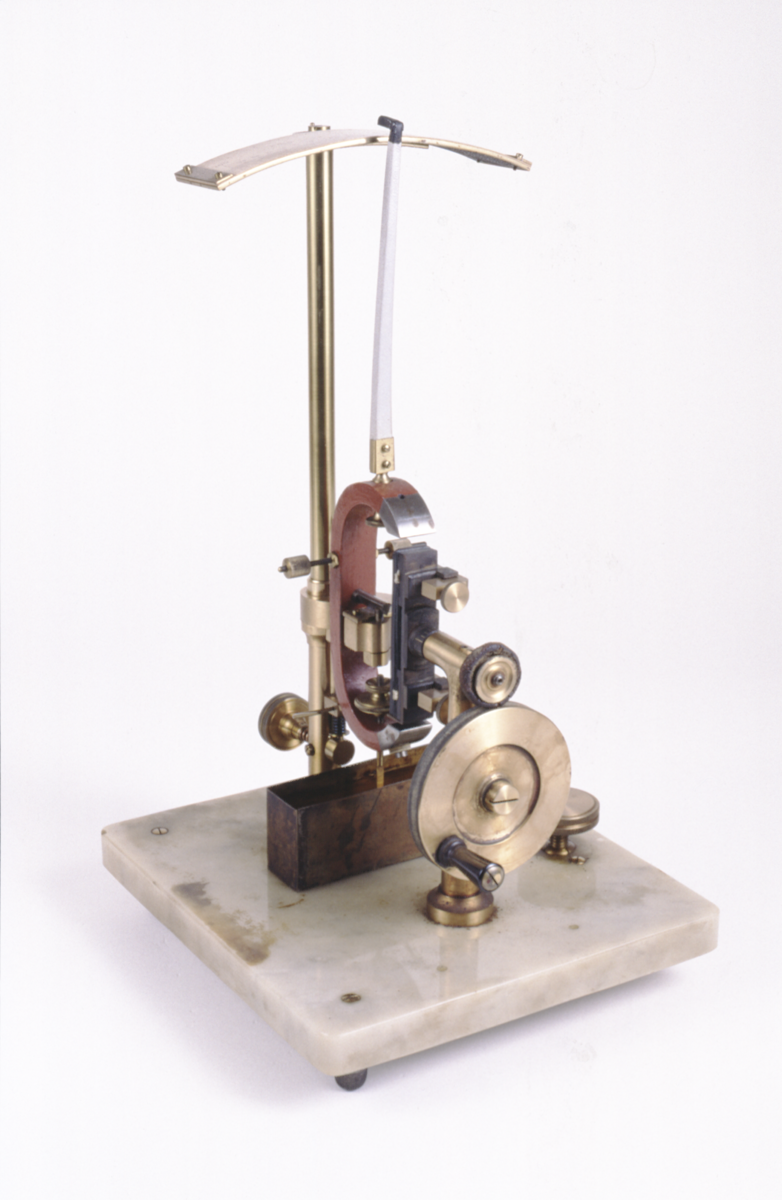
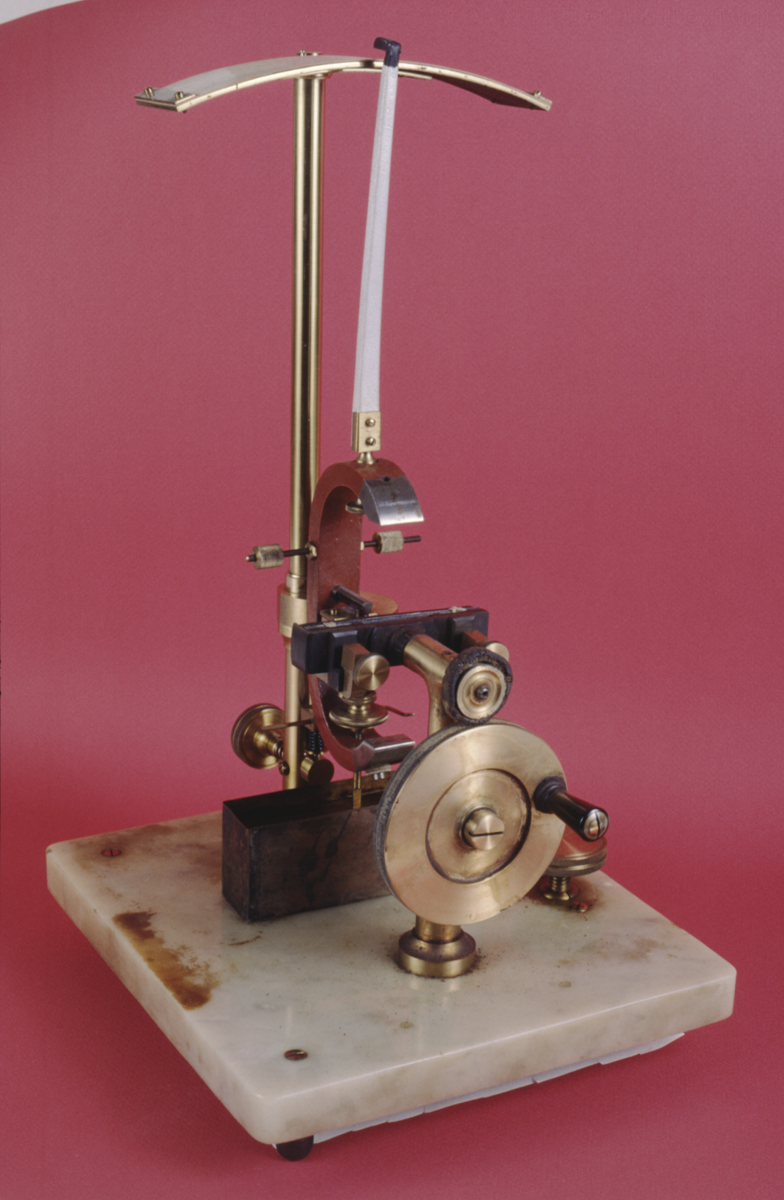
Rectangular marble base with two fixed and one levelling foot; two brass standards, one supporting a carrier for the bundle of specimen sheets, which may be rotated, with a handle, about a horizontal axis between the poles of a C-shaped permanent magnet; the magnet is carried on knife edges supported on the other brass standard, so that it may rotate freely about the same horizontal axis; a vertical pointer is attached to the top of the C-magnet, and a curved dial with scale is at the top; scale, 100 divisions on either side of a central zero; control to raise magnet off knife edges; oil damping. No inscriptions. In wooden box with hinged door and brass handle.
Condition: fine; complete (manufacturer’s nameplate missing ?).
References
Events
Description
This instrument is used to determine the hysteresis of a bundle of sheets of magnetic material. In use, the specimen is rotated uniformly so as to produce a constant deflection of the pointer. This deflection is independent of rotation speed and proportional to the amount of work done in each revolution, as a consequence of the hysteresis. The instrument is calibrated by using specimens of known hysteresis.
James Alfred Ewing (1855-1935) -
Following professorships at Tokyo (1878-1883) and Dundee (1883-1890), where he worked on seismology and magnetism, James Alfred Ewing was appointed Professor of Mechanism and Applied Mechanics at Cambridge in 1890, succeeding Stuart.James. He established the Engineering Laboratory at Cambridge, and worked closely with his friend, Horace Darwin, founder of Cambridge Scientific Instrument Company. Cambridge Scientific Instrument Company manufactured many instruments of his design, in particular the seismograph and extensometer. Ewing discovered magnetic hysteresis, and coined the term (Ewing (1881)). Other magnetic instruments of his design are the magnetic curve tracer (Wh.2008), and the magnetic permeability bridge (Wh.3346).
16/02/2021
Created by: Morgan Bell on 16/02/2021
FM:41071
Images (Click to view full size):