Accession No
1613
Brief Description
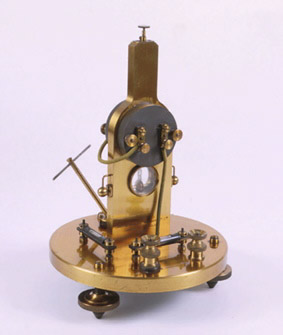
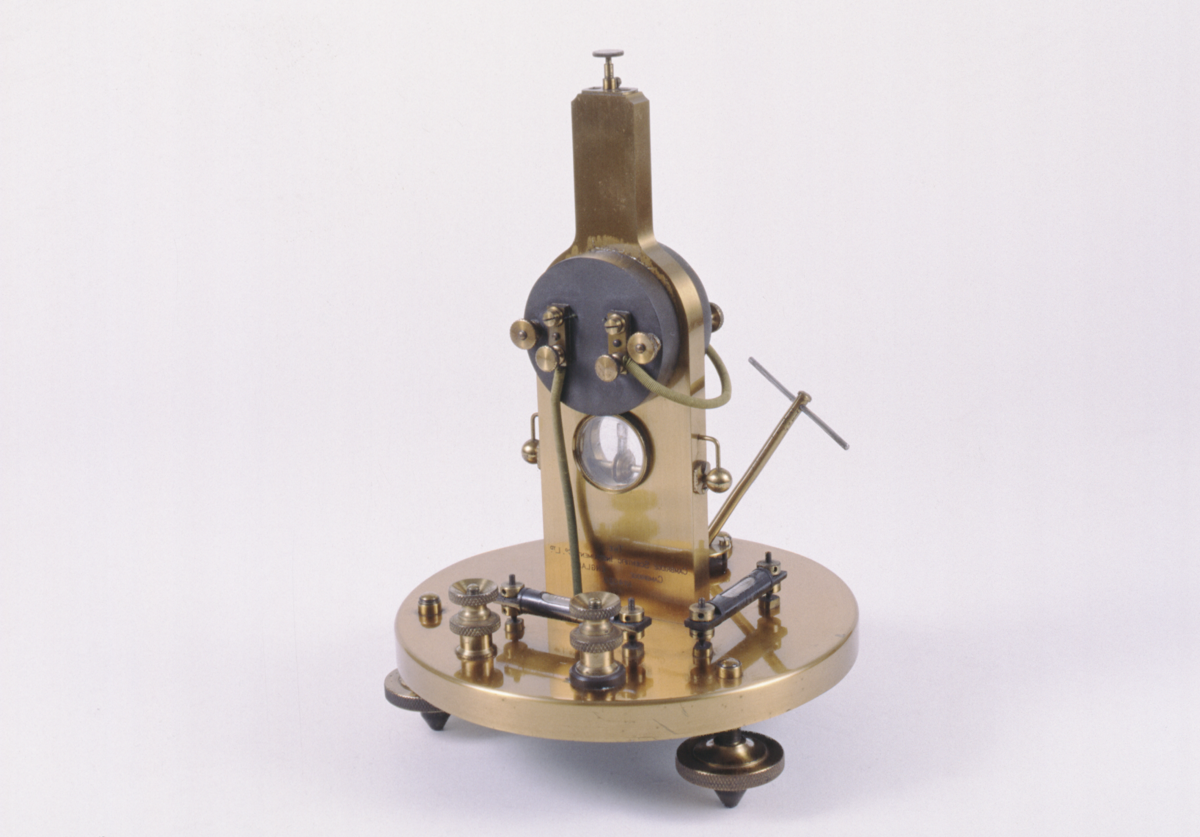
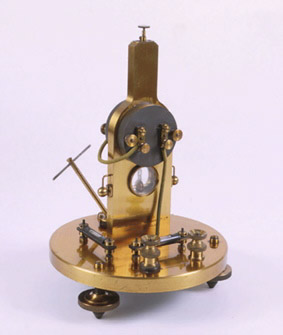
Broca galvanometer, moving magnet, reflecting galvanometer, by Cambridge Scientific Instrument Company Ltd., English, 1905
Origin
England; Cambridge
Maker
Cambridge Scientific Instrument Company Ltd.
Class
electrical
Earliest Date
1905
Latest Date
1905
Inscription Date
Material
metal (brass); plastic (ebonite); glass; stone (quartz)
Dimensions
height 250mm; base diameter 180mm
Special Collection
Provenance
Transferred from the Department of Mineralogy & Petrology, University of Cambridge, in 1972.
Inscription
‘THE
CAMBRIDGE SCIENTIFIC INSTRUMENT CO. LTD.
CAMBRIDGE, ENGLAND.
No. 4029’ (on brass support)
Description Notes
Circular brass base; three levelling feet, brass with ebonite toes; two brass terminals; two bubble levels; controlling bar magnet on brass rod with swivel connection to base; vertical brass plate with circular glazed window showing suspended mirror and damping vane; pair of vertical coaxial coils in removable ebonite boxes; two parallel vertical magnets suspended on a quartz fibre between coils.
Suspension intact. Complete.
References
Events
Description
The galvanometer is one of the earliest electrical measuring instruments and was invented by Leopold Nobili (1784-1835). A galvanometer functions through the heating effect of a current (using either a wire or a thermocouple) and it is used to measure electrical currents. Measuring devices such as the galvanometer were important to scientists as they tried to understand electricity and eventually use it.
The galvanometer measures current, which is the quantity of charge moving past a certain point per unit of time. The galvanometer used magnetized needles and copper wire in the form of a coil to achieve this.
The galvanometer on display in the electrical case as shown opposite is a modified design by Andre Broca, who was the Professor of Physics at L'Ecole Polytechnique in Paris. Broca increased the strength of the magnetic poles at the center of the coil using a special arrangement.
Before the invention of the galvanometer the most sensitive indicator of electric current was freshly prepared frog's legs which would twitch when a current was applied to them.
In the 1840's there was a great demand for galvanometers due to a rapidly expanding electrical industry. Many developments in galvanometers were made and the galvanometer was reproduced by many instrument makers all over Europe. Charles Wheatstone had a version made by Watkins and Hill in 1845 so that he could conduct experiments on the velocity of electricity.
FM:41107
Images (Click to view full size):