Accession No
4365
Brief Description
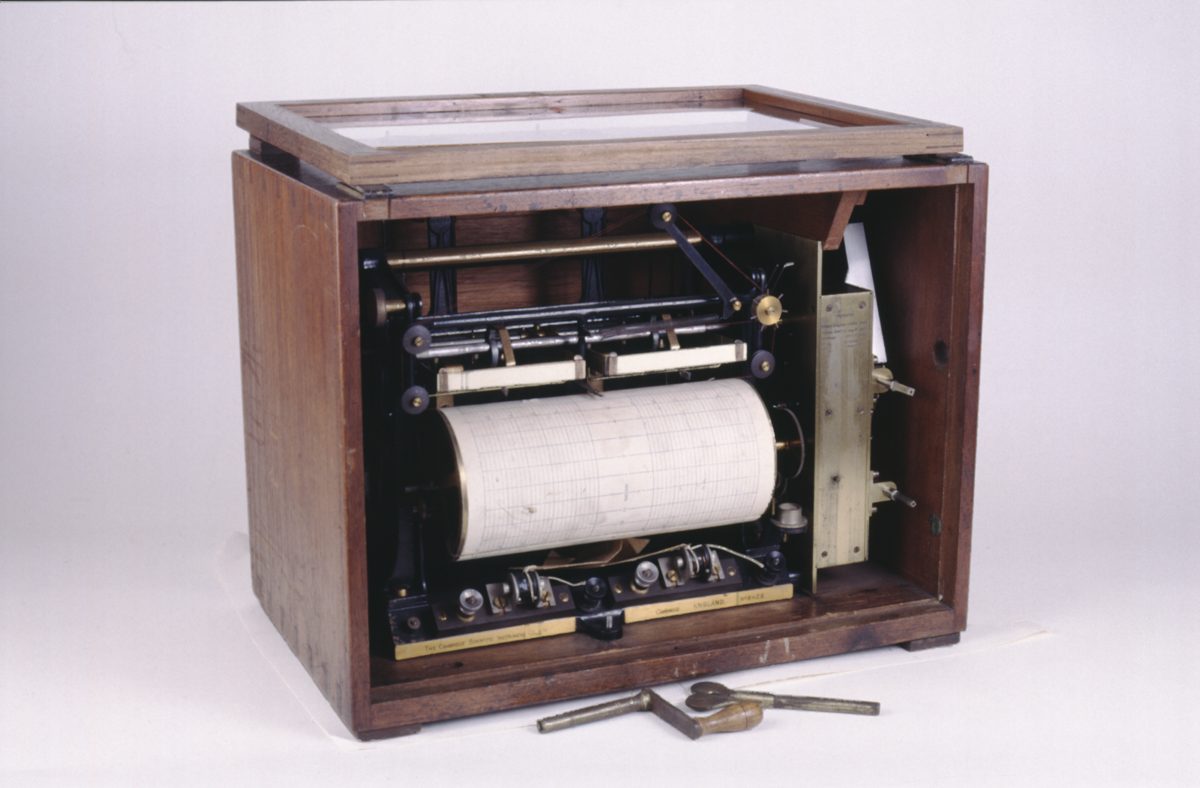
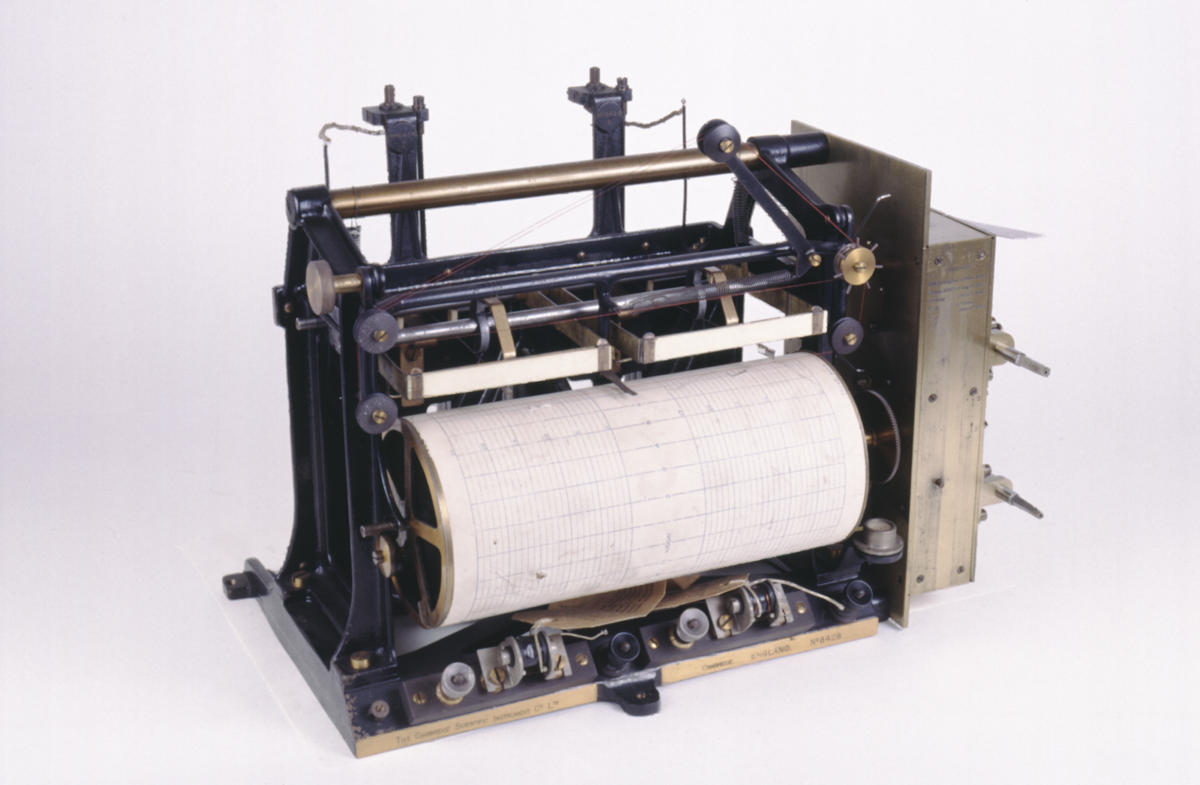
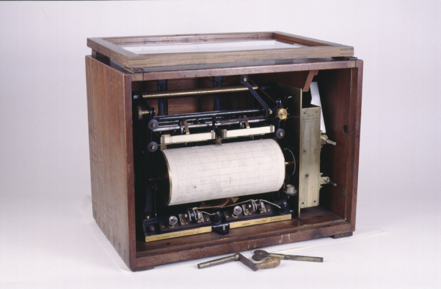
recorder, strip (thread), by Cambridge Scientific Instrument Company Ltd., English, 1909
Origin
England; Cambridge
Maker
Cambridge Scientific Instrument Company Ltd.
Class
electrical
Earliest Date
1909
Latest Date
1909
Inscription Date
Material
wood; glass; metal (iron); plastic (ivorine)
Dimensions
breadth 460mm; height 365mm; depth 295mm
Special Collection
Cambridge Instrument Company Collection
Provenance
Donated by the Cambridge Instrument Company.
Inscription
‘THE CAMBRIDGE SCIENTIFIC INSTRUMENT CO. LTD. CAMBRIDGE. ENGLAND. No. 8423’ (on front of base)
‘THE
CAMBRIDGE SCIENTIFIC
INSTRUMENT CO. LTD.
CAMBRIDGE, ENGLAND.
No. 8423’ (on ivorine plate on door)
Description Notes
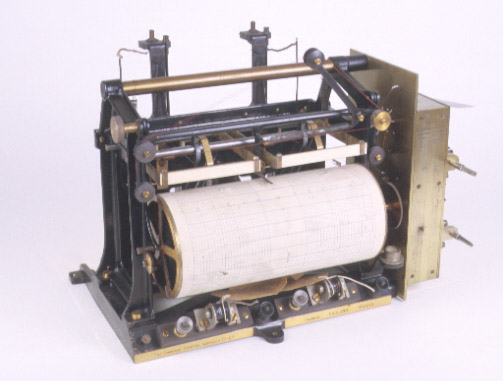
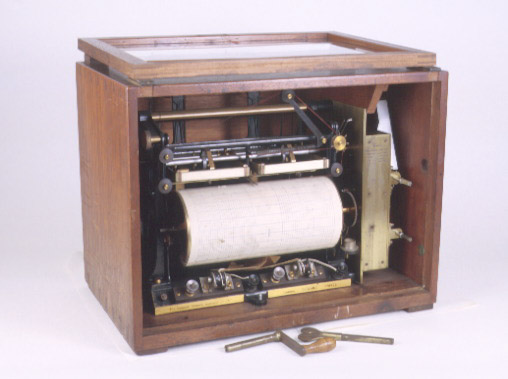
Rectangular wooden box with hinged, locking, glazed door and glazed window in top; one fixed foot and two levelling feet; cast-iron instrument frame removable from box; suspended coil D’Arsonval galvanometer at rear with long pointer extending to drum recorder at front; clamp and zero adjustment at top; upper of two clockworks depresses pointer on inked thread every minute (or half minute); the continuous inked thread is also moved along a system of pulleys periodically; lower clockwork rotates chart drum once per 25 hr. (or 2 hr. 5 min.); two terminals on base of frame for input potential; exchangeable resistance coil; two channels; one thread. With two clockwork keys; Camb. Inst. Co. repair label dated 10-4-62 made out to ‘Camb. Univ. Metall. Dept.’; instruction labels for using thermocouples attached to the two input resistances.
Similar to Wh: 4360, but larger.
Condition: fine (galvanometer suspensions intact, clockworks operational, in working order); complete.
References
Events
Description
This instrument recorded readings from a galvanometer by depressing the galvanometer pointer at regular intervals onto an inked thread, which is then pressed onto a paper chart that was wrapped around the drum. Horace Darwin, company founder and son of Charles Darwin, designed the instrument in 1905 to overcome issues with the earlier Callendar Recorder. The design remained fundamentally the same for decades.
01/04/2020
Created by: Morgan Bell on 01/04/2020
FM:41255
Images (Click to view full size):