Accession No
4019
Brief Description
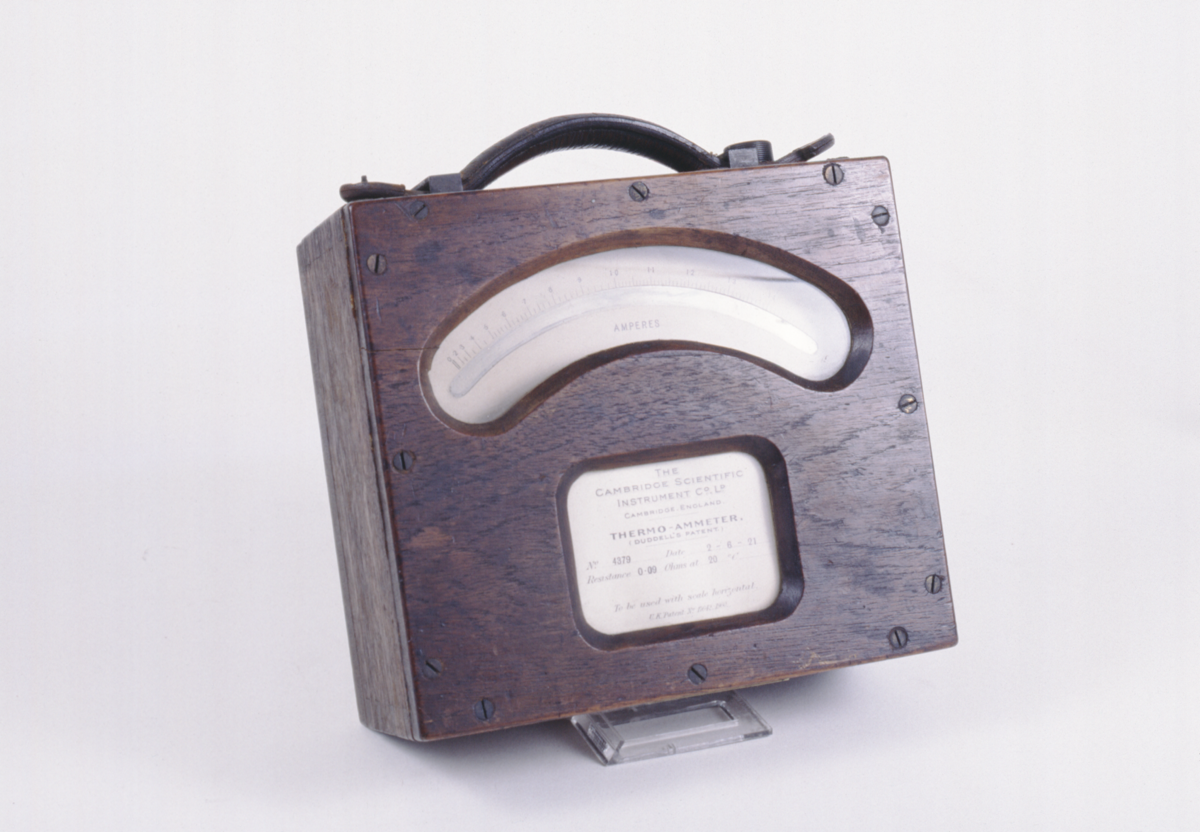
thermal, pointer ammeter, Duddell-type, by Cambridge Scientific Instrument Company Ltd., English, c. 1906
Origin
Cambridge; England
Maker
Cambridge Scientific Instrument Company Ltd.
Class
electrical
Earliest Date
1906
Latest Date
1906
Inscription Date
Material
wood; hide (leather); glass; paper
Dimensions
length 212mm; breadth 214mm; height 99mm
Special Collection
Cambridge Instrument Company Collection
Provenance
Donated by the Cambridge Instrument Company.
Inscription
‘AMPERES’ (on dial)
‘THE
CAMBRIDGE SCIENTIFIC
INSTRUMENT CO. LTD.
CAMBRIDGE, ENGLAND.
THERMO-AMMETER.
(DUDDELL’S PATENT)
No. 4379...’ (on label below dial)
Description Notes
thermal, pointer ammeter, Duddell-type, by Cambridge Scientific Instrument Company, English, c. 1906.
Wooden case; leather carrying strap; two brass terminals; glazed window showing mirror and white dial; non-linear scale, 0 to 1.5 divisions; zero adjustment screw on front of case; glazed window below dial showing white printed maker’s and specifications label, dated ‘2-6-21’.
Condition: fair (pointer inoperative); incomplete (terminal nut, zero adjustment screw missing).
References
Events
Description
R.S. Whipple’s interest in historic scientific artefacts stemmed from his day job making instruments in Cambridge.
Whipple joined the Cambridge Scientific Instrument Company in 1898, rapidly rising to become its Managing Director in 1905 and ultimately its Chairman in 1938. Over this period, Whipple helped grow the firm from a small specialist maker into an international company with thousands of employees and a world-class reputation in a wide variety of areas.
After he was promoted to Managing Director in 1905, Whipple pushed the Company to focus on mass-producible engineering instrumentation, which tended to be more profitable than precision laboratory apparatus.
17/10/2025
Created by: Hannah Price on 17/10/2025
Description
A sensitive ammeter that uses thermo-electric forces to accurately measure current in low power circuits, such as telephone lines.
17/02/2015
Created by: Joshua Nall on 17/02/2015
FM:41331
Images (Click to view full size):