Accession No
0576
Brief Description
ring dial, gilt brass, German, 18th Century
Origin
Germany
Maker
Class
dials
Earliest Date
1700
Latest Date
1750
Inscription Date
Material
metal (gilt brass, silvered brass); wood; hide (leather)
Dimensions
length 90mm; diameter 61mm; thickness 16mm; box diameter 75mm; thickness 27mm
Special Collection
Robert Whipple collection
Provenance
Purchased by Robert Stewart Whipple from Antique Art Galleries, Grafton Street, London, England on 28/02/1930.
Inscription
Description Notes
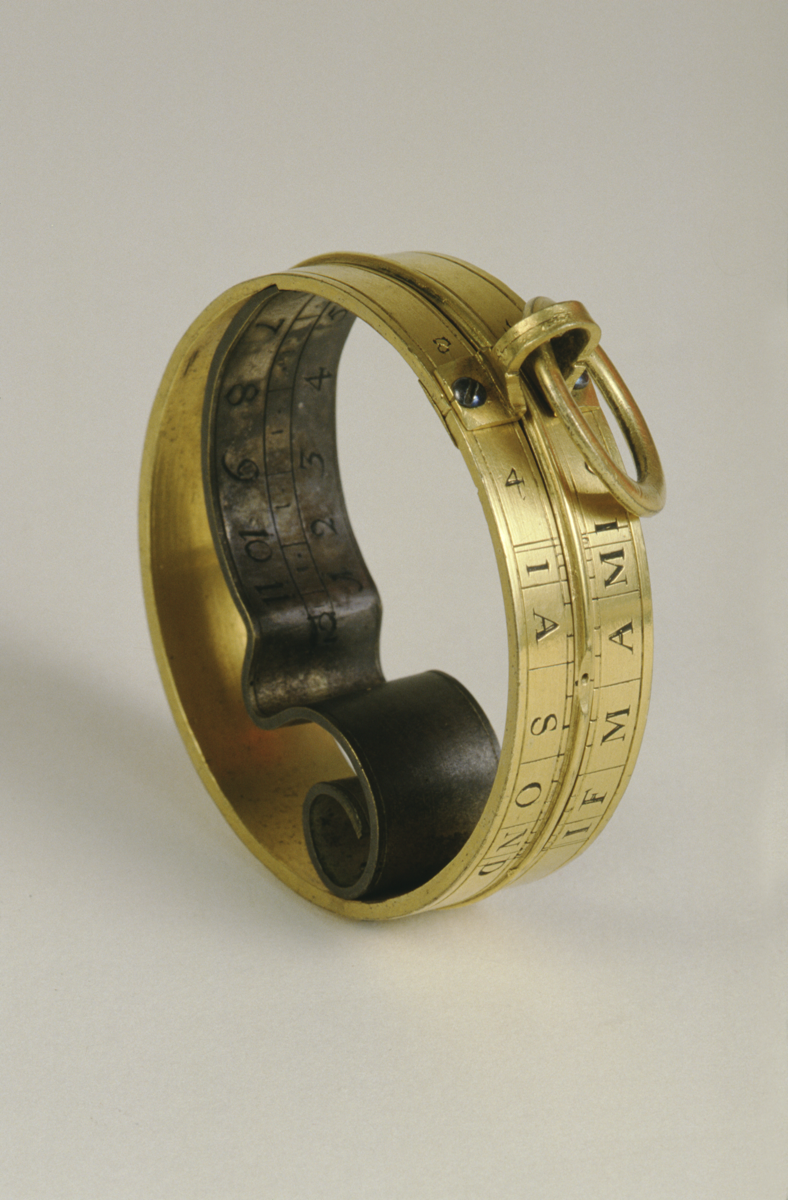
Ring dial, gilt brass, German, 18th C.
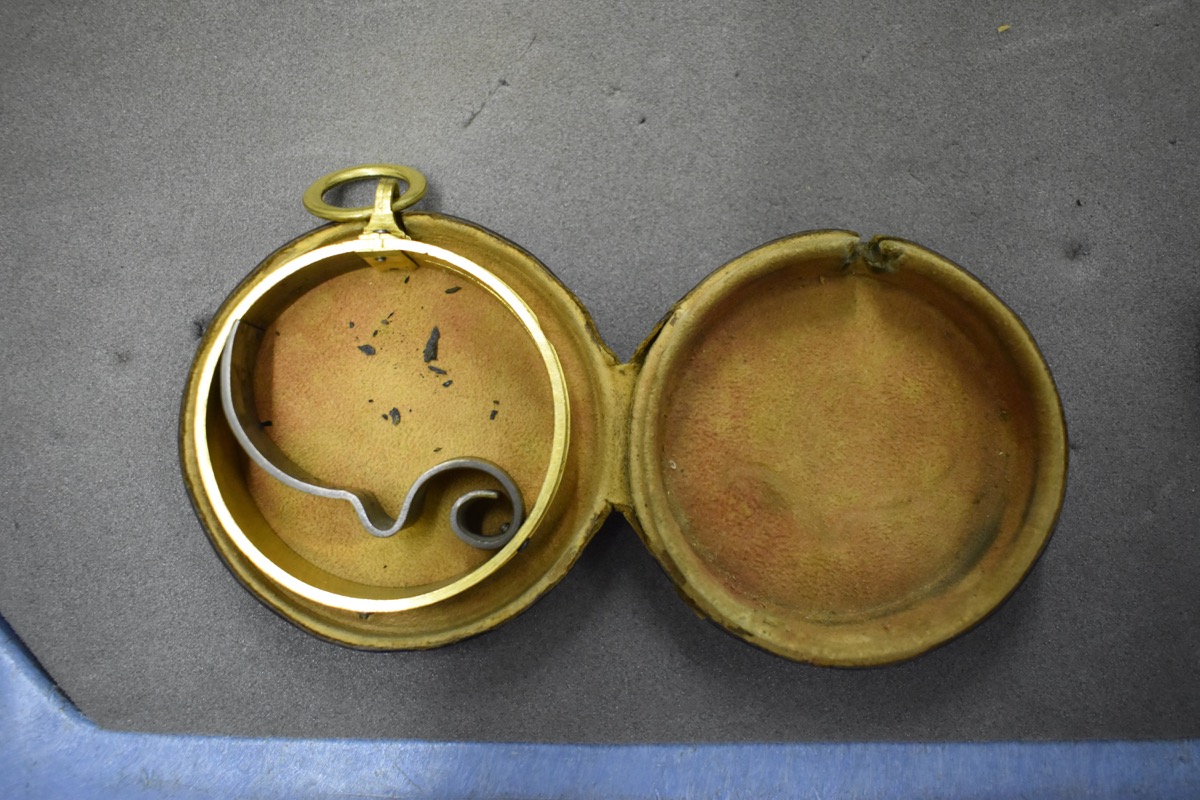
Gilt brass ring with silvered brass hour scale; fixed suspension loop with ring; ring marked on either side of loop ‘46’ and ‘48’ with 3 calibration marks on the edge of the ring, one (47˚ 30´) on the loop. Single pinhole gnomon set in a sliding ring with raised clasp joint. On the outer face a date scale divided to initialled month, subdivided to 10 days. Set within the gilt ring is a silvered brass hour scroll, with hours divided 5 - 12, 1 - 7, numbered by 1, subdivided to 15 minutes.
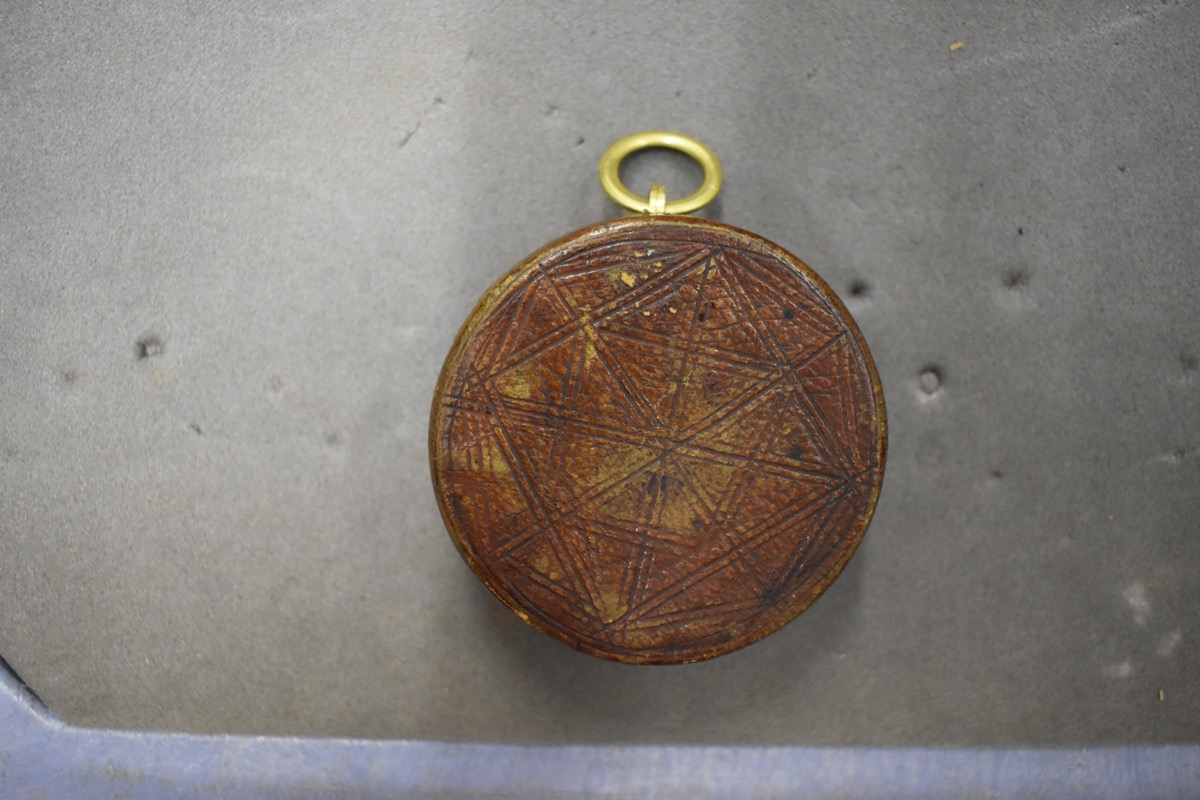
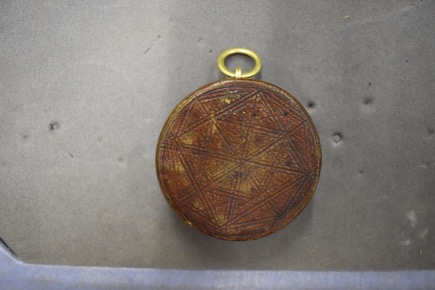
Circular wooden box covered with red leather and lined with orange suede.
Condition of box - fair.
[NOTE: On 15/04/2015 XRF analysis was conducted on this instrument. Results and analysis are given in the ‘Notes’ field.]
References
Events
Description
The ring dial is one of the oldest forms of portable sundial. It was probably developed by the Romans. It is also one of the simplest dials, and was often made very cheaply for the lower end of the market.
Ring dials tell the time from the height of the sun in the sky. They are generally not very accurate. They are used by moving the central band until the pin-hole is lined up against the correct date. After this, the dial is held up and turned until the sunlight falls through the pin-hole onto the hour scale on the other side of the ring. The small circle of light will show the hour, though it is left up to the user to work out whether to choose the morning or the afternoon reading.
FM:41409
Images (Click to view full size):