Accession No
5187
Brief Description
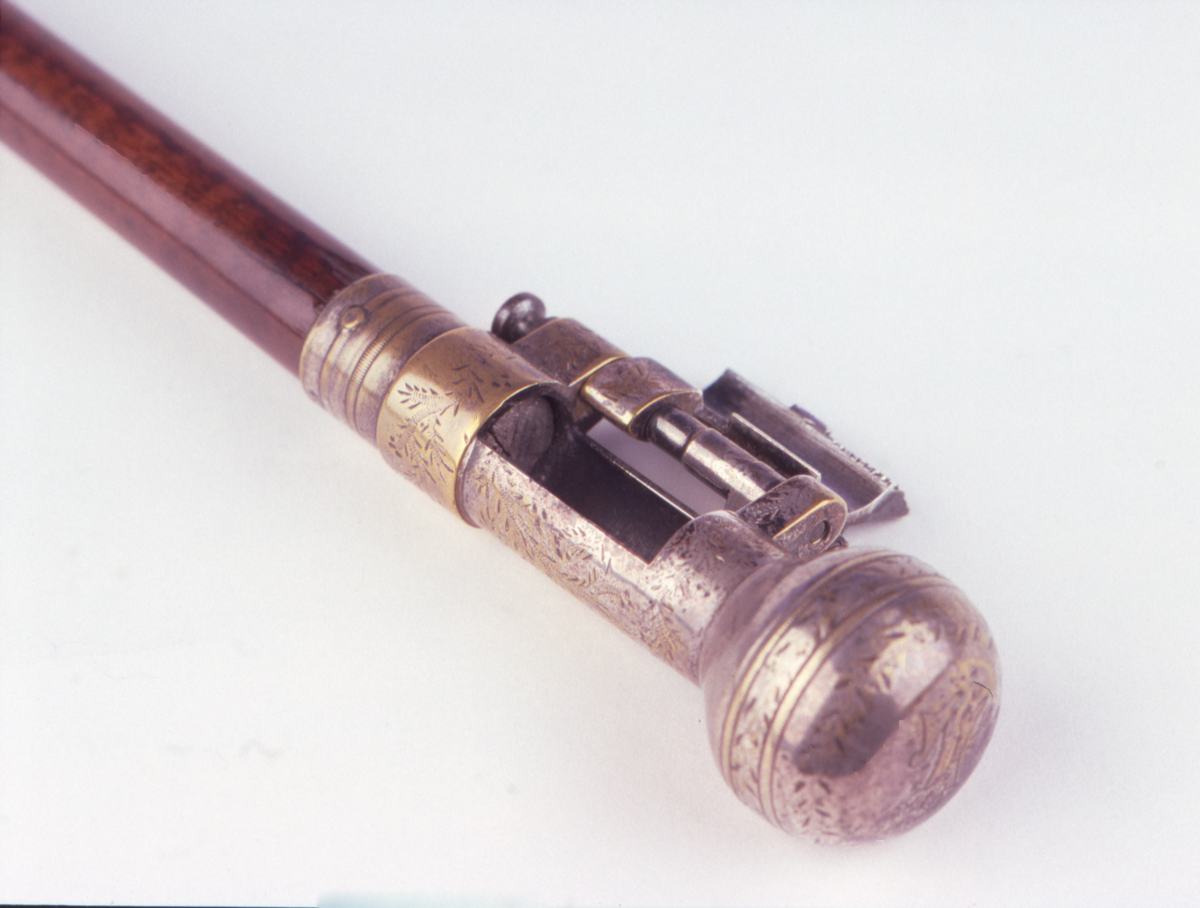
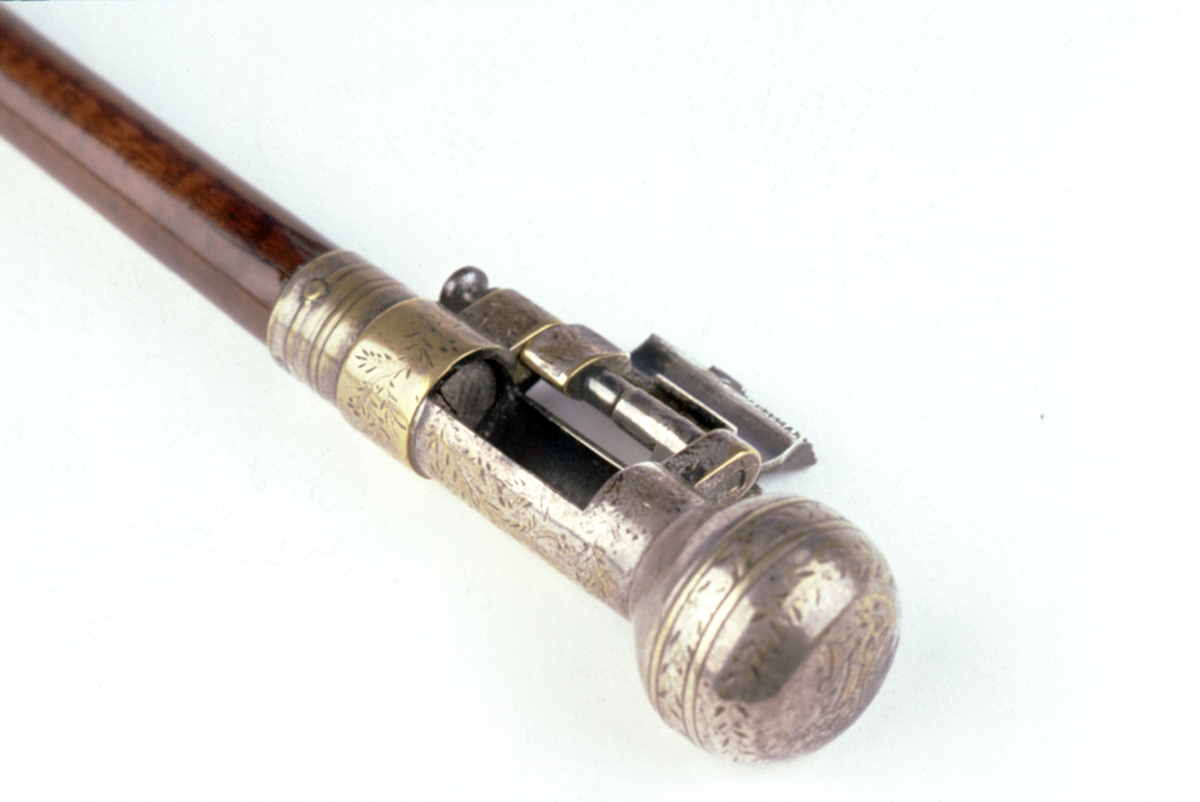
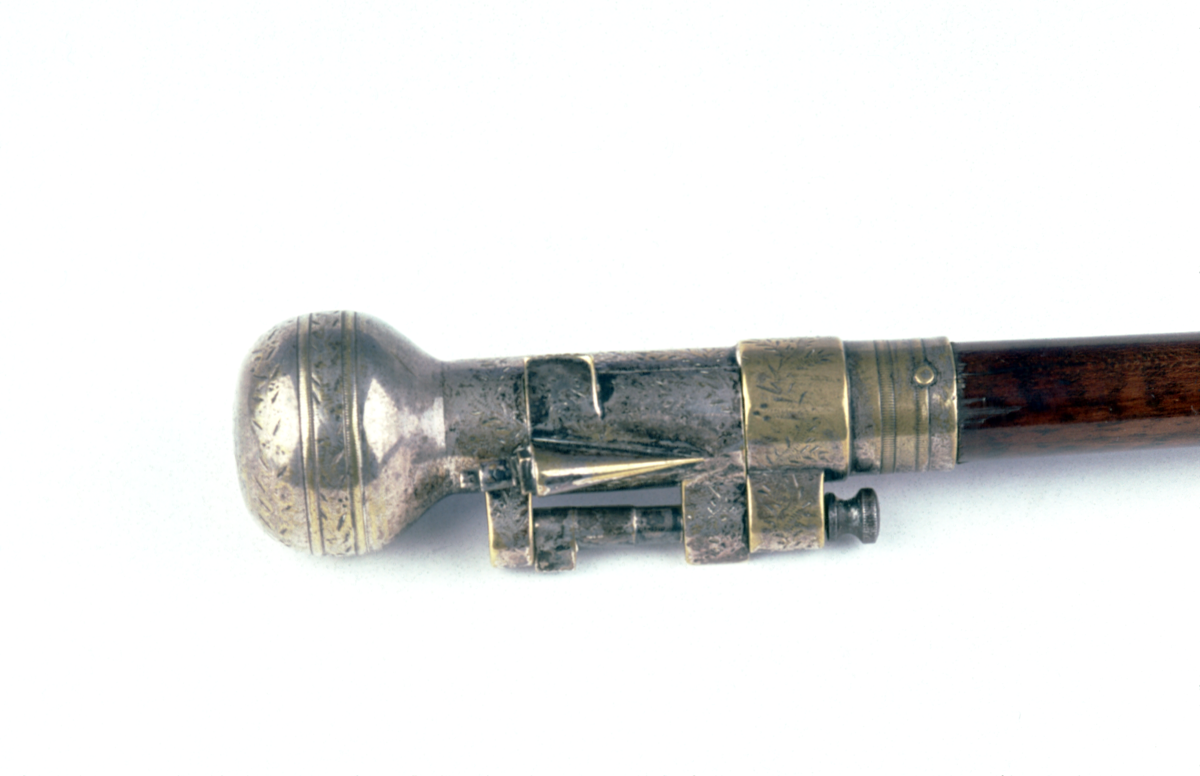
gentleman’s wooden walking stick with a cavity in the metal handle to hold a leech, 19th Century
Origin
Maker
Class
medical
Earliest Date
1800
Latest Date
1900
Inscription Date
Material
wood; metal (silver, gold, brass)
Dimensions
total length 892mm; diameter of handle 31mm
Special Collection
Provenance
Donated in 02/12/1997.
Inscription
IG (? or GI, CI, IC; engraved monogram on top of handle)
Description Notes
Brass shod wooden walking stick. The stick is varnished, with only a few dents and scratches. A small split in the wood appears just below the handle, on the opposite side to the single rivet fastening. Handle is silver, once gilt (most of gilding worn away). The handle is decorated with a pattern of leaf- and berry-bearing branches. A door with external hinge opens to reveal a leech cavity bounded by the cylindrical metal wall and hollow pommel of the handle, and the unvarnished terminus of the wooden stick. Door also carries holder for needle. The pommel of the handle bears a monogram (see inscription).
Condition good; complete.
References
Events
Description
Bleeding was accepted as a cure for a wide variety of medical complaints since Hippocrates’ teachings in the 5th century BC. It continued to be a popular until the 20th century. Physicians were known to have kept and consulted complex charts that showed which parts of the body should be bled for each illness.
One of the most popular instruments for bleeding has been the leech. A blood-sucking relative of the earthworm, when placed on the skin a leech can drink up to five times its own weight in blood. Leeches were not mentioned by Hippocrates, but were recommended by most Greek, Roman and Arabic authors.
Like other forms of bloodletting, leeching experienced a revival in the 19th century. The numbers of leeches used in Paris hospitals increased from 3 million to 41.5 million between 1824 and 1833.
The major advantage of the leech was that it could be used on almost any part of the body, particularly internally - in the mouth, the anus, the vagina; also the larynx and trachea for bronchitis and laryngitis.
Physicians would have transported their leeches in a pewter box with a perforated lid. Less common, but perhaps a more stylish form of transport, is the leech stick. Here the leech would be housed in the top of an adapted walking stick.
FM:42138
Images (Click to view full size):