Accession No
4440
Brief Description
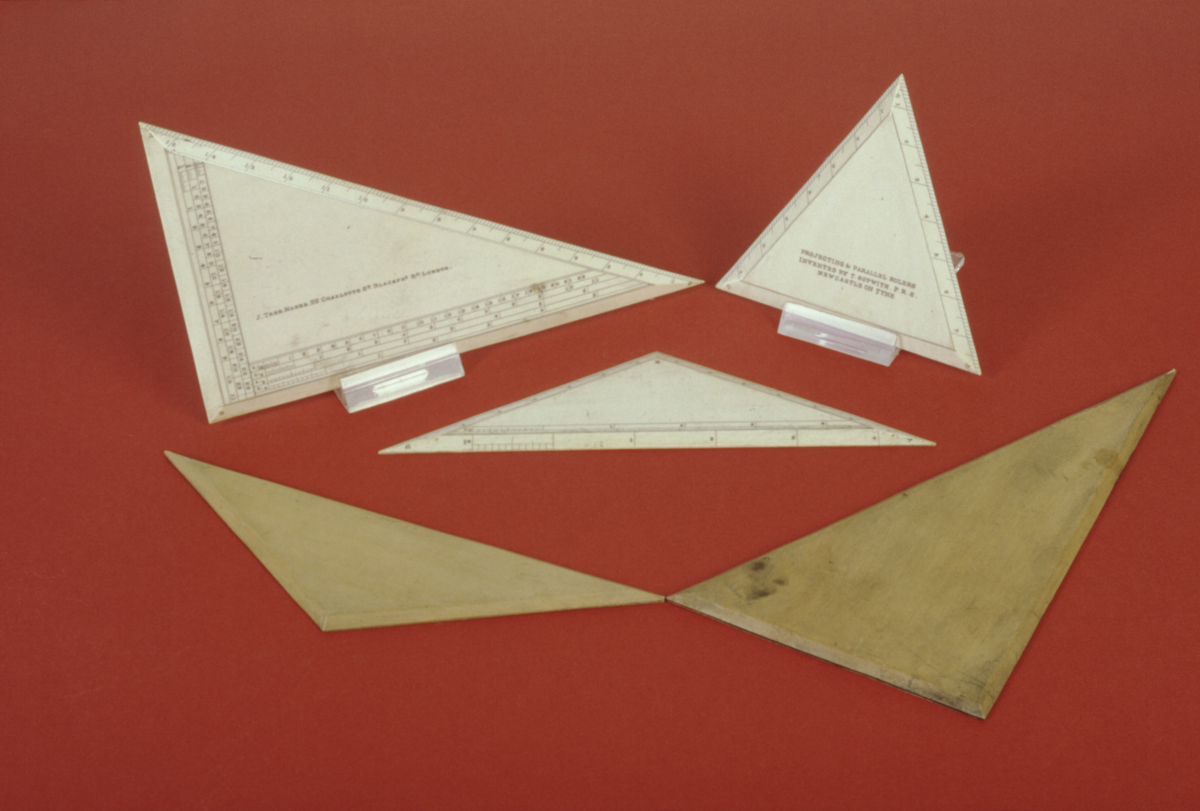
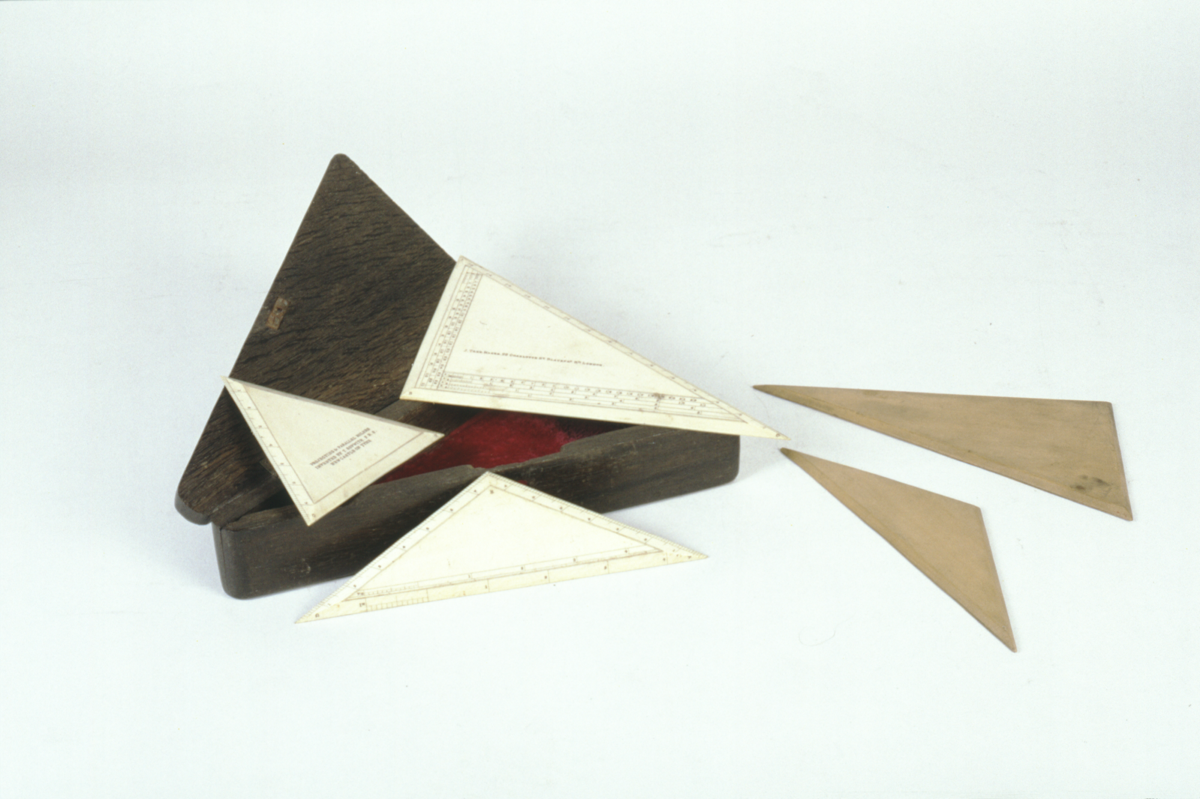
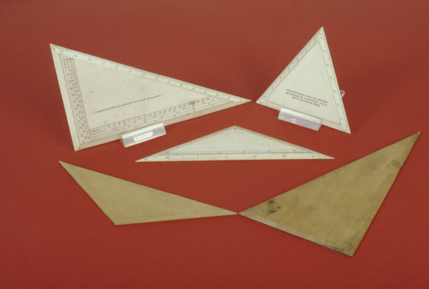
projecting and parallel rulers by J. Tree, c.1849
Origin
22 Charlotte St; Blackfriars Road; London; England
Maker
Tree. J.
Class
drawing
Earliest Date
1849
Latest Date
1849
Inscription Date
Material
ivory; wood (boxwood, oak); cloth (velvet)
Dimensions
box length 200mm; breadth 130mm; height 48mm
Special Collection
Provenance
Purchased from Tesseract in 1991.
Inscription
‘PROJECTING & PARALLEL RULERS
INVENTED BY T. SOPWITH. F.R.S.
NEWCASTLE ON TYNE’ (ivory equilateral triangle)
‘J. TREE. MAKER. 22 CHARLOTTE ST. BLACKFRS RD. LONDON.’ (ivory right-angled triangle)
‘Beverley
STAND
No 148’ (metal plaque, loose in box)
Description Notes
Three ivory triangles (equilateral, isosceles and right-angled), each with edge scales. Two unmarked boxwood triangles (one right-angled, one isosceles).
Oak case lined with red velvet (lock missing, 14-1-2000).
Metal plaque loose in box, possibly from the top of the box?, 14-1-2000.
Condition: fair; incomplete (?).
References
Events
Description
Parallel rule
Used by architects, engineers, cartographers and on nautical charts, the parallel rule is used for drawing parallel lines accurately. It is also used in conjunction with a scale rule for producing orthogonal drawings (with lines in non-parallel direction as well). The pivoting links can be extended to the required distance, but this makes the instrument liable to error for larger drawings because the extension is changed by hand, and can be varied accidentally.
18/10/2002
Created by: Saffron Clackson on 18/10/2002
FM:42166
Images (Click to view full size):