Accession No
0910
Brief Description
bimetallic thermometer, 1875 - 1925
Origin
Maker
Class
meteorology; thermometry
Earliest Date
1875
Latest Date
1925
Inscription Date
Material
metal (brass, steel, white metal); glass; paper
Dimensions
length 147mm; breadth 119mm; depth 48mm
Special Collection
Robert Whipple collection
Provenance
Inscription
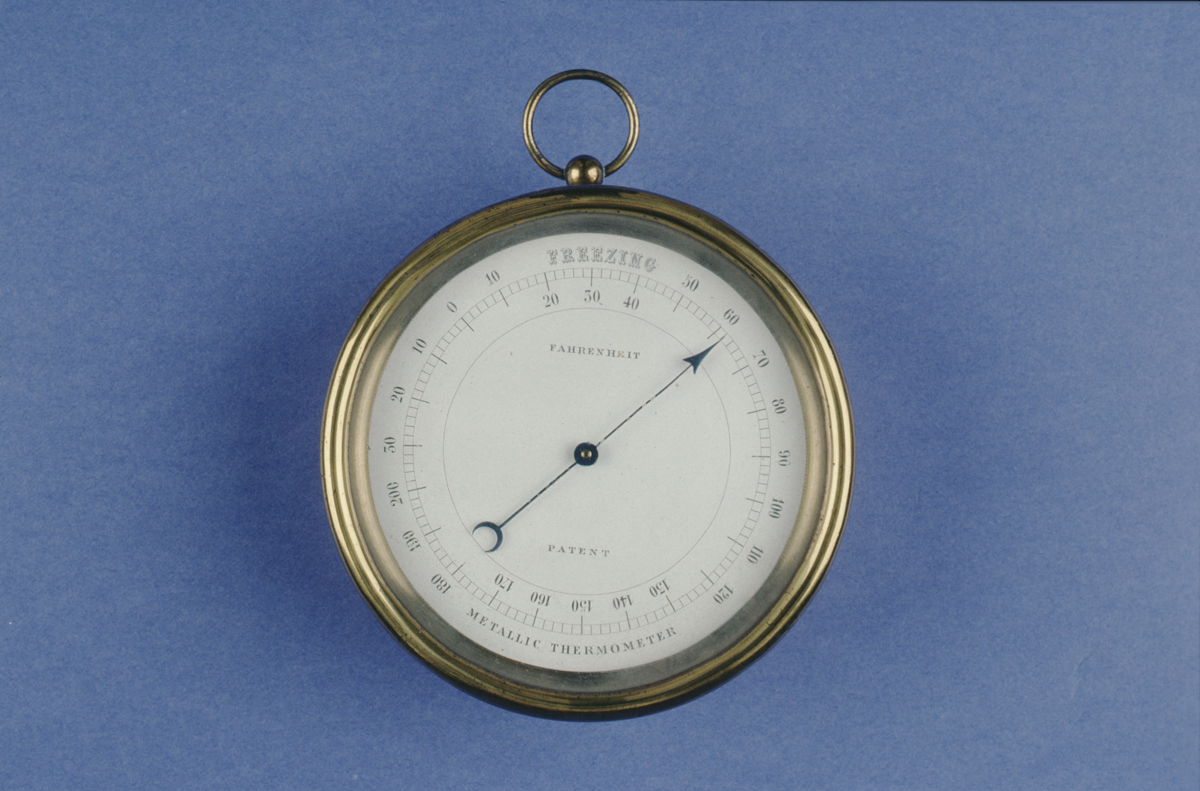
‘FREEZING
FAHRENHEIT
PATENT
METALLIC THERMOMETER’ (on dial)
Description Notes
BIMETALLIC THERMOMETER, 1875 - 1925. Round brass casing with suspension loop and patterned opening on far side from suspension point to allow air access to the bi-metallic strip. Glass front reveals varnished paper dial and steel index. Scale divided [-]30 to [210] numbered by 10 subdivided to 2.
Complete
References
Events
Description
The element of a bimetallic thermometer consists of a strip or coil of steel bonded to another metal, usually brass. The element is able to measure temperature because the two metals differ in their expansion when heated, causing the element to coil up more tightly when heated, as one metal pulls against the other. One end of the coil is fixed, the other is linked to the pointer, which moves round a dial graduated in degrees Fahrenheit.
The Fahrenheit scale takes 32 as the freezing point and 212 as the boiling point of water. It is named for the instrument maker Daniel Gabriel Fahrenheit (1686-1736) who spent many years perfecting thermometers.
26/03/2008
Created by: Dr. Anita McConnell on 26/03/2008
FM:42190
Images (Click to view full size):