Accession No
1932
Brief Description
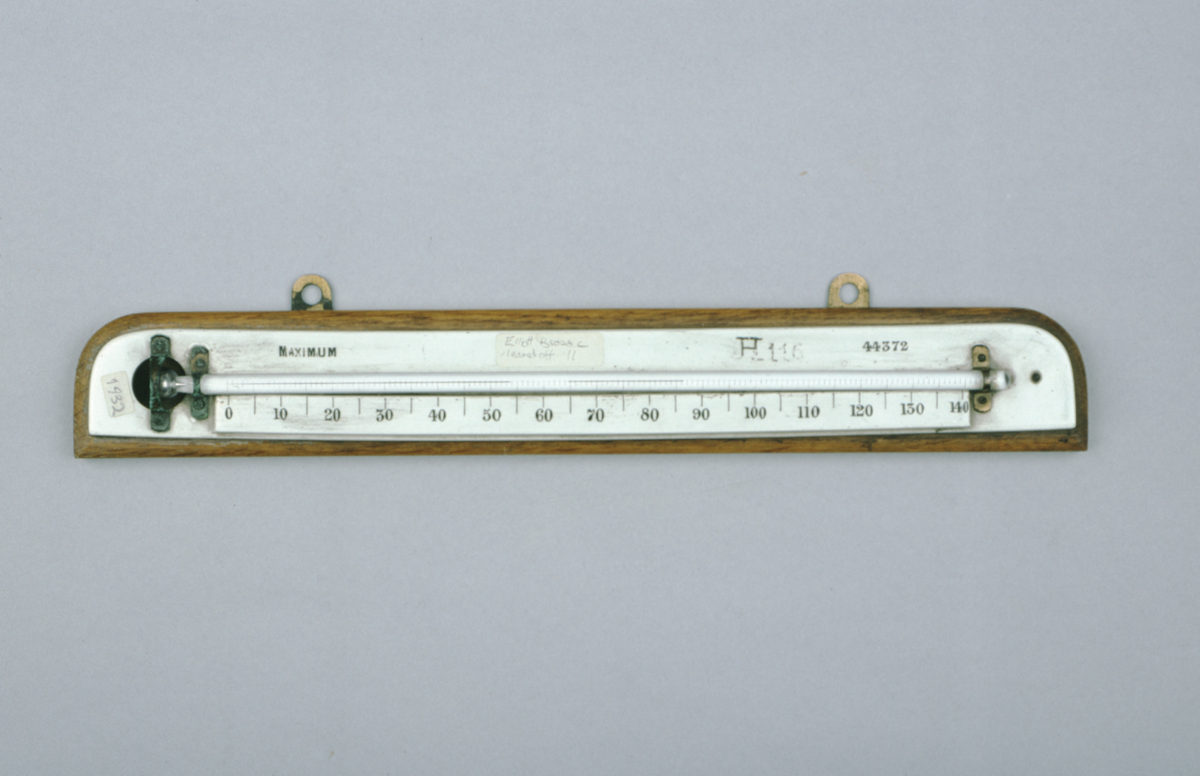
maximum thermometer, by Elliott Brothers, English, 1890 (c)
Origin
England; London; 449 Strand
Maker
Elliott Brothers
Class
laboratory apparatus; thermometry
Earliest Date
1900
Latest Date
1900
Inscription Date
Material
wood; metal (brass, mercury); glass; ceramic (porcelain)
Dimensions
length 370mm; breadth 66mm; thickness 26mm
Special Collection
Cavendish collection
Provenance
Transferred from the Cavendish Laboratory, University of Cambridge in 1974.
Inscription
‘Maximum [Elliott Bros. 449 Strand London] 44372’ (on ceramic mount)
Description Notes
Mercury-in-glass (round-bulb) Farenheit thermometer secured to ceramic mount with brass brackets (2 very corroded). Ceramic mount set on wooden mount which carries 2 brass brackets. Scale divided on thermometer, but numbered on mount, divided 0 - [143]˚F numbered by 10 subdivided to 1.
Condition poor (corrosion on brackets); complete
References
Events
Description
A thermometer is an instrument that measures how hot or cold something is, in other words, its temperature. Most familiar is the "Mercury-in-glass" thermometer, but there are many other kinds.
Many materials expand as they get hotter and contract as they get colder . This expansion and contraction can be used to measure the corresponding changes in temperature. Thus the first useful thermometers were made from a glass bulb full of mercury to which was attached a narrow glass tube. As the bulb is heated a fine thread of mercury expands up the narrow tube. Thermometers, requiring great skill in glass working, were first made by Daniel Fahrenheit of Amsterdam in 1717.
To measure temperature precisely, a numerical scale of "degrees" is needed. To provide this scale two fixed points are chosen, such as melting ice and boiling water. Convenient temperatures are then given to these two fixed points: today melting ice is given a temperature of 0 degrees and boiling water 100 degrees. This is the Celsius or Centigrade scale (although it is quite arbitrary). Fahrenheit himself originally chose the coldest temperature that he could produce (a freezing mixture of ammonium chloride and snow) as 0 degrees and body temperature as 96 degrees. This resulted in the Fahrenheit scale in which the freezing point of water is 32° F and the boiling point of water is 212° F.
01/03/2001
Created by: Chris Lewis on 01/03/2001
FM:42192
Images (Click to view full size):