Accession No
0030
Brief Description
mercury-in-glass thermometer and magnetic compass, French, 1/2 19th Century
Origin
France
Maker
Class
magnetism; thermometry
Earliest Date
1800
Latest Date
1850
Inscription Date
Material
ivory; glass; metal (mercury, steel, brass, white metal); paper
Dimensions
diameter 71mm; thickness 9mm
Special Collection
Robert Whipple collection
Provenance
Purchased by Robert Stewart Whipple in Paris in 04/1922.
Inscription
Description Notes
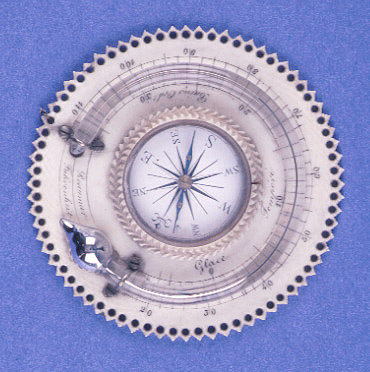
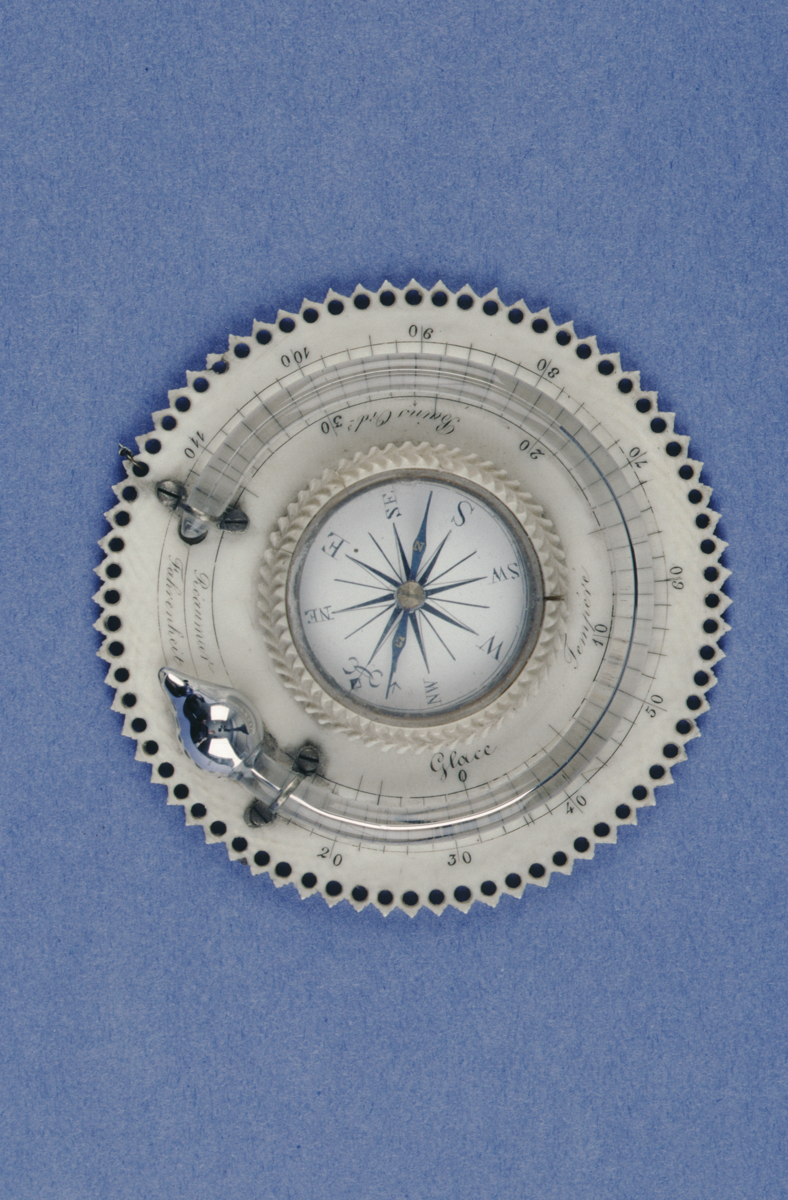
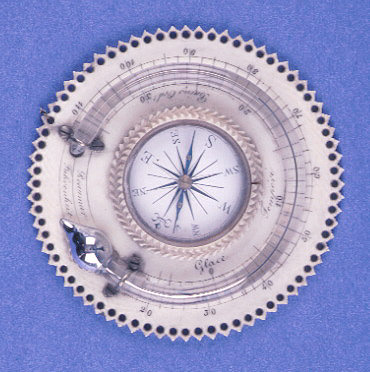
Mercury in glass thermometer and magnetic compass, French, 1/2 19th C. Round-bulb mercury in glass thermometer, graduated R and F, mounted on ivory plate with decorated rim. The thermometer is held in place by two white metal brackets. Two scales; one labelled Fahrenheit and divided [16] - [114]˚F, numbered by 10˚, subdivided to 2˚; other labelled Réaumur and divided [-8] - [36]˚R, numbered by 10˚, subdivided to 1˚. ‘Glace’ marked at 32˚F and 0 R; ‘Tempéré’ at 10 R; ‘Bains Ords’ at 26˚ R. Compass under glass, with 16-point rose, 8 points labelled; magnetic variation indicated by an arrow at 22.5˚ W of North. Blued steel marked with ‘N’ and ‘S’. Glass chipped in one place.
Condition good; complete.
References
Events
Description
Although Robert Stewart Whipple purchased his first antique instrument in 1913, it was not until the 1920s that his collection really began to grow. This is one of the first hundred objects that Whipple acquired, and demonstrates the early development of his taste for historic scientific artefacts and books.
07/10/2025
Created by: Hannah Price on 07/10/2025
Description
A compendium is the name given to a small holder for more than one instrument. Here a decorative ivory disc holds a mercury thermometer set around a magnetic compass. The thermometer is graduated in degrees Fahrenheit and Réaumur, and labelled with the French terms for ‘ice’, ‘temperate’ and ‘normal bath’. The compass dial may be of English origin as ‘W’ and ‘SW’ indicate West and Southwest, whereas the French terms would be ‘O’ for ‘Ouest’ and ‘SO’ for ‘Sudouest’.
The Fahrenheit scale, which takes 32 as the freezing point and 212 as the boiling point of water, is named after the instrument maker Daniel Gabriel Fahrenheit (1686-1736), who spent many years perfecting thermometers.
The French scientist Réné-Antoine Ferchault de Réaumur (1683-1757) took different values for his thermometer scales. After his death the Réaumur scale was generally taken as 0 for freezing and 80 for the boiling point of water.
26/03/2008
Created by: Dr. Anita McConnell on 26/03/2008
FM:42199
Images (Click to view full size):