Accession No
1454
Brief Description
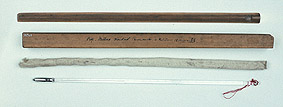
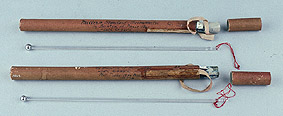
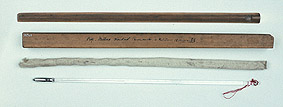
mercury-in-glass thermometers, by Bunten, French, 1841 (c) (1454.2; 1454.3), 1843 (c) (1454.1)
Origin
Paris; France
Maker
Bunten
Class
laboratory apparatus; thermometry
Earliest Date
1841
Latest Date
1844
Inscription Date
Material
metal (mercury); glass; cloth; wood; paper (cardboard, paper)
Dimensions
1454.1 case length 370mm; breadth 23mm; height 22mm; length 342mm 1454.2 case length 312mm; diameter 19mm; length 282mm 1454.3 case length 316mm; diameter 19mm; length 280mm
Special Collection
Provenance
Transferred from the Department of Mineralogy and Petrology, University of Cambridge in 02/1968 and 02/1969.
Inscription
1454.1: ‘Bunten a Paris, divise le 18 Mai 1844 Centigrade:’ (stem near bulb)
‘Bunten
25 Mai
1843
1843
Mai
1843’ (top of stem)
1454.2: ‘Bunten a Paris 1841’ (top of stem)
1454.3: ‘Bunten a Paris 1841’ (top of stem)
‘+15’
‘No 9’
Description Notes
1454.1:
Long-bulb mercury in glass centigrade thermometer, etched calibrations -23o-106oC by 5o from -20o to 1o; cloth cover and wooden case with sliding lid. Inscribed on the side of the case. ‘Prof. Millers Standard Thermometer. v. Phil. Trans. 1856/76.B’.
1454.2:
Round-bulb mercury in glass centigrade thermometer, etched calibrations -24-41oC by 5o from -20o to 1o; cloth cover and cardboard slip case covered in faded brown paper. Marked in ink ‘Miller’s Standard Thermometer C./ by Bunten of Paris 1841/-24oC to +41oC/Phil Trans 1856 Pt 111 p776’.
1454.3:
Round-bulb mercury in glass centigrade thermometer, etched calibrations -25oC-53oC by 5o to 1o; cloth cover and cardboard slip case covered in faded brown paper and marked in ink ‘Miller’s Standard Thermometer/ by Bunten of Paris 1841/D/-25o C to +53o/Phil. Trans. 1856 pt. 111. p776’.
References
Events
Description
A thermometer is an instrument that measures how hot or cold something is, in other words, its temperature. Most familiar is the "Mercury-in-glass" thermometer, but there are many other kinds.
Many materials expand as they get hotter and contract as they get colder . This expansion and contraction can be used to measure the corresponding changes in temperature. Thus the first useful thermometers were made from a glass bulb full of mercury to which was attached a narrow glass tube. As the bulb is heated a fine thread of mercury expands up the narrow tube. Thermometers, requiring great skill in glass working, were first made by Daniel Fahrenheit of Amsterdam in 1717.
To measure temperature precisely, a numerical scale of "degrees" is needed. To provide this scale two fixed points are chosen, such as melting ice and boiling water. Convenient temperatures are then given to these two fixed points: today melting ice is given a temperature of 0 degrees and boiling water 100 degrees. This is the Celsius or Centigrade scale (although it is quite arbitrary). Fahrenheit himself originally chose the coldest temperature that he could produce (a freezing mixture of ammonium chloride and snow) as 0 degrees and body temperature as 96 degrees. This resulted in the Fahrenheit scale in which the freezing point of water is 32° F and the boiling point of water is 212° F.
01/03/2001
Created by: Chris Lewis on 01/03/2001
FM:42206
Images (Click to view full size):