Accession No
3722
Brief Description
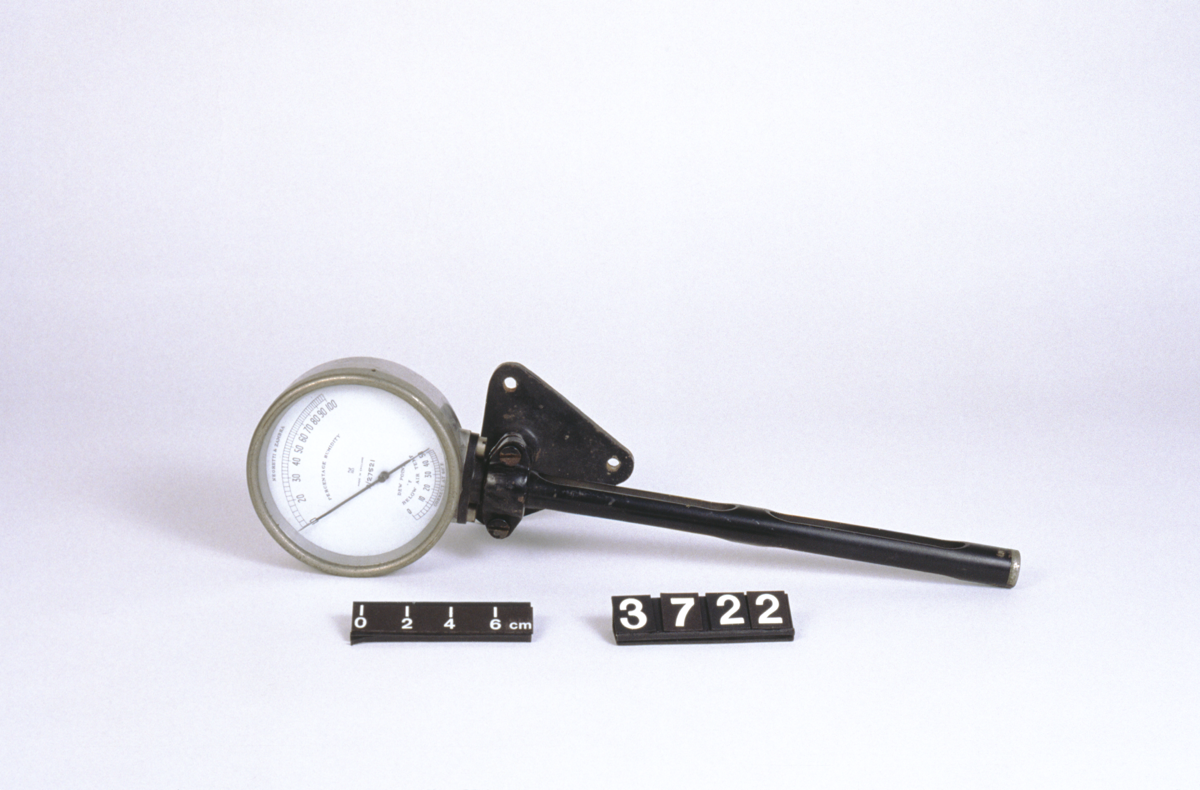
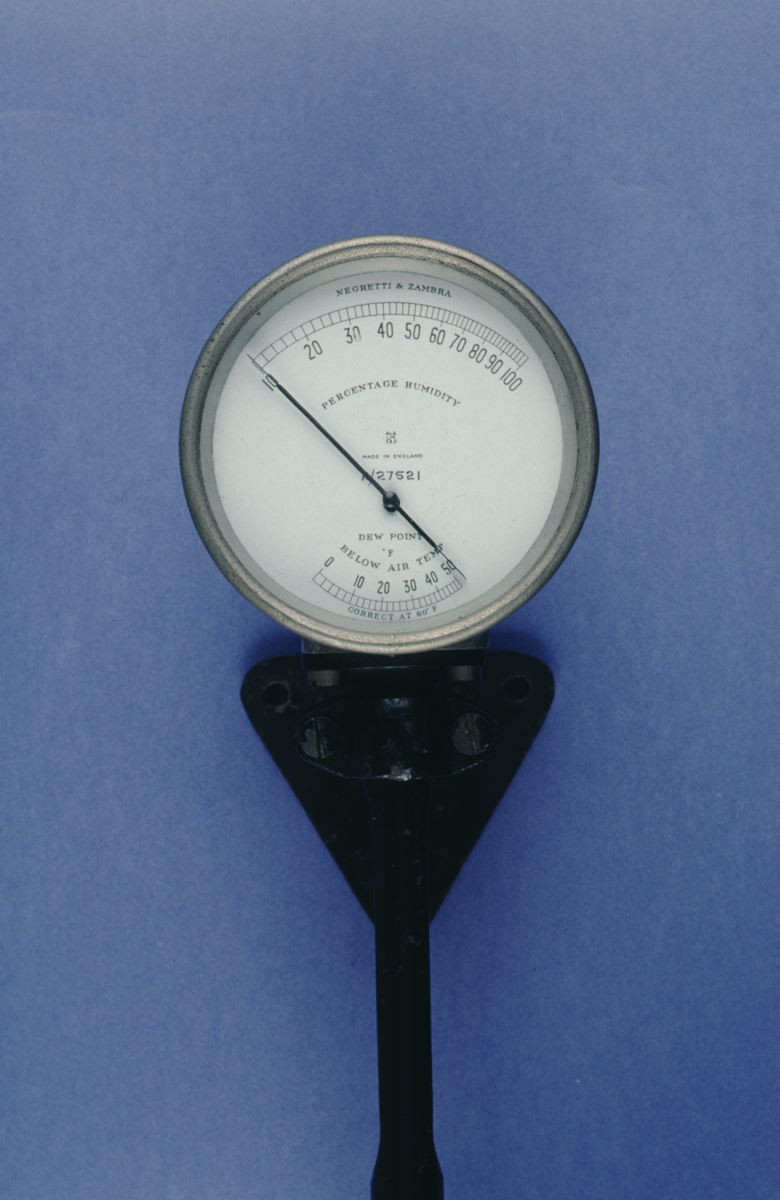
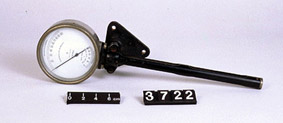
hair hygrometer, by Negretti and Zambra, English, 1940 (c)
Origin
England
Maker
Negretti and Zambra
Class
meteorology
Earliest Date
1940
Latest Date
1940
Inscription Date
Material
metal (steel); glass; hair
Dimensions
height 377mm; breadth 103mm; depth 92mm
Special Collection
Provenance
Transferred from Institute of Astronomy, University of Cambridge, Cambridge, England, 1988.
Inscription
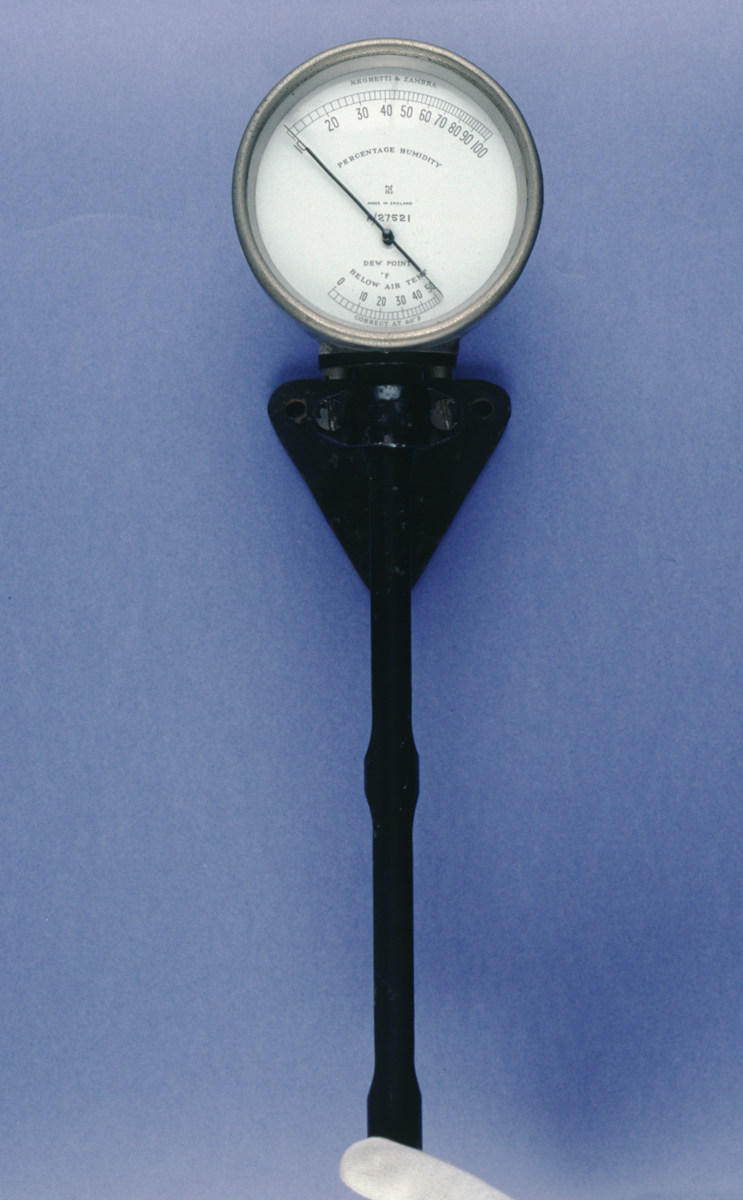
‘NEGRETTI & ZAMBRA
PERCENTAGE HUMIDITY
MADE IN ENGLAND
R/27521
DEW POINT
F
BELOW AIR TEMP
CORRECT AT 60F’
‘N221495’ (reverse of plate)
Description Notes
Hair hygrometer, by Negretti & Zambra, English, c. 1940.
Circular steel case with wall mounting. Glass front and porcelain dial with two scales, one indicating relative percentage humidity, the other the dewpoint. Beneath the case a slotted tube in which the hairs are mounted. At the lower end of the tube an adjustment screw is provided to which the hairs are anchored. At the top end of the hairs a link piece is connected direct to a crank on the pointer spindle.
Complete.
References
Events
Description
A hygrometer is an instrument that measures the amount of moisture in the air; its dampness or humidity. Hygrometers were originally devised as aids to weather forecasting, but are now more often used to monitor air-conditioning, in museums, for instance.
There are several different types of hygrometer. The earliest type uses the fact that some natural materials are sensitive to dampness. Hair, whalebone and catgut, for example, will all stretch or contract in damp or dry air, so can be made the basis for simple indicators of humidity.
Another type is the wet and dry bulb hygrometer. This consists of two identical thermometers, the bulb of one being wrapped in a fabric sleeve; the sleeve dips into a small amount of water, and is permanently wet. The second thermometer will show a slightly lower temperature due to the evaporation of water from the wet sleeve. The rate of evaporation and the amount of cooling depend on humidity. Evaporation is quick on a dry day, but much slower when it is wet. The difference in temperature between the two thermometers gives a measure of the humidity.
A more precise instrument is the dew-point hygrometer. The dew point is the temperature at which moisture in the air starts to condense as liquid. This depends upon the amount of moisture in the air in the first place, and therefore provides a measure of the original humidity. In the dew-point hygrometer, a glass tube with a gilded bulb is cooled until a mist of condensation is first seen on the gilded surface. A small thermometer inside the tube then shows what the dew point is. By comparison with another thermometer outside the tube it is possible to work out the humidity from a table.
01/03/2001
Created by: Chris Lewis on 01/03/2001
FM:42208
Images (Click to view full size):