Accession No
0446
Brief Description
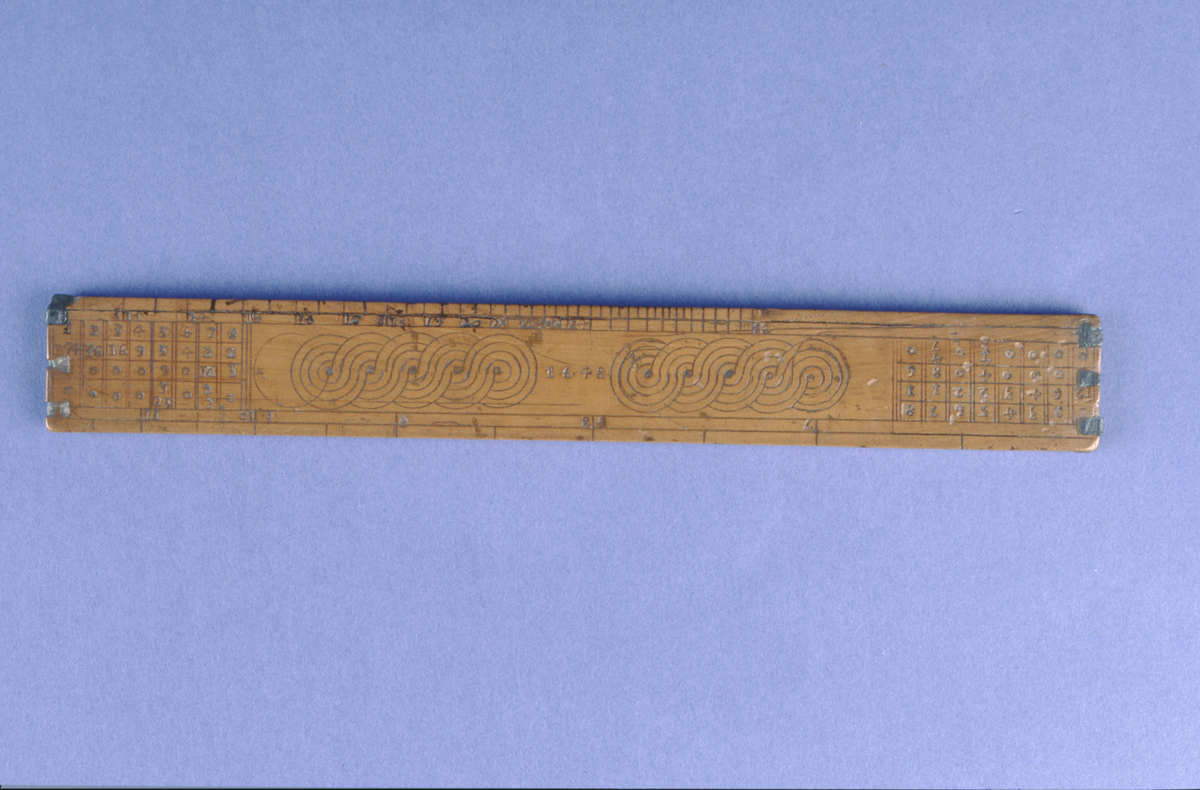
carpenter’s rule, 1648
Origin
Maker
Class
mathematics
Earliest Date
1648
Latest Date
1648
Inscription Date
1648
Material
wood (boxwood); metal (lead)
Dimensions
length 314mm; breadth 40mm; thickness 7mm
Special Collection
Robert Whipple collection
Provenance
Purchased from T.H. Court in 05/1927. ‘from Major Goodall’s collection,’ according to the accession register.
Inscription
‘1648’ (reverse)
Description Notes
Wooden carpenter’s rule, 1648.
Boxwood rule with lead ends. Obverse has scale of inches along each end divided [0] - [12] numbered by 1 subdivided to 1/8. Reverse has unequal scale starting on one edge and continuing on the other, divided [6.5] - 36 numbered 7, 8, 9, 10, 11, 13, 14 ... 24, 36. Also timber scales. Rather crude engraving on front and back.
Condition fair (missing 2 lead lugs at one end); complete
References
Events
Description
Scale Rule
A straight rule with a scale engraved along the length is the simplest instrument for making linear measurements, and has been used since antiquity. However, scale rules were not commonly used for making scale drawings until around 1550 in Northern Europe. Anthropomorphic dimensions such as the foot were commonly used for the scale.
Scale rules can be straight or folding and often have even scales on one side and diagonal scales on the other, which enable the user to divide any measurement into 100 parts. They were often decorated by the maker, demonstrating artistic as well as mathematical skills (although they became more purely functional from mid 18th century). They were usually made of brass, silver, ivory or boxwood.
FM:42271
Images (Click to view full size):