Accession No
0976
Brief Description
simple microscope, screw-barrel type; English; circa 1730
Origin
England
Maker
Class
microscopes
Earliest Date
1730
Latest Date
1730
Inscription Date
Material
ivory; leather (shagreen); metal (brass, steel); glass; cloth (velvet)
Dimensions
box length 178mm; breadth 72mm; height 54mm
Special Collection
Robert Whipple collection
Provenance
Inscription
Description Notes
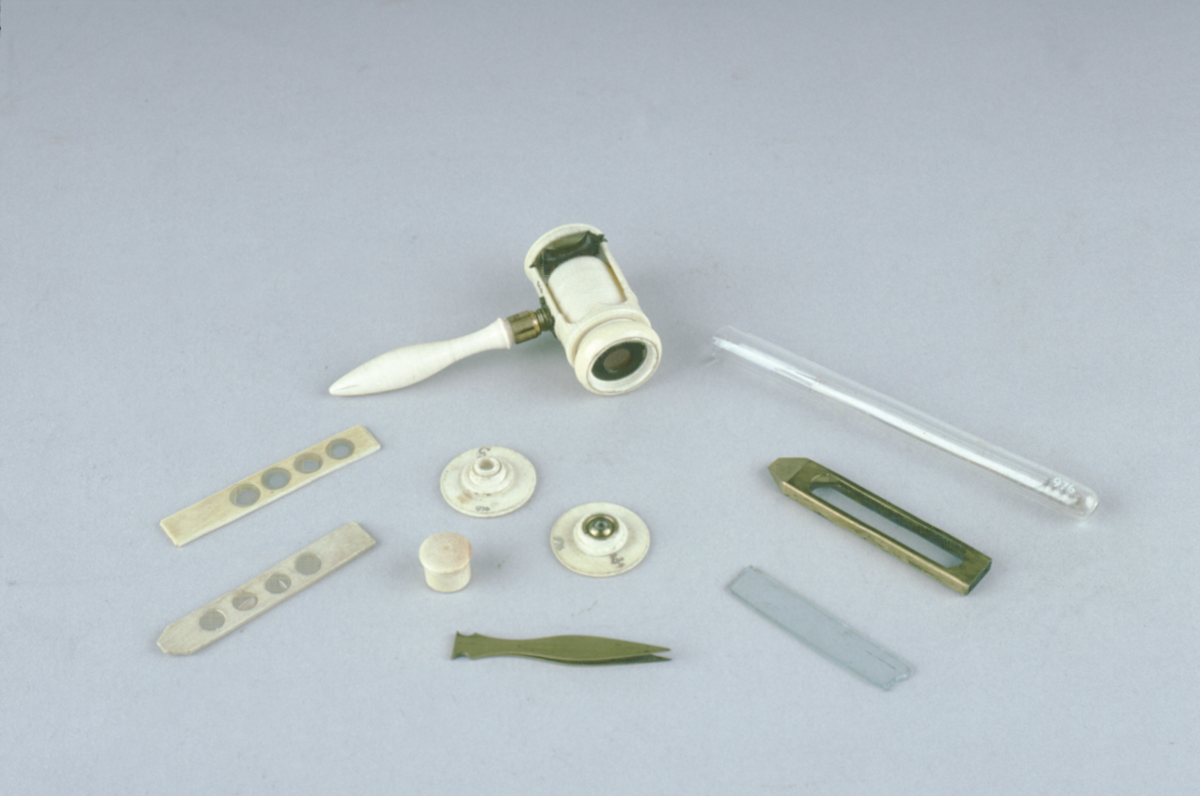
Simple microscope, screw-barrel type; English; circa 1730.
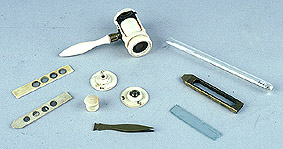
Ivory; body with threaded condenser bearing on leather and brass 2 piece stage; steel spring; brass ferrule for turned ivory handle (handle and ferrule not original); two objectives marked ‘4’ and ‘5’; brass tweezers; ivory talc and ring box; two glass tubes with brass wire; two 4-object ivory slides; incomplete brass live box.
Fitted wooden case covered with black shagreen and lined with green velvet.
References
Events
Description
This type of simple microscope, employing only one lens, was first described in 1702, by James Wilson in the Philosophical Transactions of the Royal Society. The design was in fact the work of the Dutch microscopist Nicolaas Hartsoeker.
The essential feature of the design is the threaded cylinder, carrying a condensing lens, which screws in and out of the body. The microscope is hand-held, and the slide is inserted at one end — the whole instrument is then pointed towards a light source.
Large numbers of these microscopes were made, and they proved extremely popular. This was in part due to the recommendation of John Harris, in his 1704 book Lexicon Technicum, in which he wrote that “of all microscopes I have ever seen for commodiousness, various uses, portability and cheapness, I never met with anything like Mr. Wilson’s Glasses.”
26/02/2008
Created by: Boris Jardine, with text from Olivia Brown’s Catalogue 7 on 26/02/2008
FM:42372
Images (Click to view full size):