Accession No
0514
Brief Description
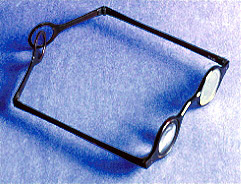
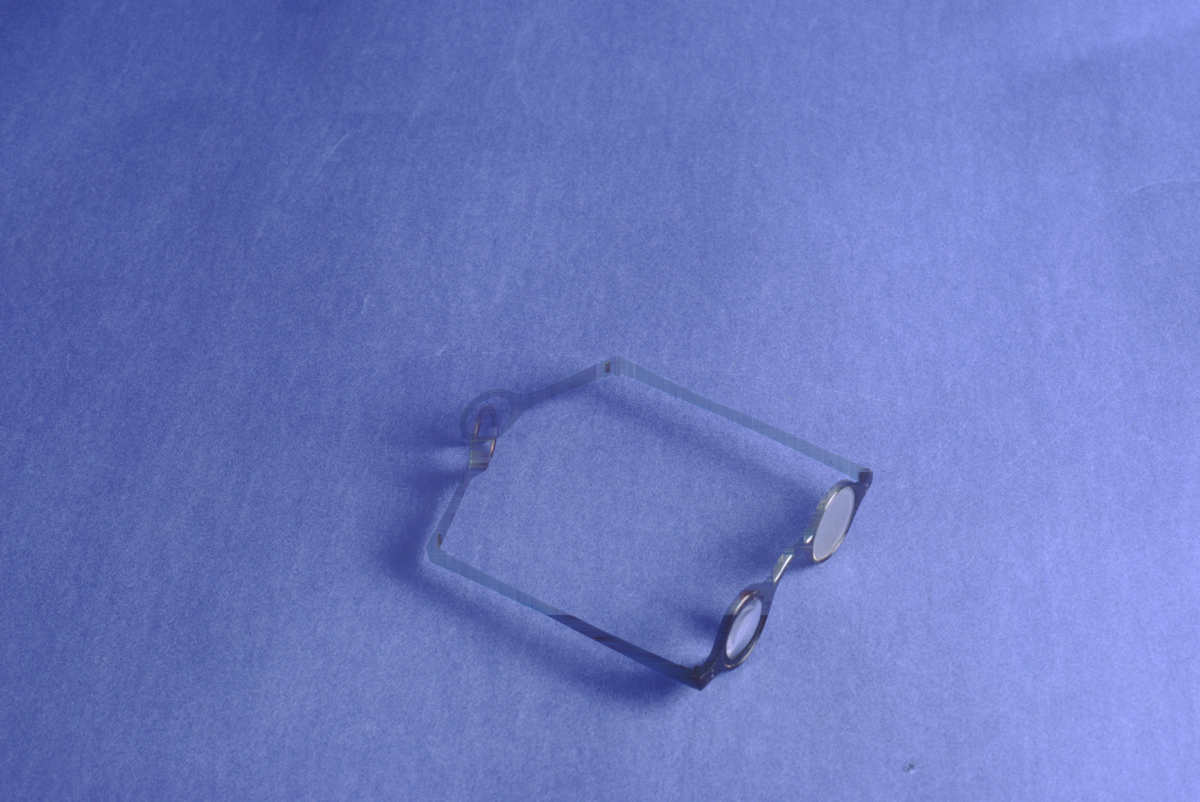
spectacles, temple, 1800 (c)
Origin
Maker
Class
optical
Earliest Date
1800
Latest Date
1800
Inscription Date
Material
organic (tortoise shell, horn); glass
Dimensions
length 112mm; breadth 32mm
Special Collection
Robert Whipple collection
Provenance
Purchased from T.H. Court on 28/05/1927.
Inscription
Description Notes
Tortoise shell frame. Round lenses. One lens frosted glass, the other plano-convex. ‘C’-bridge. Hinged double side pieces with large ring ends. Inner rim of horn round convex lens.
Condition: good/fair; complete.
References
Events
Description
Spectacles
Usually consisting of a pair of lenses held in a frame, spectacles may have originated in the ancient civilizations of China and the Mediterranean, but early forms were crude. It was only in the 18th century that the grinding of lenses became sufficiently advanced to make then really effective for correcting sight defects. In order to correct for near sightedness, the lenses must be concave, which diverges the rays of light (angles them apart), and for long sightedness they must be convex, to angle the rays of light together.
Spectacles are not solely used for defective eyesight; the Inuit and the Yupik use wooden spectacles with very small slits in them to reduce the glare from snow and ice.
FM:42570
Images (Click to view full size):