Accession No
0145
Brief Description
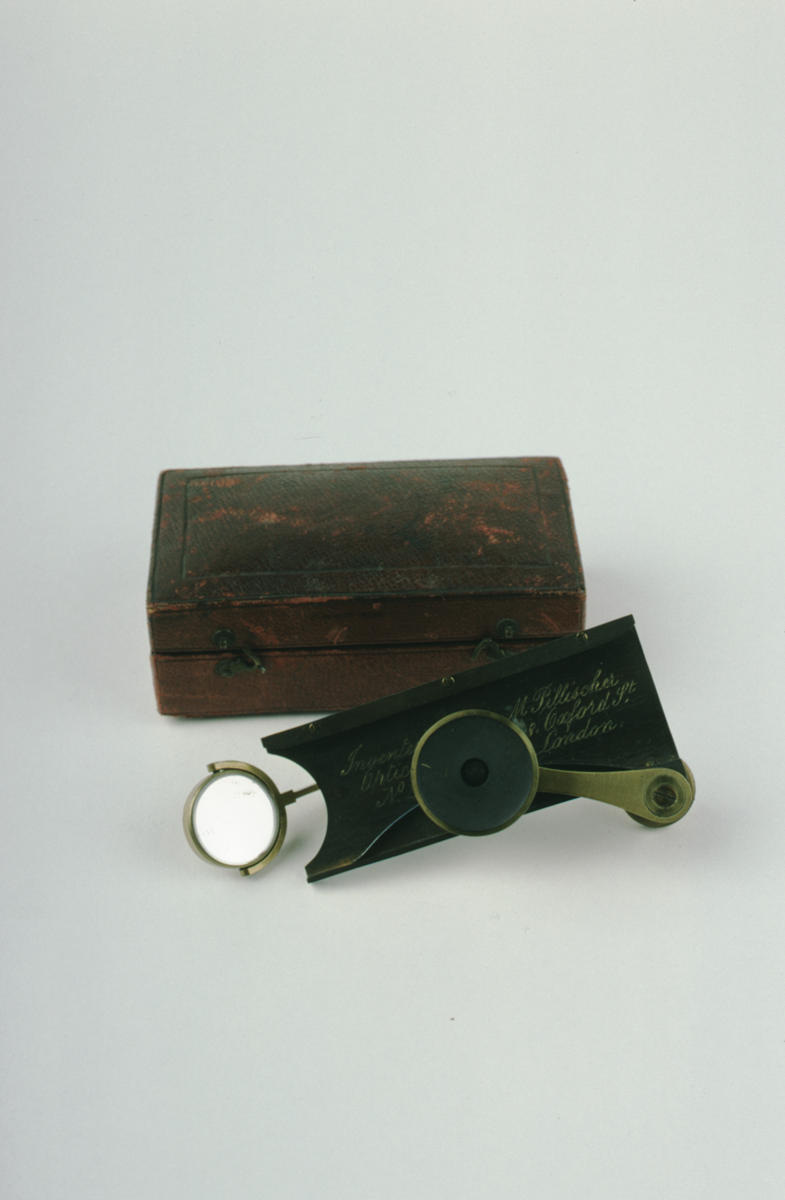
simple microscope; made by M. Pillischer; circa 1849
Origin
398 Oxford Street; London; England
Maker
Pillischer. M.
Class
microscopes
Earliest Date
1849
Latest Date
1849
Inscription Date
Material
metal (brass, steel); glass (mirror); hide (morocco leather); cloth (silk); wood
Dimensions
box length 95mm; breadth 56mm; height 35mm
Special Collection
Robert Whipple collection
Provenance
Purchased by Robert Stewart Whipple from T.H. Court on 18/04/1924.
Inscription
“Invented by M. Pillischer Optician / No 42 / 398 Oxford St. / London”
Description Notes
Oxidised brass tray with grooved sides and steel spring clip for slides; aperture with rotating aperture control below; brass arm carries objective; hinged 2 part brass arm below carries swinging concave mirror; 3 objectives, 1/4, 1/16, and 1/30.
Fitted wooden case, covered with morocco and lined with red silk.
11/03/2021 2 slides, one of which is broken found in box. May well not be part of object -- have been put in bag. Object is possibly incomplete -- there is a gap in box for a disc to assist in viewing opaque objects.
References
Events
Description
The simple microscope is essentially one lens, or one thick lens which is composed of two or three pieces of glass. The simple microscope has a short focal length which means that in order to focus clearly the microscope has to be held up to the eye. The magnifying power in this type of microscope ranged from 70 to 250 times.
Antoni van Leeuwenhoek (1632-1723) was a cloth merchant from Delft and made the earliest surviving examples of a simple microscope. Leeuwenhoek crafted the lens from glass beads and mounted the lens in between metal plates. A spike was used to hold the specimen close to the lens and the microscope was then handheld in front of the eye. Leeuwenhoek was the first person to see bacteria. The capillary circulation of the blood, as discovered and demonstrated by Marcello Mapighi could also be observed through a simple microscope. The simple microscope remained in use alongside the compound microscope, as it was a useful alternative if clear images could not be viewed through compound microscopes.
In the early years of the 18th Century, many simple microscopes were of the screw barrel type ,which were produced in ivory or brass. Those particularly interested in the natural world used simple microscopes as they were portable and very useful for work in the field. The botanical microscope as seen in the microscope case (accession number 0587) would open out as the box itself was opened making it immediately ready for use.
FM:42605
Images (Click to view full size):