Accession No
0342
Brief Description
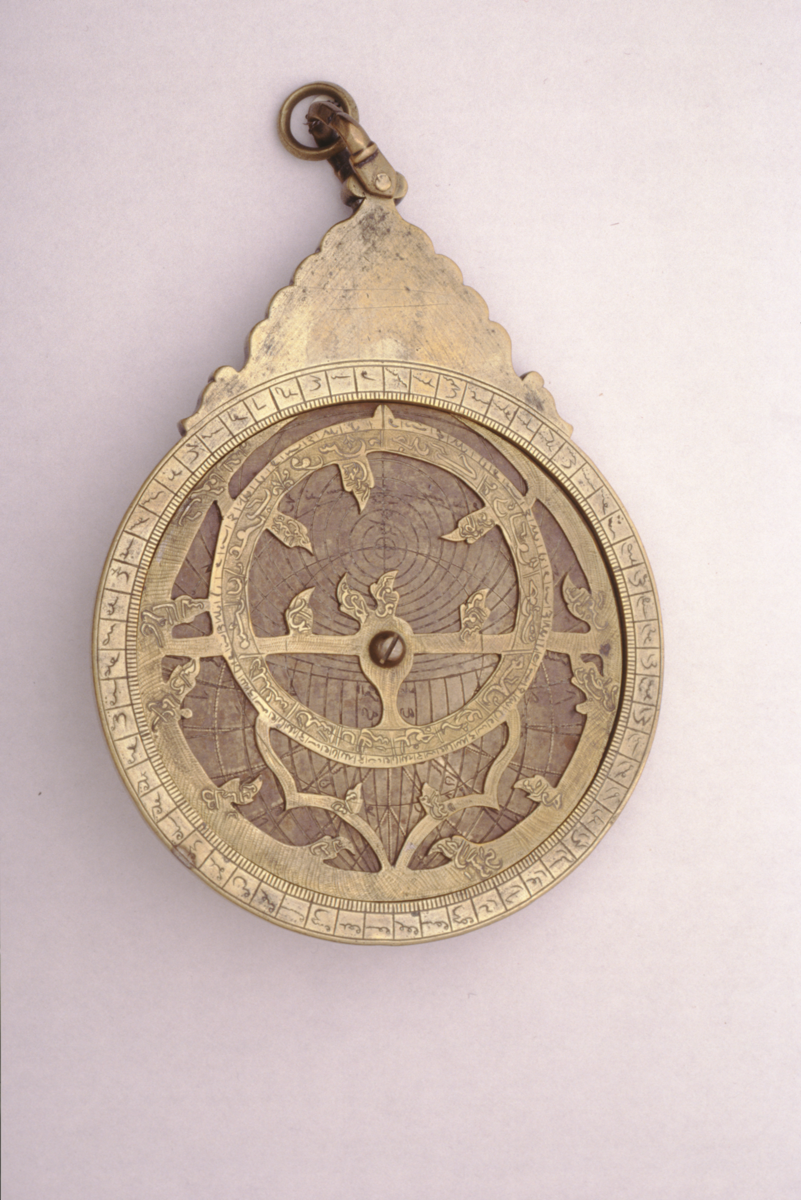
planispheric astrolabe, Islamic, Persian [tentative attribution], mid-17th Century
Origin
Persia [tentative attribution]; Islamic [Iran?]
Maker
Class
astronomy
Earliest Date
1650
Latest Date
1650
Inscription Date
Material
Brass
Dimensions
length 190 mm; breadth 125 mm; thickness 16 mm
Special Collection
Robert Whipple collection
Provenance
Purchased by Robert Stewart Whipple from Antique Art Galleries, London, on 30/11/1927. Accessions register V.1 records the following remark with the entry: “from M. Grassi, Florence”. This presumably refers to the well known Grassi art dealership: http://www.grassistudio.com/Grassi-Studio-News-and-Events-DesktopDefault.aspx?tabid=20&lg=en .
Inscription
Description Notes
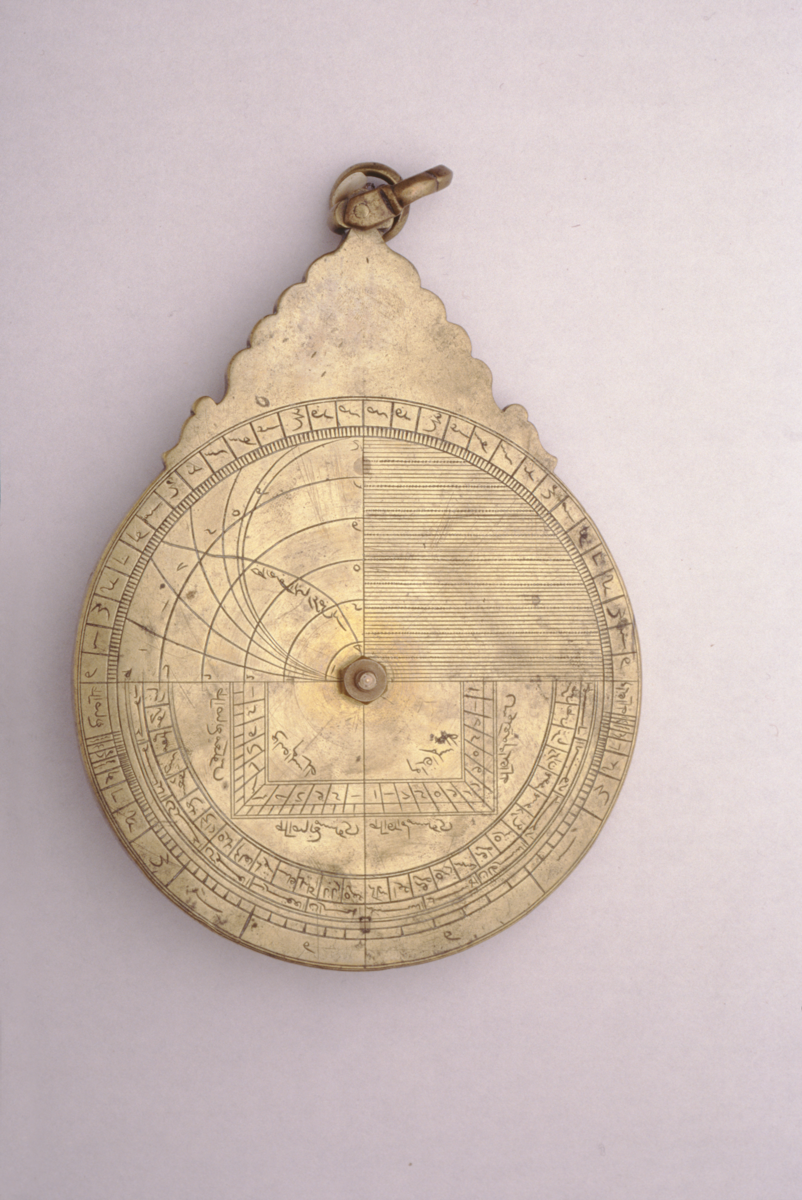
Brass planispheric astrolabe, with 4 plates and rete for 17 stars. On the reverse are a sinical quadrant, horary quadrant, geometrical quadrant. Lacks alidade.
[NOTE: On 15/04/2015 XRF analysis was conducted on this instrument. Results and analysis are given in the ‘Notes’ field.]
References
Events
Description
An astrolabe is a model of the heavens with the earth placed at the centre. A section of the heavens is projected on to the astrolabe. The co-ordinates of stars and planets are depicted on a grid called the rete. The earth is represented by latitude plates of which there are more than one. This is because the movement of the stars depends upon the latitude of the place from where the observation is made. Cambridge has a latitude of 52°, Rome 42°, Madrid 41°, and Paris 49°. Each latitude plate has circles and lines engraved on them which include the tropic of Cancer and Capricorn, the equator and a twilight line. The rete and latitude plates are housed within the mather which has a raised edge called the limb. On European astrolabes the limb is engraved with a degree scale showing 0° to 360° and / or a scale of 24 equal hours.
On the back of the astrolabe are engraved several scales including a calendar scale and a shadow square. On Islamic astrolabes extra scales and tables are engraved for finding the direction of Mecca (for times of prayer). At the back of the astrolabe is also the alidade (see diagram above). The alidade has sights through which an astronomer would take simple observations of the sun or of a particular star, to find the time of day or night. The sights can also be used for finding the heights of buildings, trees or hills.
From display label:
This astrolabe has four plates, and a rete with 17 stars. On the reverse are a sinical quadrant, an horary quadrant, and a geometrical quadrant. The alidade is missing
FM:42629
Images (Click to view full size):