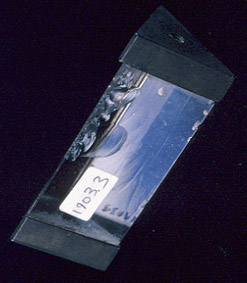
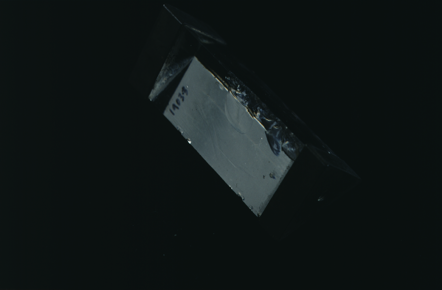
Accession No
1903
Brief Description
three prisms, 19th C (?)
Origin
Maker
Class
optical
Earliest Date
1800
Latest Date
1900
Inscription Date
Material
glass; metal (brass)
Dimensions
length variable ; breadth variable; height variable
Special Collection
Cavendish collection
Provenance
Transferred from the Cavendish Laboratory, University of Cambridge in 1974.
Inscription
Description Notes
1903.1 length 157mm breadth 31mm height27mm
1903.2 length 143mm breadth 30mm height 28mm. Glass 60˚ prism, bound in brass at both ends, with threaded holes in the brass end plates.
1903.3 length 69mm breadth 30mm height 28mm
Condition
References
Events
Description
Prism
A prism consists of a translucent piece of glass or crystal, usually triangular in cross section, which is used to separate light into a spectrum of its separate colours.
The instrument works because different wavelengths of light are refracted (bent) by different amounts as they enter and leave the prism; the shorter wavelengths (towards the blue end of the spectrum) are refracted by the greatest amount, and the longer wavelengths (towards the red end) are refracted the least. This spreads out normal white light, which is a mixture of all the different colours, into its constituent parts and produces the rainbow effect of a spectrum.
18/10/2002
Created by: Saffron Clackson on 18/10/2002
FM:42645
Images (Click to view full size):