Accession No
0372
Brief Description
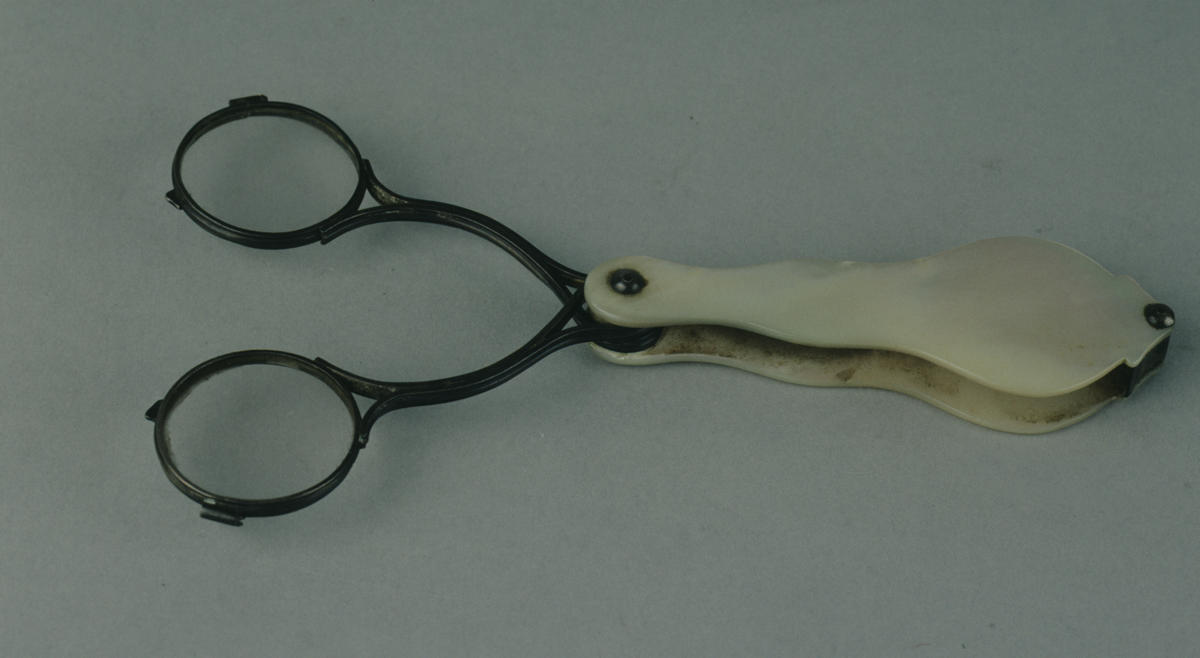
scissors-glasses, 1750-1800
Origin
Maker
Class
optical
Earliest Date
1750
Latest Date
1800
Inscription Date
Material
organic (mother of pearl); metal (silver); glass
Dimensions
length 110mm; breadth 39mm; thickness 16mm
Special Collection
Robert Whipple collection
Provenance
Purchased from R. Stein and Co., Brussels, on 02/04/1927.
Inscription
Description Notes
Double mother of pearl handle rivetted together at both ends with silver arms and mounts for plain glass lenses folding between handle.
Condition: fair; complete.
References
Events
Description
R.S. Whipple’s interests as a collector included objects from the everyday world. He was particularly beguiled by two popular ways to improve eyesight: spectacles and opera glasses. Whilst today we might not think of these items as ‘scientific’, in the 18th and 19th century both were often the bread-and-butter trade of optical instrument-makers.
17/10/2025
Created by: Hannah Price on 17/10/2025
Description
Spectacles
Usually consisting of a pair of lenses held in a frame, spectacles may have originated in the ancient civilizations of China and the Mediterranean, but early forms were crude. It was only in the 18th century that the grinding of lenses became sufficiently advanced to make then really effective for correcting sight defects. In order to correct for near sightedness, the lenses must be concave, which diverges the rays of light (angles them apart), and for long sightedness they must be convex, to angle the rays of light together.
Spectacles are not solely used for defective eyesight; the Inuit and the Yupik use wooden spectacles with very small slits in them to reduce the glare from snow and ice.
FM:42716
Images (Click to view full size):