Accession No
0205
Brief Description
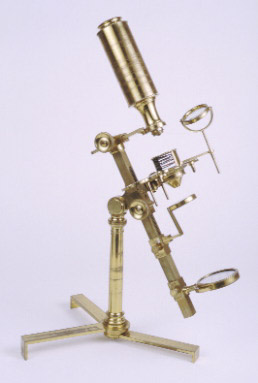
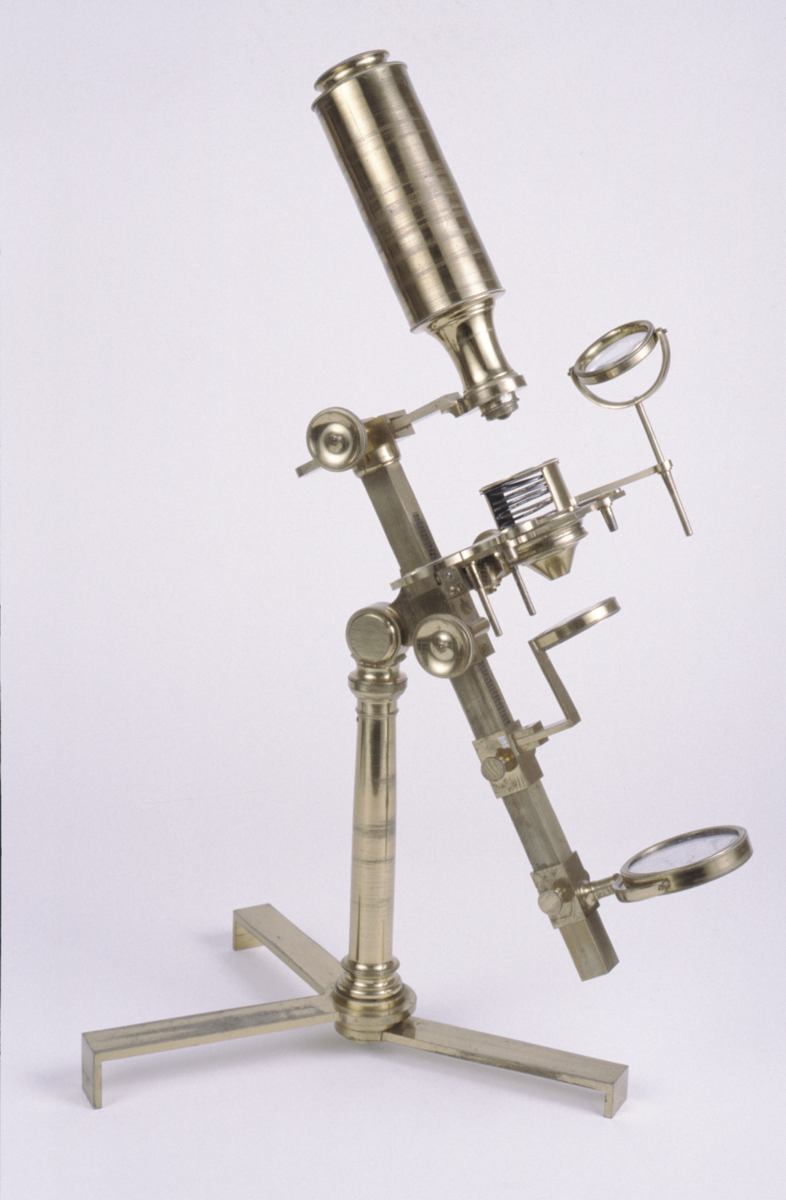
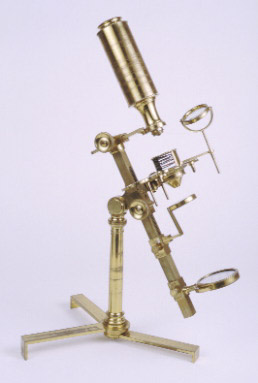
compound microscope, side pillar type; by W & S Jones; English; circa 1800
Origin
30 Holborn; London; England
Maker
W & S Jones
Class
microscopes
Earliest Date
1800
Latest Date
1800
Inscription Date
Material
metal (brass); glass; wood (boxwood, other, ebony); ivory
Dimensions
box length 326mm; breadth 248mm; height 100mm; microscope height 431mm; depth 250mm; breadth 230mm
Special Collection
Robert Whipple collection
Provenance
Acquired by Robert Stewart Whipple through T. H. Court on 21/03/1925. This object was part of the Crisp Collection, and was sold as Lot 314 at the auction of this collection held on 17/02/1925 at the Steven’s Auction Rooms.
Inscription
‘W & S JONES, 30 Holborn, LONDON’
Description Notes
Brass; folding tripod foot; brass pillar; compass joint to square-sectioned limb with rack; stage moved along rack by knurled screw; square stage with circular aperture and fittings for stage forceps etc.; substage swinging concave mirror fitted to limb with clamp; substage condenser; body tube screws to arm at the head of the stage; arm with rack operated by knurled screw, and whole turns on head of pillar giving ‘aquatic’ motion; eyepiece with 2 lenses screws to body with field lens; push fits to collar with snout and further lens. Fitted wooden box. Stage condenser lens; stage forceps; 3 boxwood slides; frog plate; 4-object live slide box; 3 4-object ebony slides, 3 4-object ivory slides; 4 lieberkuhn objectives; 1 lieberkuhn; ivory talc and ring box; 2 objectives with brass dust caps; 2 pairs of tweezers; sprung stage; wheel of 6 objectives; cone; 2 compass microscopes with ivory handles, one with lieberkuhn objective; 2 speculum holders.
References
Events
Description
Robert Stewart Whipple had a particular interest in the history of optical instruments, especially microscopes. Over the course of his life Whipple would acquire more than two hundred examples—nearly 20% of the objects in his collection. This is one of them, acquired through Whipple's trusted dealer T.H. Court in 1925.
Like many of his contemporaries, Whipple conceived of the gradual improvement of instruments in evolutionary terms. When microscopes were collected together and displayed chronologically, one could see the step-by-step advancements in optical quality and mechanical design that had led to the state-of-the-art instruments of the present day. In this way, historic instruments were vital material sources for understanding the progress of science itself.
08/10/2025
Created by: Hannah Price on 08/10/2025
FM:42774
Images (Click to view full size):