Accession No
2896
Brief Description
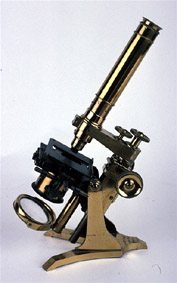
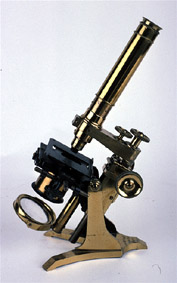
achromatic compound microscope, by Andrew Ross, English, circa 1843
Origin
England; London
Maker
Ross, Andrew
Class
microscopes
Earliest Date
1843
Latest Date
1843
Inscription Date
Material
metal (brass); glass; wood
Dimensions
height 380 mm; depth 185 mm; breadth 134 mm; box height 269mm; depth 262mm; breadth 208mm
Special Collection
Provenance
Purchased from Christie’s, South Kensington, London, England; lot 52, 21/10/1982. Purchased with assistance of a grant-in-aid administered by the Science Museum.
Inscription
‘ANDW ROSS,
LONDON
NO 86’
Description Notes
Lacquered brass; claw foot; double stand; tubular tail-piece with swinging plano concave mirror; square limb pivots between uprights; fixed stage with substage condenser and knurled pinions operating horizontal and lateral movement, triangular sectioned racked pillar fits into limb operated by knurled screw either side of limb; horizontal bar to screw fit body; draw tube marked 1-3” to 1/10”.
Fitted wooden box with assorted accessories many of which do not fit the instrument 3 eyepieces; 2 objectives (2 signed A Ross which do not fit); stand for bull’s-eye condenser; brass tweezers; 3 spare stage attachments; box for lieberkuhn and numerous other bits and pieces which do not seem to fit including a drum microscope.
References
Events
Description
Andrew Ross first described the ‘bar-limb’ microscope in 1843. With this instrument, he substantially lowered the centre of gravity in comparison with earlier models. He also altered the shape of the foot and improved the method of mounting the instrument by replacing the compass joint with trunnions mounted between two very solid supporting plates.
31/08/2006
Created by: updated by Ruth Horry on 31/08/2006
FM:42800
Images (Click to view full size):