Accession No
1535
Brief Description
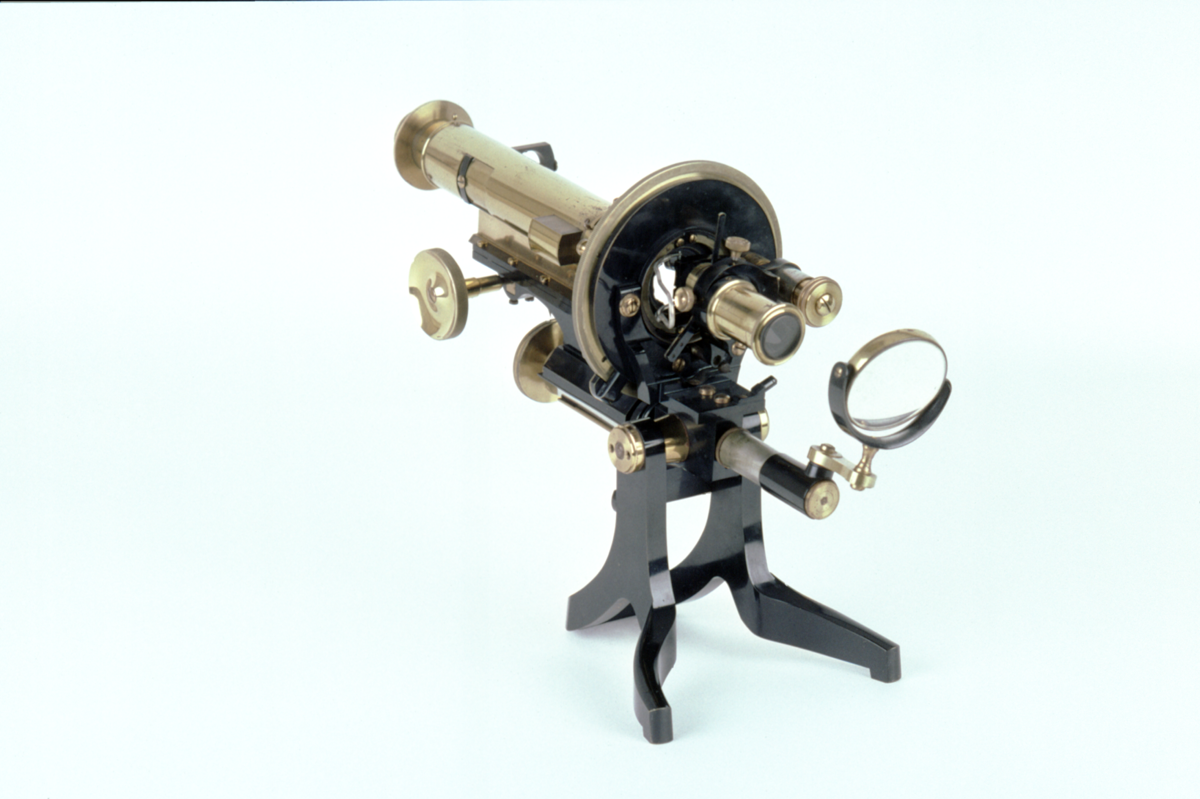
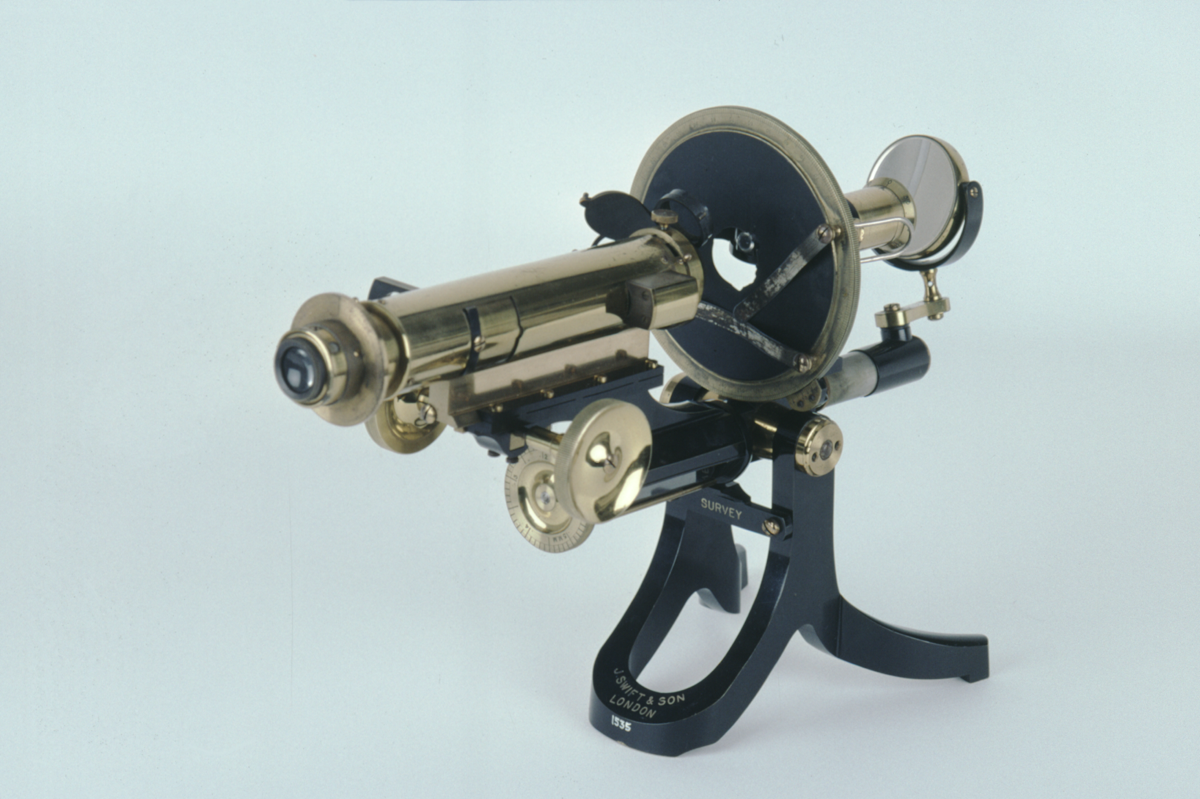
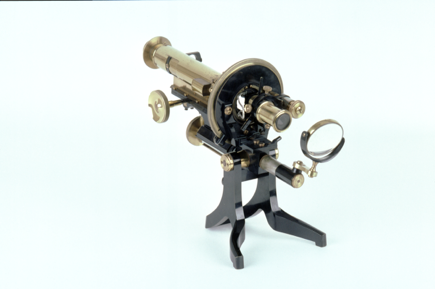
achromatic compound microscope, petrological, “Survey” model, by J. Swift and Son, English, 1920-1925
Origin
England; London
Maker
J. Swift and Son
Class
microscopes
Earliest Date
1920
Latest Date
1925
Inscription Date
Material
metal (brass, steel); glass
Dimensions
height 355mm; depth 200mm; breadth 141mm; box length 397mm; breadth 232mm; height 155mm
Special Collection
Provenance
Transferred from the Sedgwick Museum of Earth Sciences, University of Cambridge.
Inscription
‘J SWIFT & SON
LONDON
SURVEY’ (on back of the stand)
‘14583 H.V.’ (under the stand)
Description Notes
“Survey” Model; black finish with brass screws and fittings; kettledrum / claw-foot stand; pair of uprights with a brace and support for the instrument in a horizontal position; pivoting limb; circular stage with knurled brass ring divided 0 - (360) by 10 to 1; stage clips; vernier to 5’; substage mounted on a swinging arm to move it out of the optic axis when on the lowest point of a lateral screw thread; condenser with uppermost lens on a sliding shoe with a steel clip to push to away from the lower condenser; iris diaphragm; stop; polariser; divided flange 0 - (360) by 45; swinging plano / concave mirror on a brass arm from a shoe round the tailpiece; cranked moulded limb, pair of brass coarse focus screws either side of the limb; fine focus ring at the head of the column divided (0) - 5mm to 0.1; index on the back of the limb; push fit eye piece; flange below eye piece; slot below flange with brass collar; slot in sliding tube in middle of body for a Bertrand Lens and stop; slot with brass cover for micrometer; double nosepiece. 2 objectives in brass cases 1 In and 1/4 In.
References
Events
Description
This is a petrological microscope, petrology is the scientific study of the origin, composition, structure and properties of rocks. The microscopic study of which is called petrography.
The achromatic microscope
When light travels through an ordinary lens each colour is bent through a different angle. In a microscope this causes what is known as chromatic aberration, whereby a spectrum of colours will appear around the image being viewed. Chromatic aberration was a big draw back when using early versions of the compound microscope.
Chromatic aberration was overcome due to the important work by Lister in 1830 who developed the achromatic lens for microscopes. The new type of lens prevented colour separation by combining two lenses made of different types of glass. The first lens that light passed through would split the colours and the second lens acted to bring the colours back together again. This produced a much sharper and clearer image than was previously achieved.
In the Victorian period the achromatic microscope became a vital tool in medical and scientific research. Improvements to the optical performance of the microscope saw developments in the design and construction of the microscope. The microscope became sturdier and could focus to a finer level.
Scientific instrument makers in the Victorian period who improved the rigidity of the optical tube and the focusing ability of the achromatic microscope include Andrew Ross, James Smith and Hugh Powell.
FM:42826
Images (Click to view full size):