Accession No
0650
Brief Description
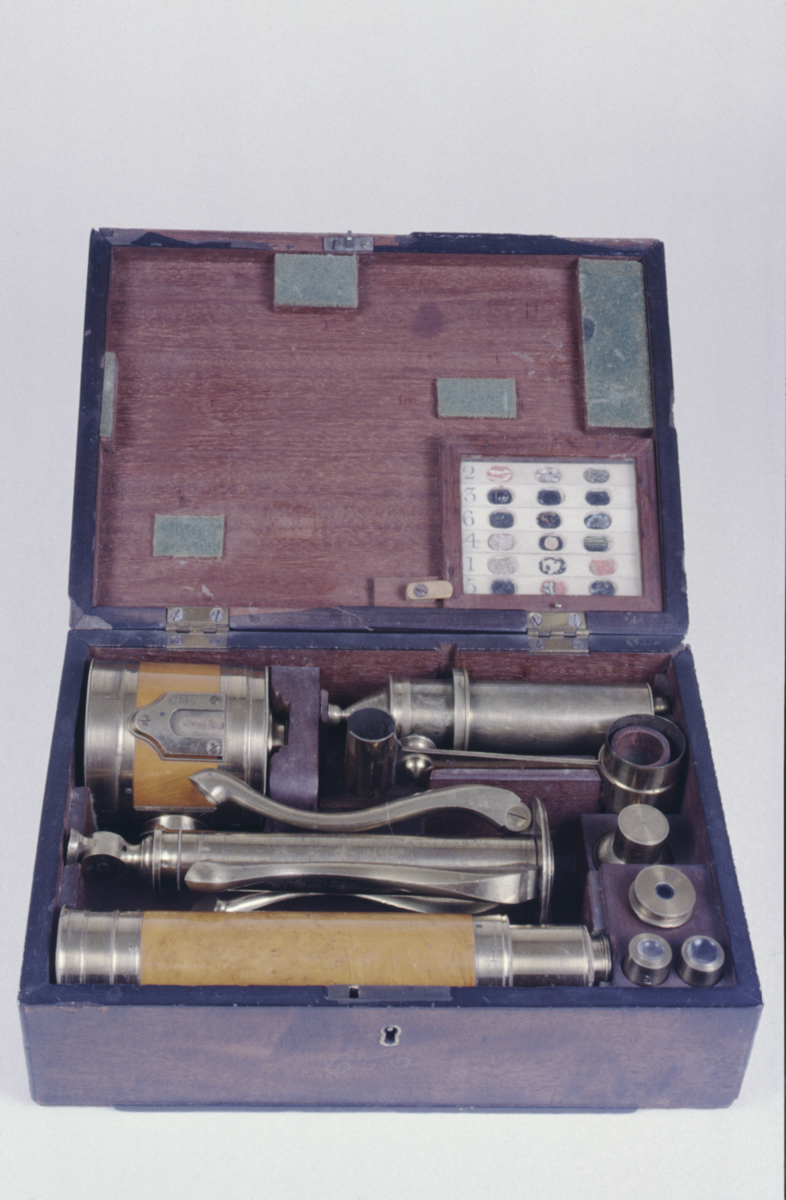
optical cabinet, telescope and simple microscope, by H. Hughes, English, 1840 (c)
Origin
England; London
Maker
Hughes, H.
Class
optical; astronomy; microscopes
Earliest Date
1840
Latest Date
1840
Inscription Date
Material
metal (brass); wood; glass
Dimensions
telescope length 176mm; microscope body length 72mm; box length 234mm; breadth 171mm; depth 76mm
Special Collection
Robert Whipple collection
Provenance
Purchased from T.H. Court on 05/11/1930.
Inscription
‘Invented and Made by H. HUGHES/ LONDON’
Description Notes
Brass. 3 legged stand to brass pillar with compass joint and shoe. Telescope. Brass ferrules with wooden body. 3 brass draw tubes numbered 1-3, 4 on body housing for shoe marked ‘6’, sliding cover for screw fit eyepiece.
Microscope body with brass shoe marked C.M6 brass ferrules with wooden body. Screw fit eyepiece with large lieberkuhn marked “M” and signed. Aperture in side of body with screw-fit brass object holder marked ‘C.M9’. Glazed end and push fit condenser lens marked ‘C.M8’
Brass tube with push fit finials either end and large steel spring marked M.5. Double arm round body to clamped socket (fits round pillar), open sided tube with screw thread one end and swinging mirror. Slot for slide. Stage forceps. Marked ‘13’. Objective lieberkuhn in brass case marked ‘G’. Various lens in brass mounts marked ‘8’, ‘7’, ‘12’, and ‘11’. Compass with 8 cardinal points and fleur-de-lis north. 6 opaque ivory slides numbered 1-6.
References
Events
Description
Robert Stewart Whipple had a particular interest in the history of optical instruments, especially microscopes. Over the course of his life Whipple would acquire more than two hundred examples—nearly 20% of the objects in his collection. This optical cabinet is one of them, purchased through Whipple's trusted dealer T.H. Court in 1930.
Like many of his contemporaries, Whipple conceived of the gradual improvement of instruments in evolutionary terms. When microscopes were collected together and displayed chronologically, one could see the step-by-step advancements in optical quality and mechanical design that had led to the state-of-the-art instruments of the present day. In this way, historic instruments were vital material sources for understanding the progress of science itself.
08/10/2025
Created by: Hannah Price on 08/10/2025
FM:42834
Images (Click to view full size):