Accession No
1823
Brief Description
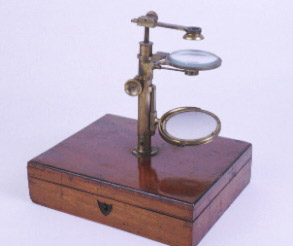
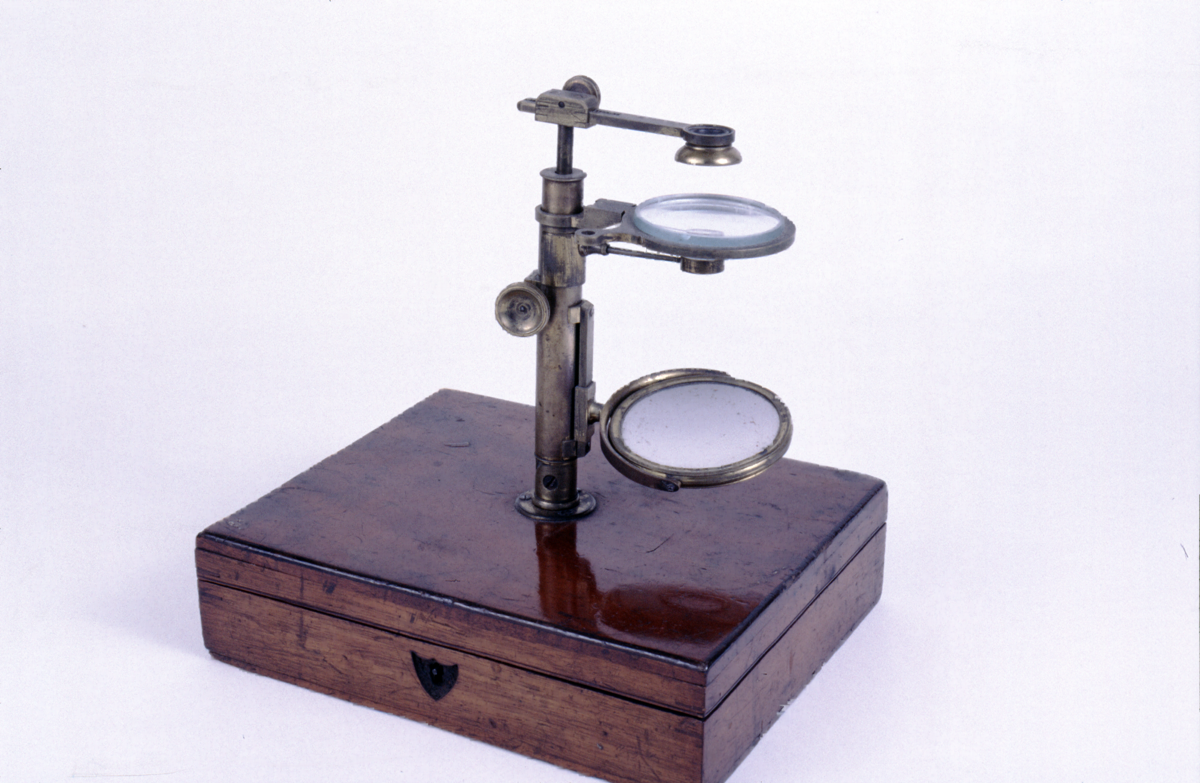
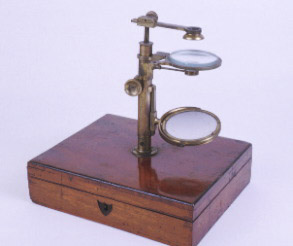
simple microscope, aquatic type, by Bancks [Banks] and Son, English, 1820-1827
Origin
England; London; Strand
Maker
Bancks (Banks) and Son
Class
microscopes
Earliest Date
1820
Latest Date
1827
Inscription Date
Material
metal (brass, steel); glass (mirror)
Dimensions
box length 213mm; breadth 175mm; height 55m
Special Collection
Heywood collection
Provenance
Purchased from the H.Heywood collection under estate duty exemption benefit with the assistance of a Science Museum grant-in-aid.
Inscription
“BANCKS & SON Strand London Instt. Makers to HIS MAJESTY”
Description Notes
Brass; hinged pillar screws into lid of box; swinging concave mirror, with small plain mirror on reverse mounted on bar parallel to pillar on an slide; rack and pinion focus; circular stage slots into shoe at the head of the pillar; inner pillar hollow with fitting for rod with pinion turning over rack on lens holder; watch glass; eight lenses six marked ‘1’-’6’; the two remaining with lieberkuhns; black steel disc; hand lens.
References
Events
Description
Growing interest throughout the eighteenth century in natural history, and more particularly in pond-life, stimulated the development of the “Aquatic” microscope. This was initially designed by John Ellis (1710 - 1776) and is therefore often referred to as the “Ellis Aquatic”.
Ellis, a peripatetic naturalist, commissioned his first instrument in 1752 from John Cuff. It was designed to hold small samples of pond-water on a watch-glass stage. In this way the microscopic creatures contained in it could be observed. Several of these microscopes have dissecting tools as part of the kits and could also be used for microscopic dissection.
FM:42845
Images (Click to view full size):