Accession No
2173
Brief Description
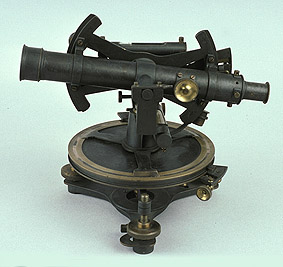
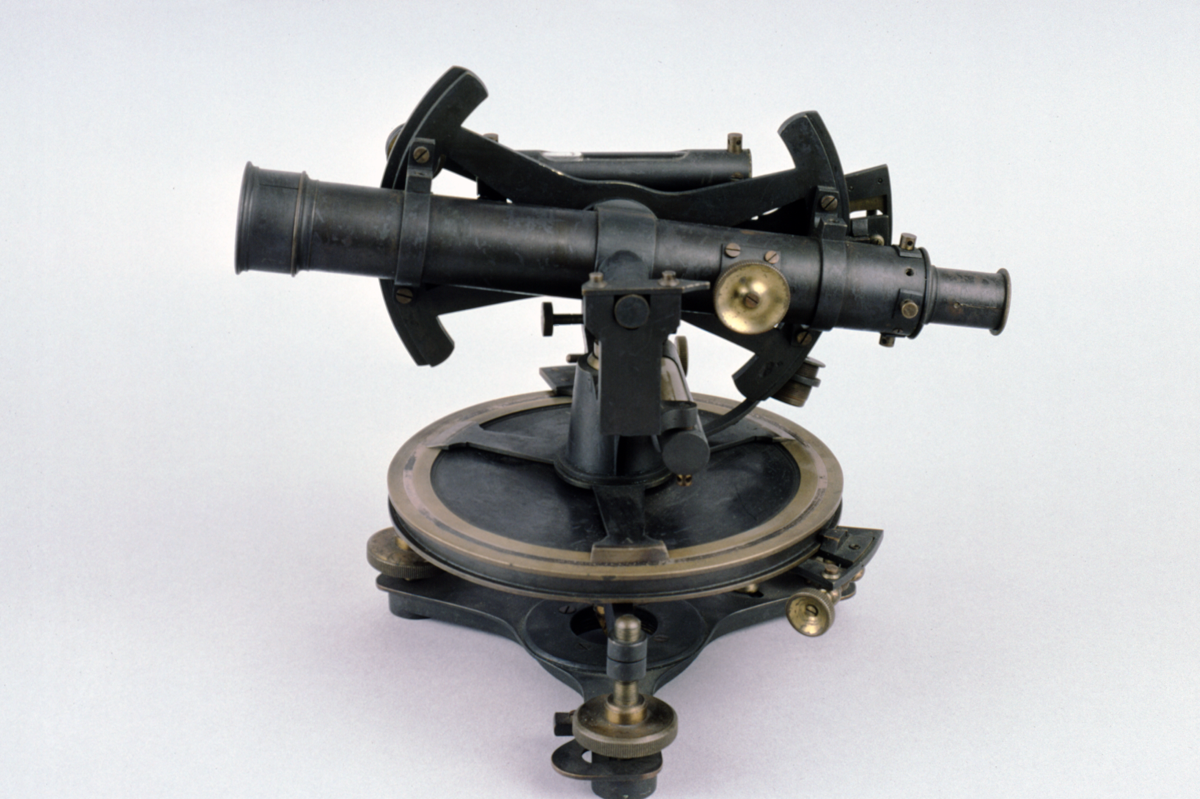
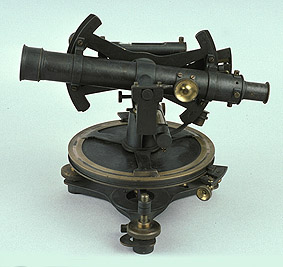
6-inch Everest theodolite, by Thomas Jones, English, 1880 (c)
Origin
England; London; 1 Rupert Street
Maker
Jones, Thomas
Class
surveying
Earliest Date
1880
Latest Date
1880
Inscription Date
Material
metal; glass
Dimensions
length 245mm; breadth 187mm; height 208mm
Special Collection
Provenance
Transferred from Department of Geography, University of Cambridge, Cambridge, England, 05/1969.
Inscription
‘Thomas Jones 1 Rupert St. London
285
[logo]’ (on horizontal circle)
Description Notes
6-inch Everest theodolite, by Thomas Jones, English, c. 1880.
Telescope with rack and pinion focus moving the objective. Inverting, sliding eyepiece. Lens cap. Bubble mounted on right, outside vertical arcs; no graduations. Vertical arcs with silvered scale divided 40 - 0 - 40˚, subdivided to 20’ of arc; read by 2 opposing verniers and microscopes to 1’ of arc. Objective end scale also has Diff. of Hypo and base scale divided 25 - 0 - 25. Clamp and motion screws for vertical motion. Clipping screws.
Two short standards project from central pillar to support telescope. Bubble mounted on pillar. Horizontal silvered circle divided 0 - 360˚, subdivided to 20’ of arc. Read by 3 vernier plates, projecting on arms from central pillar, to 30” of arc; single microscope. Clamp and motion screw for vernier plate and horizontal circle. 3 levelling feet on tribrach limbs onto clamped base plate with central threaded hole for attachment to tripod.
References
Events
Description
The theodolite is a relatively, simple tool used for measuring angles, both horizontal and vertical. They work using the same principles as a protractor, the ‘point A’ is located and the angle noted, and then the telescope is pointed at ‘point B’ and the second angle is taken.
Although primarily used in surveying the theodolite can be applied to both meteorology and navigation.
Gemma Frisius proposed the idea behind the theodolite in 1533. At the time new methods of surveying were being used and by combining an Alidade, a magnetic compass and the degree scale on the back of an Astrolabe, the calculations made by modern theodolites could be observed. Unfortunately, this method was not practical due to the combination of instruments. The best of the attempts to simplify the process was the ‘theodolitus’, first described in print by Leonard Digges in 1571.
However, this instrument could only take measurements in the horizontal plane. Despite this it was still thought of as the ‘common’ Theodolite up to the late 18th century.
During the 19th century the Altazimuth Theodolite was considered the most useful theodolite, as it could measure on the horizontal and vertical planes. Three notable types of Altazimuth Theodolite were developed: The Everest Theodolite, the Plain Theodolite and the Transit Theodolite. It is the Transit Theodolite, which is still used today.
FM:42913
Images (Click to view full size):