Accession No
0742
Brief Description
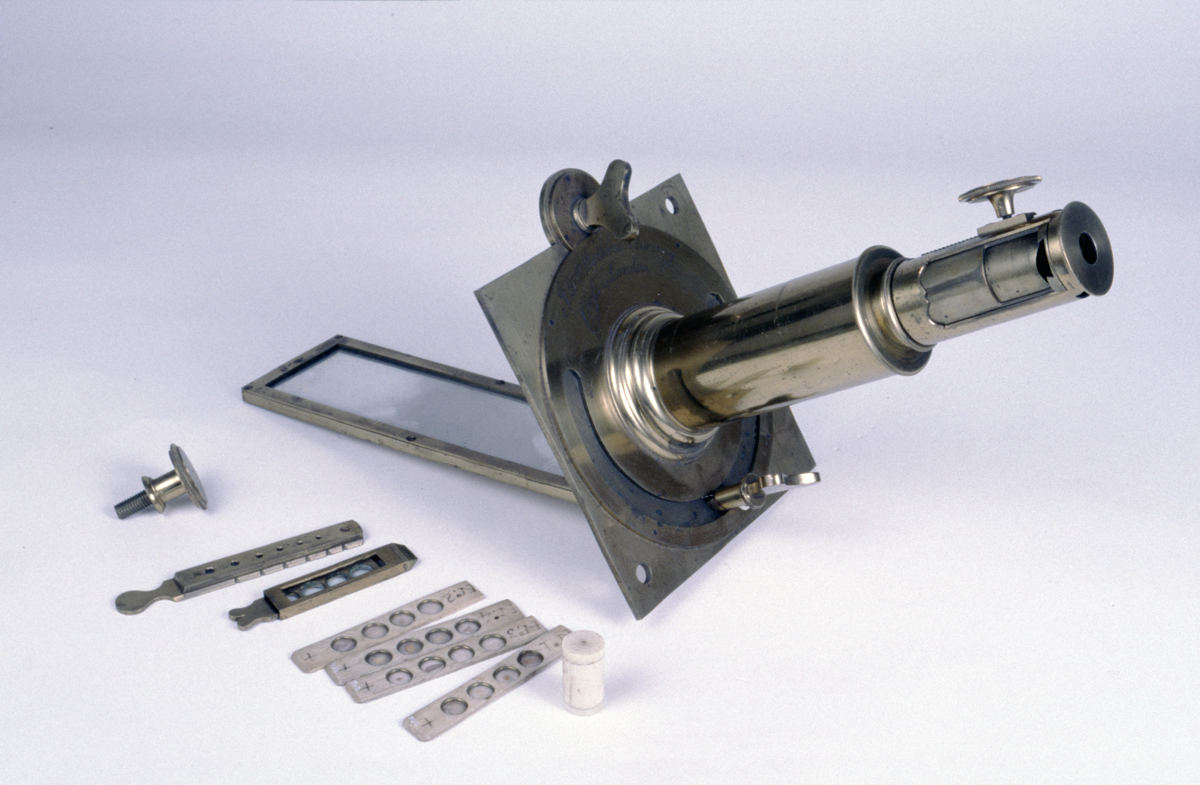
solar microscope, by J. and W. Watkins, English, 1791-1808
Origin
England; London; Charing Cross
Maker
J. and W. Watkins
Class
microscopes
Earliest Date
1791
Latest Date
1808
Inscription Date
Material
metal (brass, steel); glass; ivory; wood
Dimensions
box length 248mm; breadth 160mm; height 87mm
Special Collection
Robert Whipple collection
Provenance
Purchased from L.H. Spero, Harrow, England, in 08/1933.
Inscription
‘J & W Watkins Charing
Cross London’
Description Notes
Brass; square plate with circular inner ring; pinned to rectangular mirror mounted on racked semicircle and moved by key headed screw; second key headed screw rotates racked circle and mirror; 2 screw holes with 2 knurled screws for attachment to shutter; screw fit body with condenser lens; draw tube; screw fit screw barrel type transparent-object body with rack focus; 2 part brass stage with steel spring; 6 objective slider; live slide; 4 4-object ivory slides; ivory talc and ring box.
Fitted wooden case.
References
Events
Description
R.S. Whipple had a particular interest in the history of optical instruments, especially microscopes. Over the course of his life Whipple would acquire more than two hundred examples—nearly 20% of the objects in his collection. This is one of them, purchased in Harrow in 1933.
08/10/2025
Created by: Hannah Price on 08/10/2025
Description
A solar microscope acts like a magic lantern, projecting a magnified image onto a screen where many could see it simultaneously. As such, they were commonly used for teaching.
It is worked in a dark room. The sun's rays fall on a plane mirror placed outside the room, and are reflected toward a condensing lens and then on to to a second lens by which they are concentrated at its focus. The object to be magnified is at this point, and its image is projected onto a screen beyond it.
FM:42972
Images (Click to view full size):