Accession No
1806
Brief Description
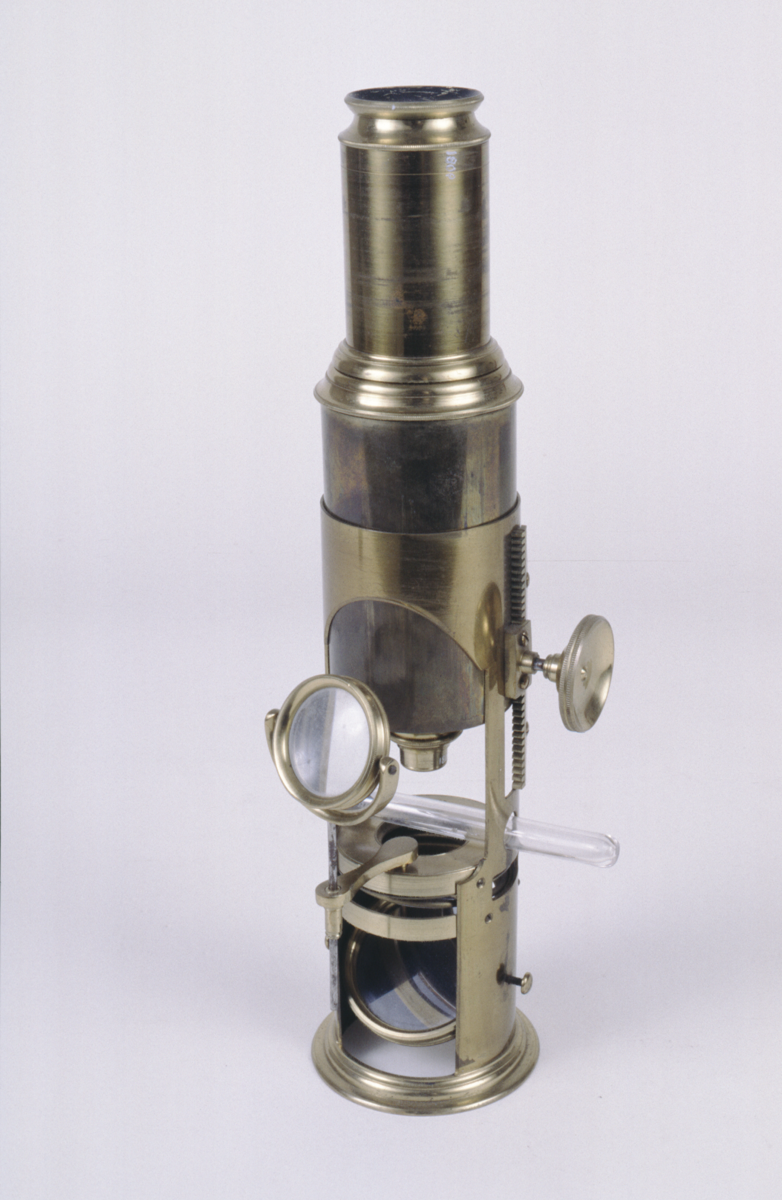
compound microscope, drum type, by J. P. Cutts, Sons and Sutton, English, 1845 (c)
Origin
England; Sheffield
Maker
J. P. Cutts, Sons and Sutton
Class
microscopes
Earliest Date
1845
Latest Date
1850
Inscription Date
Material
metal (brass); glass; ivory; wood; cloth (velvet)
Dimensions
box length 286mm; breadth 151mm; height 80mm
Special Collection
Heywood collection
Provenance
Purchased from the H.Heywood collection under estate duty exemption benefit with the assistance of a Science Museum grant-in-aid.
Inscription
‘J.P. Cutts Sons & Sutton
Opticians to Her Majesty
Sheffield’
Description Notes
Brass open sided cylinder; swinging concave mirror in base; sprung stage; slots in cylinder for slide and glass tube; racked edge with knurled screw on collar; collar divided 1-6; push fit body with screw fit objective and screw fit mount for field lens and eyepiece.
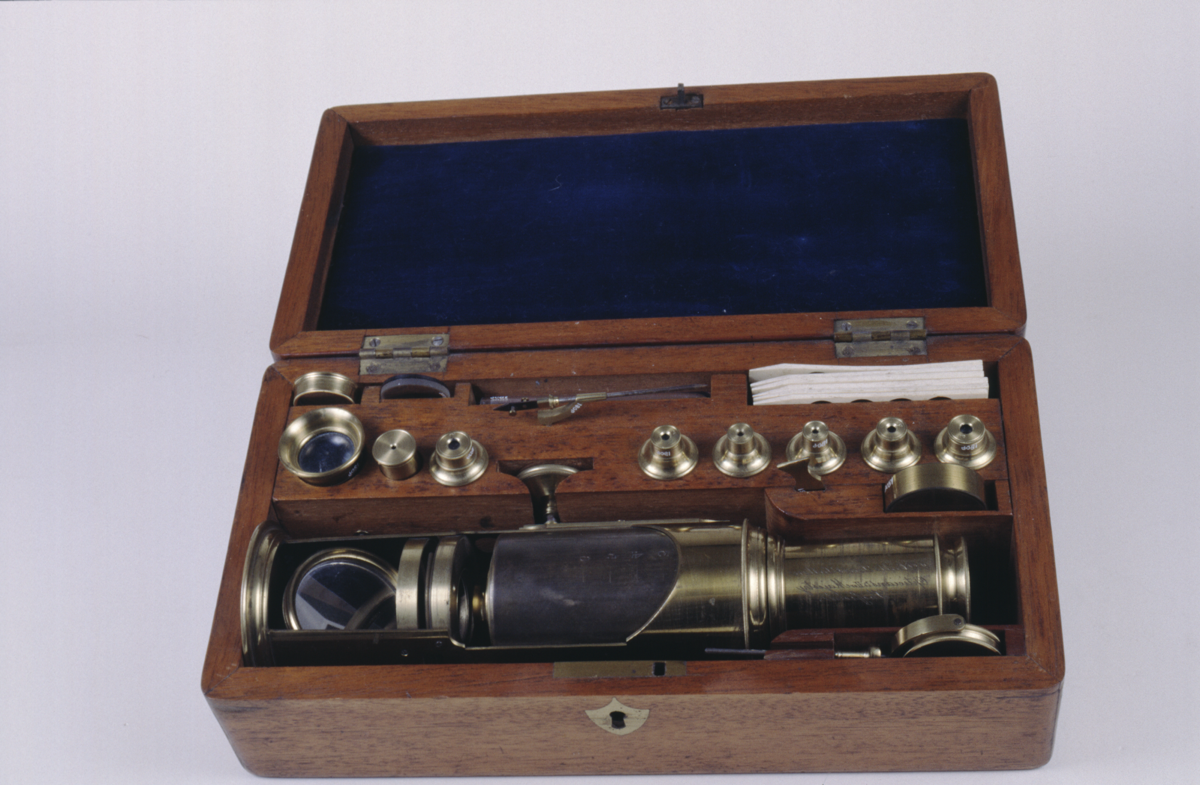
Six objectives marked 1-6; brass talc box; six 4-object ivory slides; glass tube; black and white ground; stage condenser; stage forceps; watch glass; live box; hand magnifier; forceps; circular trough.
Fitted wooden box lined with blue velvet with an internal drawer for talc’s etc.
condition: good; complete
References
Events
Description
The compound microscope was developed during the 17th Century and was closely related to the refracting telescope. Its popularity increased after the publication of Robert Hooke’s (1635-1703) Micrographia in 1665. Micrographia contained detailed pictures, never before seen, of insects magnified using a compound microscope.
A compound microscope uses two or more lenses. The lenses are held at certain distances from each other and are mounted inside a rigid tube. The tube was usually made from pasteboard, ivory, or most commonly, brass. The basic compound microscope magnifies an image in two stages -
Stage one: Light from a mirror is reflected up through the specimen into a powerful objective lens.
Stage two: The image produced by the objective lens is magnified again by the eye lens, which works like a simple magnifying lens.
The first compound microscope consisted of a simple barrel which would have been held up to the light. Later developments ensured that the compound microscope had a stable base, usually a brass stand and a side pillar.
In the 17th Century, the compound microscope had some serious drawbacks which made it easier to use a simple microscope (which have only one lens) instead. The image produced by a compound microscope was often affected by two types of aberrations known as chromatic and spherical. These aberrations caused blurring to the image (spherical) and the edge of the specimen to colour (chromatic). Chromatic aberration was removed at the end of the 18th Century by Harmanus van Deijlan, an instrument maker in Amsterdam. In 1830, spherical aberration was overcome by Joseph Lister, who developed the achromatic lens. Achromatic lenses became widely used in microscopes in the 1850s and are still used today.
Created by: Corrina Bower
FM:42974
Images (Click to view full size):