Accession No
2755
Brief Description
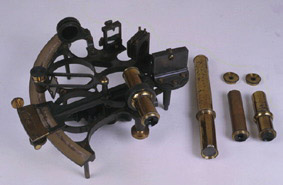
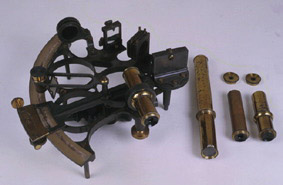
sextant, by Elliott Brothers, English, 1893 (c)
Origin
England; London
Maker
Elliott Brothers
Class
navigation
Earliest Date
1893
Latest Date
1900
Inscription Date
Material
metal (oxidised brass, brass, silver); glass; wood (ebony)
Dimensions
box length 256mm; breadth 245mm; height 128mm
Special Collection
Provenance
Transferred from Estate Management, University of Cambridge, Cambridge, England, 06/1981.
Inscription
‘ELLIOTT BROS. LONDON’
‘814’
Description Notes
Sextant, by Elliott Bros., English, 1893 (c).
Triple circle oxidised brass frame. Index mirror with 4 shades. Adjustable horizon glass with 3 shades. Mount for telescopic sight with lateral adjustment by knurled screw. 2 screw-fit brass telescopes, screw-fit dark tube (?; long screw fit tube with grid; 8-2-2000), 1 push-fit brass tube with parallel wires, 2 screw-fit eyepiece filters (one stuck in box; 8-2-2000). Reinforced index arm with pivoted reading microscope and reflector, type-B vernier on silver, clamp and tangent screws. Main scale divided on silver [-5]-[160] by 1˚, subdivided to 10’. Ebony handle with brass fitting for stand, 3 feet. Fitted box with Class A Kew Certificate, dated 6-1893. (Hook fastening missing). Brass owner’s plate detached.
Condition: good; incomplete? (parts missing?).
References
Events
Description
This instrument is a typical late-19th century sextant with a Kew ‘Class A’ certificate. The Government organised sextant and chronometer testing at Kew Observatory and makers submitted instruments for certificates of different grades. With a certificate, a sextant would command a higher price.
More on sextants and navigation
Today navigation instruments such as radar, radio and satellites update a ship’s position continuously. During the 17th and 18th centuries manual calculations had to be made using instruments such as the backstaff, octant or sextant.
The term “sextant” refers to an arc of 60°. The sextant is a portable instrument that measures angles between distant objects. It is an instrument that has been used in the fields of astronomy, surveying and navigation. When navigating, the sextant is used to measure latitude to an accuracy of 0.01 of a degree. To use the sextant the navigator moves the index arm until the index mirror appears to line up the sun within the horizon mirror. By reading the angle off the index arm, the angle of the sun (and therefore the ship's latitude) can be calculated.
Much thought was put into the design for the sextant in an attempt to make them as accurate as possible. The first examples of sextants were made of brass and were mostly large and heavy. Over time the frame was designed to be rigid and light. A successful and popular design in the 18th Century was the “double-frame” or “pillar frame” sextant which was patented by Troughton in 1788. An example of this sextant can be seen in the navigation case.
The Search for Longitude
The sextant was also used in an attempt to determine longitude as well as latitude. In the 1750’s Tobias Mayer’s design of a reflecting circle was given to the British Board of Longitude who gave the instrument to Captain John Campbell to test fully at sea. Campbell liked the idea but found the circle too awkward to use. John Bird was ordered by Campbell to design a 60° arc (the sextant), which he thought to be adequate for the longitude measurements required. (To discover more about the search for longitude have a look at some of the books).
31/08/2006
Created by: updated by Ruth Horry on 31/08/2006
FM:43034
Images (Click to view full size):