Accession No
2353
Brief Description
sector, English, 19th Century
Origin
England
Maker
Class
calculating; mathematics
Earliest Date
1800
Latest Date
1900
Inscription Date
Material
ivory; metal (brass)
Dimensions
length closed 159mm; breadth 37mm; thickness 3mm
Special Collection
Provenance
Bequeathed by R.S. Newall, 1978.
Inscription
Description Notes
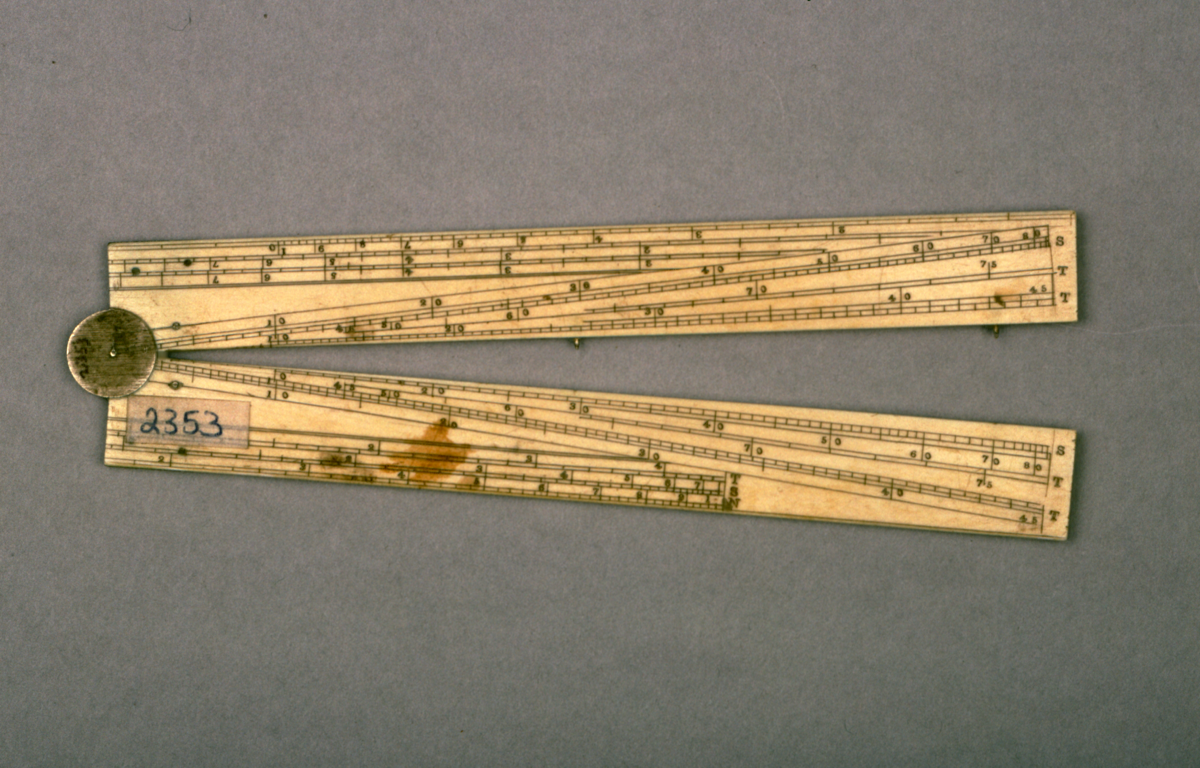
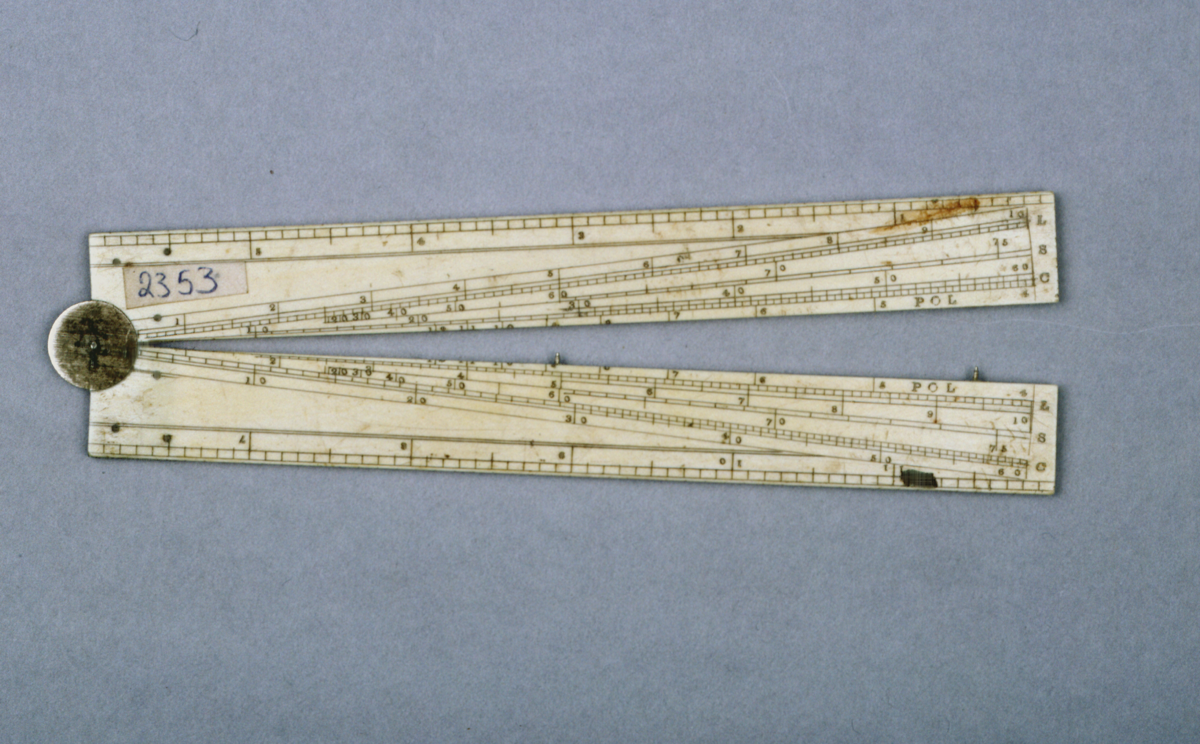
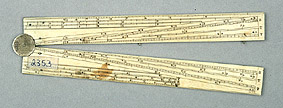
Ivory sector with brass hinge and locating pins.
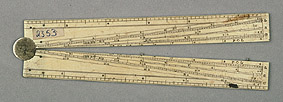
Obverse: asymmetric double scales of: ‘L’ (lines), divided [0] - 10, numbered by 1, subdivided to 0.1; ‘S’ (secants), divided 20˚ - 75˚, numbered by 10˚, subdivided to 1˚; ‘C’ (chords), divided [0] - 60˚, numbered by 10˚, 0 - 30 subdivided to 1, 30 - 60 subdivided to 30´; ‘POL’ (polygons), divided 12 - 4, numbered by 1. On the fully opened limbs a single scale of inches, divided [0] - [12], numbered by 1 (except 6), subdivided to 0.1.
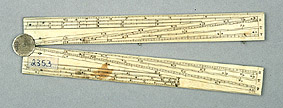
Reverse: asymmetric double scales of: ‘S’ (sines), divided [0] - [90˚], numbered by 10˚, 0 - 60 subdivided to 1, 60 - 80 subdivided to 2, 80 - 85 subdivided to 2˚ 30´; ‘T’ (tangents), divided 45˚ - 75˚, numbered by 10˚, subdivided to 1˚; ‘T’ (tangents), divided [0] - 45˚, numbered by 10˚, subdivided to 30´. On the fully opened limbs, single scales of: ‘T’ (log tangents), divided [1˚ 10´] - [45˚], numbered 2, 3...7, 2[0], 3[0], 4[0]; ‘S’ (log sines), divided [1˚] - [90˚], numbered 2, 3...1[0], 2[0]...7[0]; ‘N’ (log numbers), divided [1] - 10[0], numbered 2, 3...10, 2[0], 3[0]...10[0]. Brass studs inlet at significant points on scales.
On fully opened outer edge of limbs, a decimal foot, divided [0] - [100], numbered by 10 (except 50), subdivided to 1.
Condition good (some staining); complete.
References
Events
Description
Sectors were used for calculation by navigators, surveyors, gunners and draftsmen (and, famously, by Galileo) from the about the mid-16th Century to the mid-19th Century. During the 16th Century, they were used as general mathematical tools, but the introduction of logarithms drastically expanded their application. Usually made of brass, wood or ivory, they look like a jointed rule with scales engraved on either side.
Sectors use the principle of similar triangles (that the ratio of lengths of two sides of similar triangles will always be the same) with scales of proportion for calculating mathematical functions such as finding the line of equal parts, inscribing a rectangular polygon inside a circle of a given radius and protracting angles. This made them useful for similar calculations to a slide rule.
18/10/2002
Created by: Saffron Clackson on 18/10/2002
FM:43071
Images (Click to view full size):