Accession No
0306
Brief Description
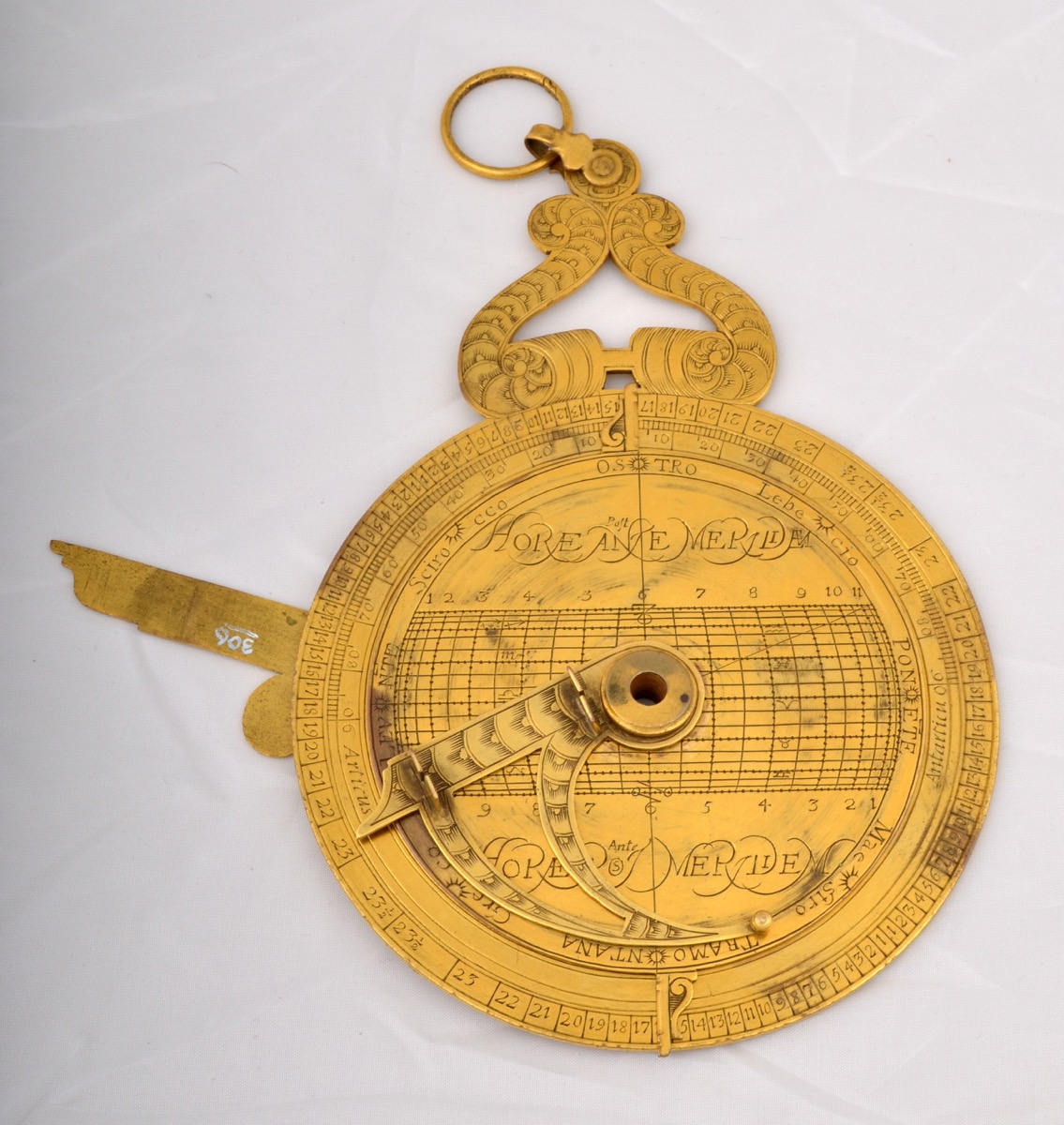
gilt brass nocturnal, purportedly by Antonius Giamini, but actually a c. 1920 fake
Origin
Netherlands; Amsterdam [possible, see Price 1956]
Maker
fake, unknown maker Giamini, Antonius [purported]
Class
dials
Earliest Date
1920
Latest Date
1920
Inscription Date
Material
metal (gilt copper)
Dimensions
length 200mm; diameter 120mm
Special Collection
Robert Whipple collection
Provenance
Purchased from Gertrude Hamilton (trading as 'Mercator’), Paris, on 20/04/1928. Copy after the original in the Mensing Collection (331).
Inscription
‘Antonius Giamini fecit Romae’ (? cannot find this; 28-1-2000)
Description Notes
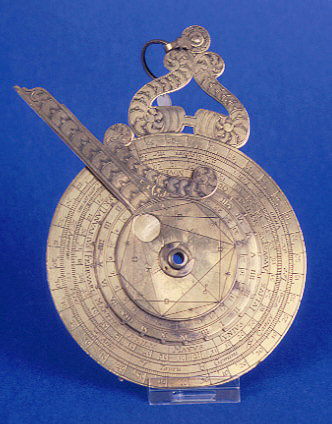
Gilt brass with pierced scroll handle, suspension shackle and ring. Fixed calendar disc divided ‘IANVARIUS - DECEMBER’, numbered by 10 days and subdivided to 1 day. Zodiac scale divided to marked symbol, numbered by 10˚, subdivided to 1˚. 1st Aries at 20 March. Rotatable disc has hour scale divided I - XII, I - XII, numbered by I; also lunar age scale divided 1 - 2 1/2 (1-29 1/2; 28-1-2000), numbered by 1; index with inscribed sun; cogs at each hour. Rotating index with central aperture and full moon, rotating over a phase diagram.
Reverse: outer edge divided 1 - 23 1/2, 23 1/2 - 1 twice, numbered by 1. ‘Antarticu’ 90 - [0] - 90 Articus by 10 to 1, with an index either side of a rotating volvelle. 8-point wind rose round the edge of the volvelle, named in Italian. De Rojas projection across the centre. Rotating alidade marked ‘horae ante meridiem / post’.
Copy of an object in the Mensing collection, which itself is now believed to also be a forgery.
[NOTE: On 15/04/2015 XRF analysis was conducted on this instrument. Results and analysis are given in the ‘Notes’ field.]
References
Events
Description
The 'Mensing forgeries'
In 1956 Whipple Museum curator Derek Price discovered that antique scientific instruments had attained the status of fine art in one specific and unwanted sense: they were being faked. Starting with an investigation of a single suspect instrument, Price soon found that the problem of instrument forgery was greater than any one object or any single collection.
Price began work at the Whipple Museum in 1951 on a project entitled ‘The History of Scientific Instrument Making’. It was his PhD supervisor, Rupert Hall, who put Price on to the question of authenticity. He soon found several pieces of evidence that confirmed Hall’s suspicions.
Price identified a total of five instruments in the Whipple’s collection that were definitely fake. In each case, the forgery could be matched to at least one other identical object in a collection elsewhere in Europe.
Price traced all of these instruments back to a single source, the Amsterdam auction house Frederick Muller & Co., which in the early 20th century had been under the direction of the collector and dealer Anton Mensing. Every fake identified by Price was a copy of an instrument sold in two sales run by Mensing. This nocturnal, along with an astrolabe, Wh.0305), were both copied from items listed in a 1924 sale of Mensing’s personal collection.
07/10/2026
Created by: Hannah Price on 07/10/2026
Description
The Whipple Museum was intended from its outset to be first and foremost an academic institution: “a cultural accessory to modern research”.
Since 1944, the Museum has been proud to honour and maintain this legacy. A vibrant Department of History and Philosophy of Science has flourished around the museum. This is just one of the objects from R.S. Whipple’s founding collection that remains a crucial resource for research into past science.
*The ‘Mensing’ fakes*
In the early 1950s as part of his PhD work, scholar Derek de Solla Price made a startling discovery. Amongst the many gems in the Whipple collection were a small number of forgeries. These were the first fake scientific instruments to have ever been publicly identified. Price explained his findings to R.S. Whipple, who "took it very well, understanding the various dubious points ... when his critical attention was drawn to them." More recently, curators in the Museum have extended Price's work and found at least two more fake pieces.
17/10/2025
Created by: Hannah Price on 17/10/2025
Description
Nocturnal
Nocturnals have been known since at least the 10th Century, and may date from even earlier times. They were generally designed for sailors’ use, to find the time at night by the stars. Most of the ones used on board ship would have been made of wood. However, many metal nocturnals with elaborate decoration also survive.
Various different stars can be used to find the time at night. But the most common ones that nocturnal-makers chose were the Pole Star and the Great Bear. The inner disc of the nocturnal was adjusted so that the short pointer was positioned over the correct date. Then the instrument was lifted up until the user could see the Pole Star through the central hole. With the nocturnal still in this position, the long pointer was turned until it lined up with the two ‘pointer’ stars at the end of the Great Bear. Where the edge of the pointer crossed the inner disc it would show the time.
Many nocturnals had teeth carved into the inner disc to mark the hours so that the time could be read in the dark, by counting round the number of teeth between the big pointer and the small one.
FM:43166
Images (Click to view full size):