Accession No
1149
Brief Description
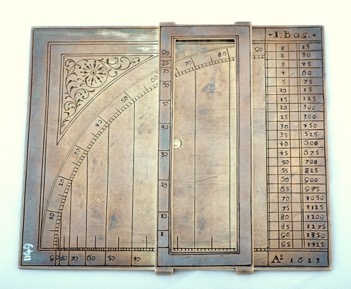
sine/cosine calculator, in silver, purportedly by Johannes Bos, 1623, but actually a c. 1920 fake
Origin
Netherlands; Amsterdam [possible, see Price 1956]
Maker
fake, unknown maker Bos, Johannes [purported]
Class
horology; calculating
Earliest Date
1911
Latest Date
1925
Inscription Date
1623
Material
metal (silver); hide (leather)
Dimensions
case length 88mm; breadth 84mm; thickness 15mm
Special Collection
Provenance
Derek de Solla Price, as part of his research into possible fakes in the Whipple collection published in 1956, asserts that this is a copy of the original sine/cosine calculator sold in sale of Mensing Collection. Donated by Robert S. Whipple in 06/1952. Purchased by Robert S. Whipple from Antique Art Galleries, Grafton Street, London, in 06/1952.
Inscription
‘I BOS Ao 1623’
Description Notes
Sine/cosine calculator, in silver, fake, c. 1920, (purports to be by J. Bos, 1623).
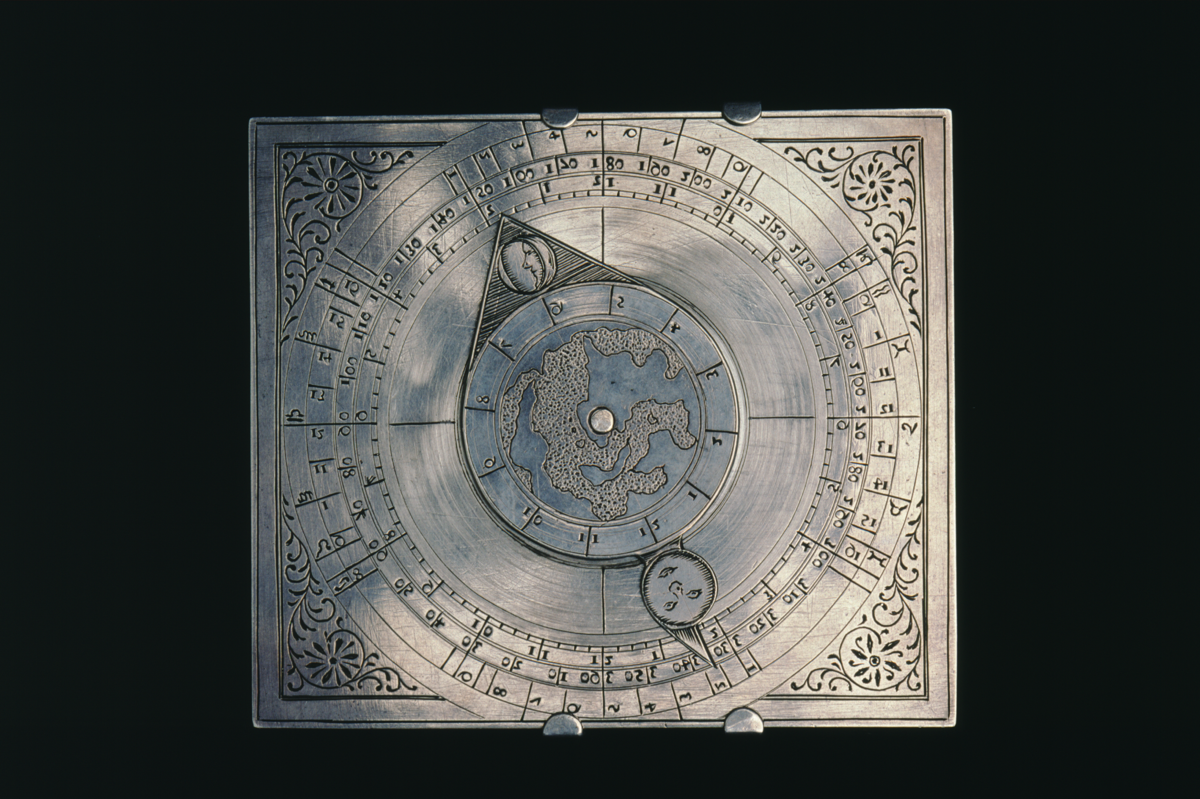
Circles divided 1-12 twice by 1 to 15´and 0 - 360˚ by 10˚ and 1 - 9 twice, and the signs of the zodiac, 6 either side (next to numbers 8,9,1,11-16; 28-1-2000). Rotating volvelle with sun and moon index divided 1- 12.
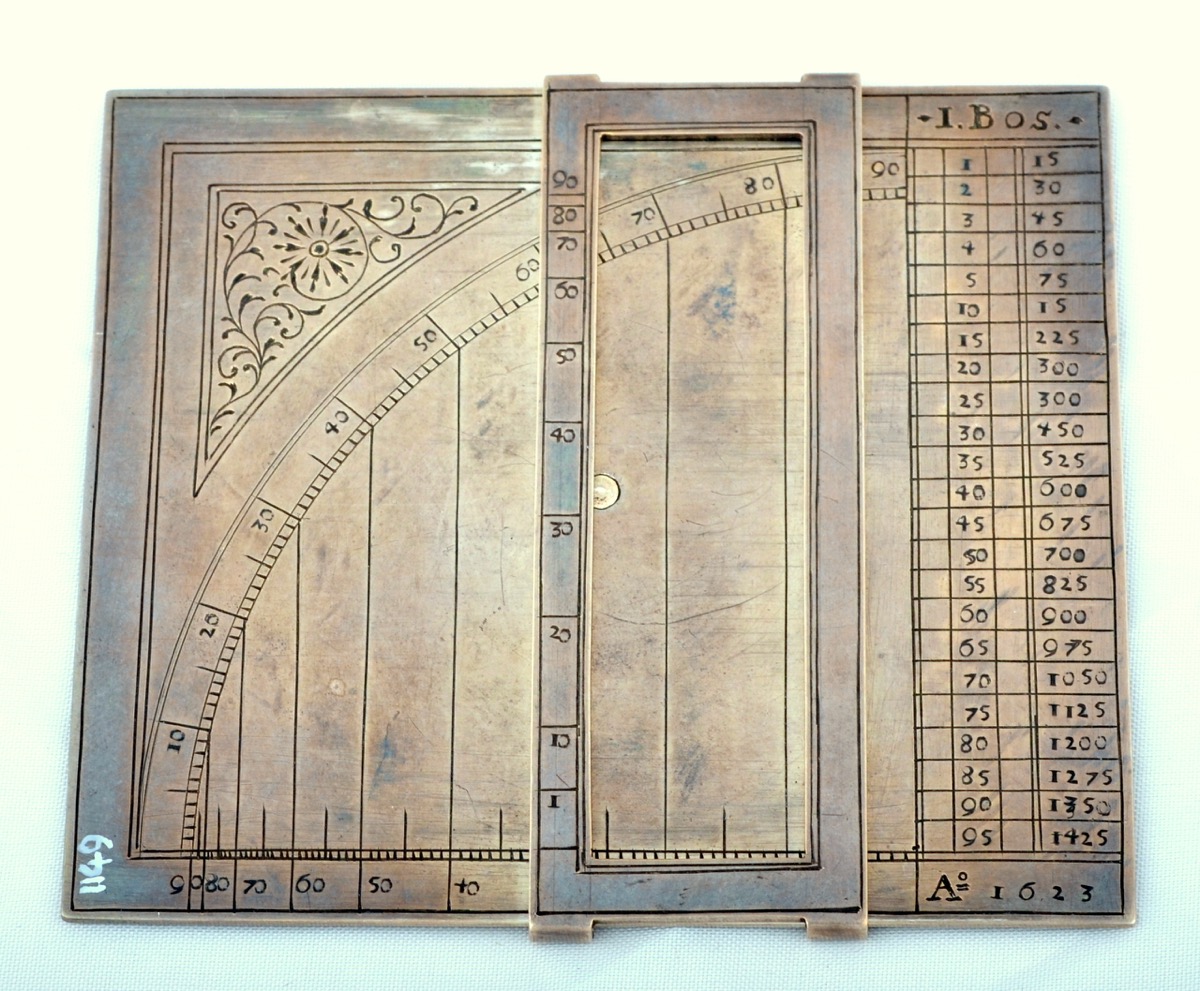
Verso arc divided [0] - 90˚ by 10 to 1, and a diminishing scale along the bottom; sliding bar divided 0 - 90˚; table at one end.
Slip case.
Complete.
[NOTE: On 15/04/2015 XRF analysis was conducted on this instrument. Results and analysis are given in the ‘Notes’ field.]
References
Events
Description
This sine/cosine calculator was not made by Johannes Bos in the 17th century: it is a 1920s forgery.
In 1956 Whipple Museum curator Derek Price discovered that antique scientific instruments had attained the status of fine art in one specific and unwanted sense: they were being faked. Starting with an investigation of a single suspect instrument, Price soon found that the problem of instrument forgery was greater than any one object or any single collection.
Price found a total of five instruments in the Whipple’s collection that were definitely fake. In each case, the forgery could be matched to at least one other identical object in a collection elsewhere in Europe.
Price traced all of these instruments back to a single source, the Amsterdam auction house Frederick Muller & Co., which in the early 20th century had been under the direction of the collector and dealer Anton Mensing. Every fake identified by Price was a copy of an instrument sold in two sales run by Mensing. This instrument was copied from a 1911 sale of the Strozzi family collection.
In this case, the forger evidently copied the instrument from the catalogue photographs alone. The fake matches the size of the photograph, rather than the original instrument, and it is blank on the back because no photograph of that side of the instrument was provided.
07/10/2026
Created by: Hannah Price on 07/10/2026
Description
The Whipple Museum was intended from its outset to be first and foremost an academic institution: “a cultural accessory to modern research”.
Since 1944, the Museum has been proud to honour and maintain this legacy. A vibrant Department of History and Philosophy of Science has flourished around the museum. This is just one of the objects from R.S. Whipple’s founding collection that remains a crucial resource for research into past science.
*The ‘Mensing’ fakes*
In the early 1950s as part of his PhD work, scholar Derek de Solla Price made a startling discovery. Amongst the many gems in the Whipple collection were a small number of forgeries. These were the first fake scientific instruments to have ever been publicly identified. Price explained his findings to R.S. Whipple, who "took it very well, understanding the various dubious points ... when his critical attention was drawn to them." More recently, curators in the Museum have extended Price's work and found at least two more fake pieces.
17/10/2025
Created by: Hannah Price on 17/10/2025
FM:43168
Images (Click to view full size):