Accession No
2893
Brief Description
pair of 12-inch globes (celestial and terrestrial), by Newton and Son, English, 1851 (c)
Origin
England; London; 66 Chancery Lane
Maker
Newton and Son
Class
cartography; astronomy
Earliest Date
1851
Latest Date
1851
Inscription Date
Material
paper; metal (brass); wood
Dimensions
celestial globe height 480mm; horizontal ring diameter 450mm terrestrial globe height 460mm; horizontal ring diameter 430mm
Special Collection
Provenance
Purchased from Sotherby’s, England; lot 12, 19/10/1982.
Inscription
‘Published 1st January 1842 by
NEWTON AND SON 66 Chancery Lane,
LONDON’ (horizon circle of terrestrial globe)
‘NEWTON’S
NEW & IMPROVED
CELESTIAL GLOBE
on which all the stars, nebulae and clusters etc.
Manufactured by Newton & Son, Chancery Lane’ (cartouche on celestial globe)
Description Notes
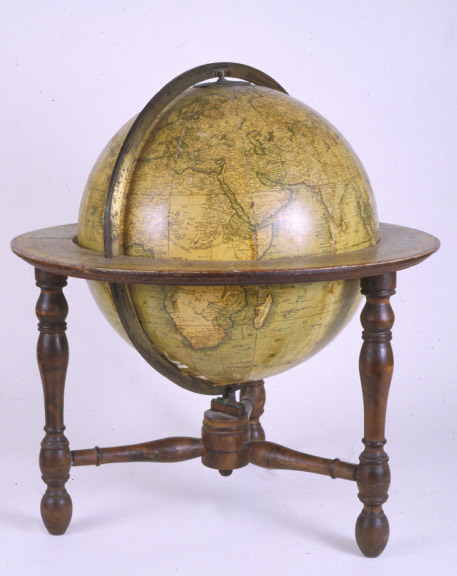
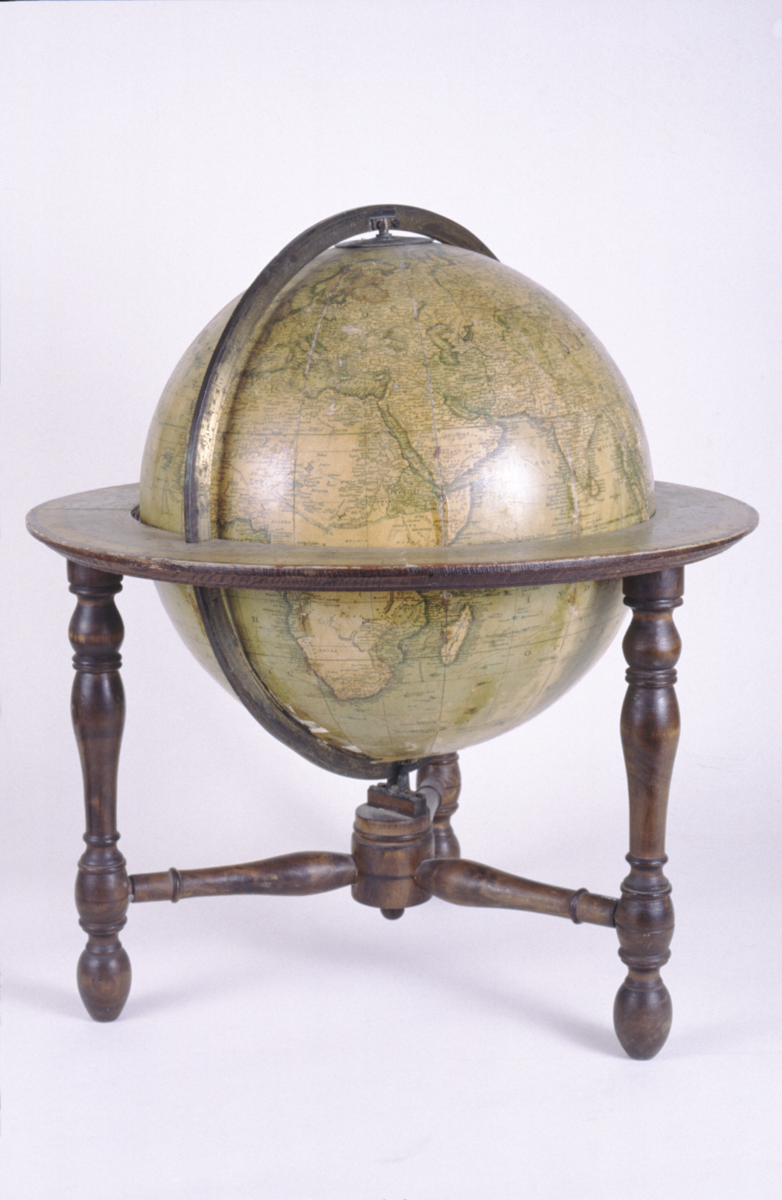
pair of 12-inch globes (celestial and terrestrial), by Newton, London, c.1851. Both plaster spheres with printed paper gores.
Terrestrial globe: 12 engraved and hand-coloured paper gores. Polar axis; brass hour circle divided clockwise and anticlockwise I - XII, I - XII, numbered by I. Brass meridian circle divided 0- 90˚ - 0 - 90˚ - 0, numbered by 10˚, subdivided to 1˚. Wooden horizon circle with printed calendar plate with 32 compass points, signs of the zodiac and calendar to one day. Set on three turned wooden legs with stretchers.
Celestial globe: 12 engraved and hand-coloured paper gores to celestial pole. Polar axis; brass hour circle divided in both directions I - XII, I - XII, numbered by I. 7 magnitudes of stars. Brass meridian circle divided 0 -90˚ - 0 - 90˚ - 0, numbered by 10˚, subdivided to 1˚. Wooden horizon circle with paper dial, compass points, signs of the zodiac and calendar to 1 day. Set on three turned wooden legs with stretchers.
Condition
References
Events
Description
Celestial globes modelled the heavens and the location of stars in relation to one another. Used to chart the location of the Earth in the universe and for geodesic calculations, these globes were useful in solving navigational and astronomical problems. Terrestrial globes modelled the Earth’s movements in relation to the stars, Sun, and Moon, and promoted interest in exploration and charting the surface of the globe. Often, celestial and terrestrial globes were sold as a set, as seen in this example. In the nineteenth century, the role of the globe turned from astronomical to geographical study as the importance of the Earth’s surface was increasingly emphasized. During this period, terrestrial globes were used increasingly as teaching aids for geography lessons for example. This set of globes was produced by Newton, a family firm that was one of the leading English globe makers during the early nineteenth century. The company’s history begins with the engraver and globe maker Nathaniel Hill (fl. 1746–1768) who taught the craft to Thomas Bateman (fl. 1754–1781). Bateman trained John Newton (1759–1844) who founded his own firm in 1780. When this set of globes was produced, Newton’s grandson, William Edward Newton (1818–1879), was running the family company and likely oversaw the production of these objects.
14/01/2014
Created by: Allison Ksiazkiewicz on 14/01/2014
FM:43171
Images (Click to view full size):