Accession No
0349
Brief Description
horizontal instrument, by John Holland [attributed, questionable], after Oughtred, English, mid-17th Century
Origin
England
Maker
Holland, John [attributed, questionable]
Class
dials
Earliest Date
1650
Latest Date
1675
Inscription Date
Material
metal (brass)
Dimensions
length 774mm; breadth 774mm
Special Collection
Provenance
On loan from Trinity College, University of Cambridge from 1951.
Inscription
Description Notes
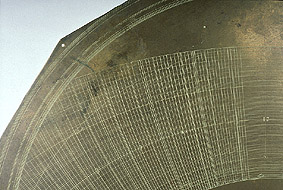
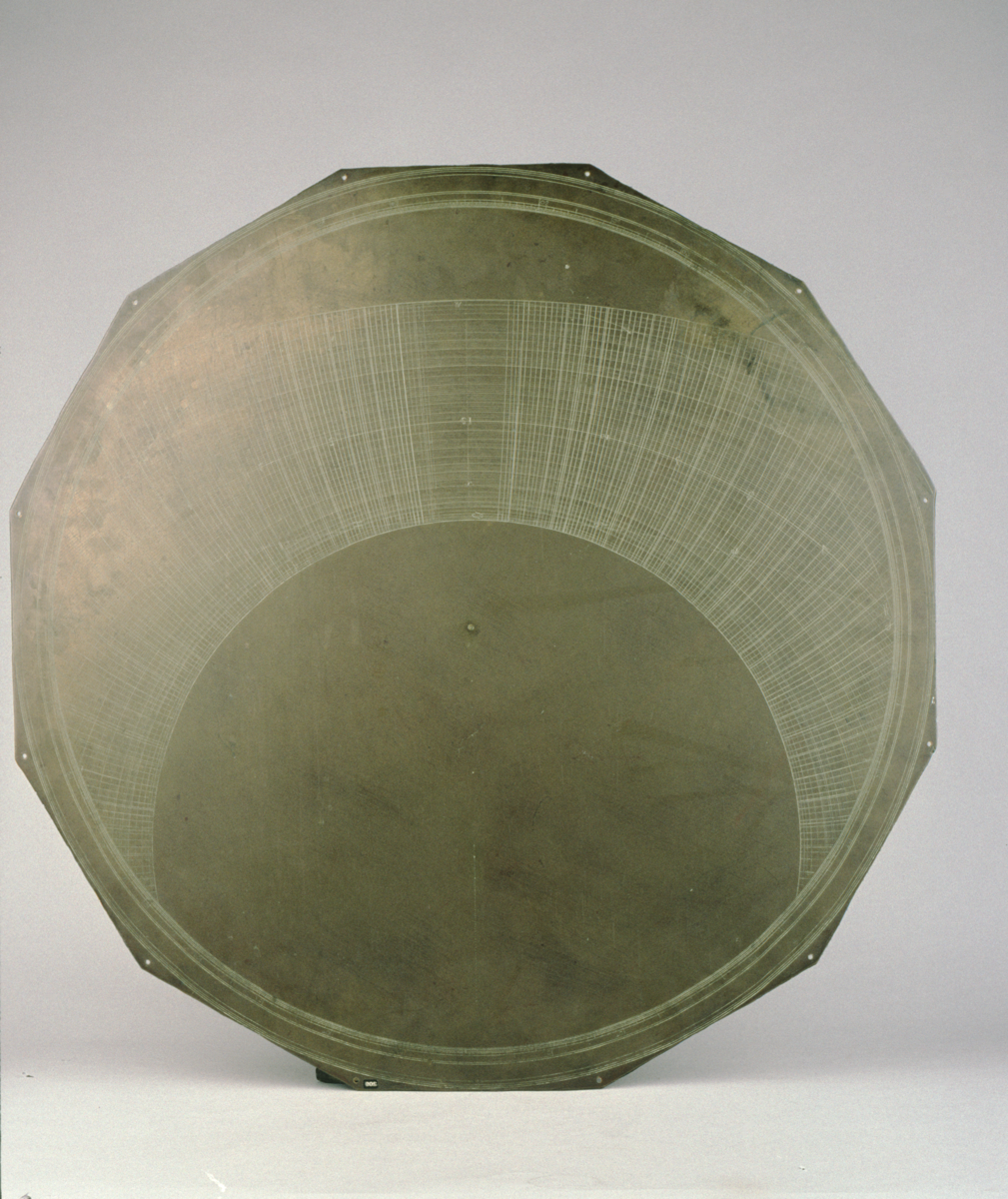
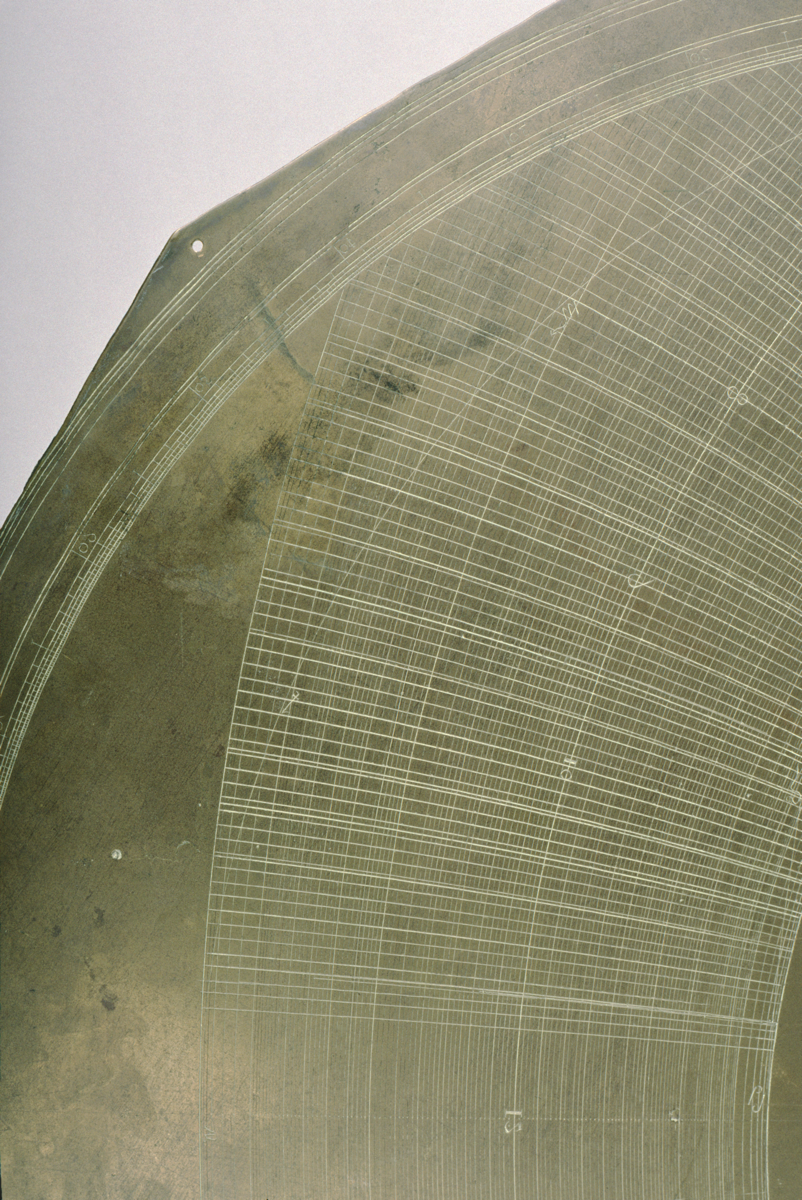
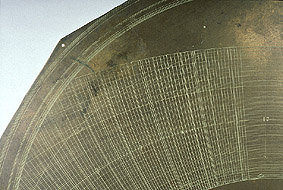
12-sided brass plate, partially engraved with markings for double horizontal dial, Degree scale divided [0] - [90] - [0] -[90] numered by 10 subdivided to 7.5’. Hour scale for normal horizontal dial have not been engraved, but the lines for horizontal projection have been marked on. Lines of declination from tropic to tropic through the equator every 20’ crossed by hour lines with hours marked 4 a.m. to 8 p.m. Intermediate lines have been incorrectly engraved in numerous places. Line of ecliptic drawn and marked by zodiac symbol. Screw holes at each corner for attachment to base. Instrument engraved for a latitude of 52˚15’.
Complete (unfinished)
References
Events
Description
The horizontal instrument was designed by the mathematician William Oughtred (1575-1660). The projection was published in 1624, without acknowledgement, by Edmund Gunter. Not until 1632 was Oughtred's own description issued. Subsequently he stated that he had produced the design 'Long agoe, when I was a young Student of the Mathematical Sciences', and it may be that it dates from the period 1595-1603 when Oughtred was a fellow of King's College.
This extremely large example of the horizontal instrument has been made for the latitude of Cambridge. It is not well made; there are some obvious errors in the engraving. Neither is it properly finished, there is no central index arm, nor is it pierced to take the gnomon pin. Possibly it is the work of John Holland of Trinity College who made a smaller example of this instrument in 1650.
Oughtred described the horizontal instrument as being useful 'for the working of most questions which may be performed by the globe, and the deliniation of Dyals upon any kind of Plaine'. 'To finde the houre of the day' was only one of 30 different uses. The majority were analogue type solutions of problems typically associated with the astrolabe or the Gunter Quadrant, providing information on, for example, the solar declination and right ascension and the times of sunrise and sunset.
[Trinity College label]
12/12/2022
Created by: Morgan Bell on 12/12/2022
FM:43174
Images (Click to view full size):