Accession No
0636
Brief Description
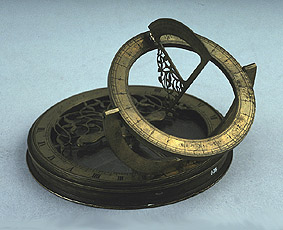
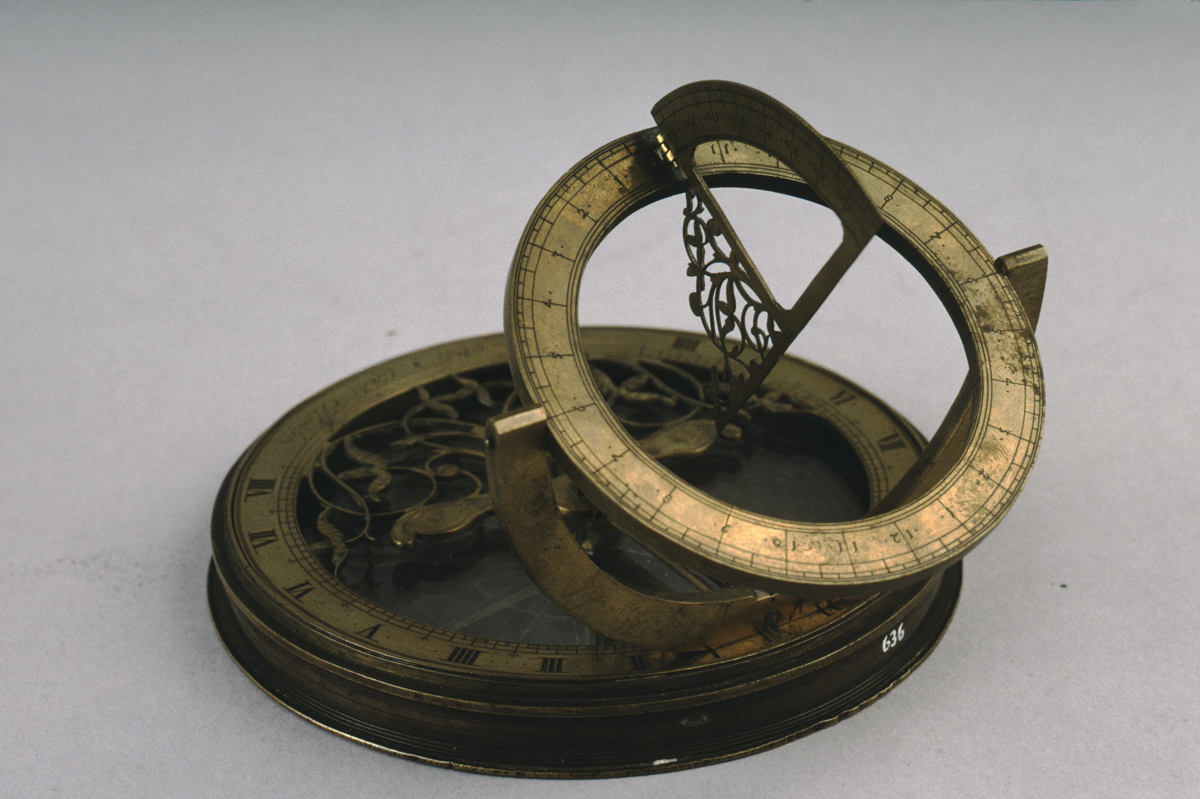
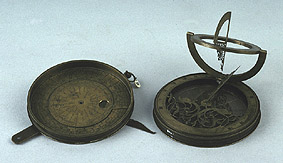
astronomical compendium by Pieter Wils, Dutch, 1670
Origin
Haarlem; Holland (Netherlands)
Maker
Wils. Pieter
Class
dials
Earliest Date
1670
Latest Date
1670
Inscription Date
1670
Material
metal (brass, steel); glass
Dimensions
length 164mm; diameter 116mm; thickness 24mm
Special Collection
Robert Whipple collection
Provenance
Purchased from T. H. Court in 11/1930.
Inscription
‘Pieter Wils * Fecit Haerlem’
Description Notes
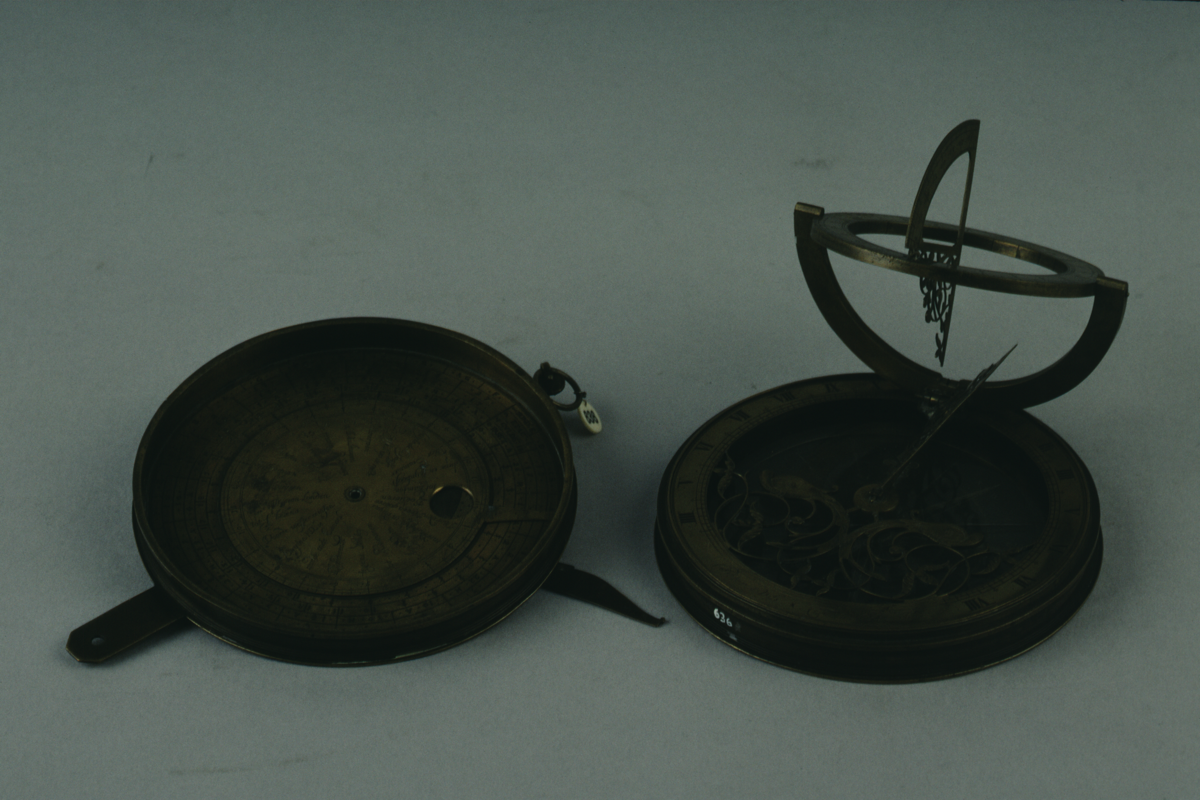
Circular 2-part pushfit case with suspension shackle and handle on lid.
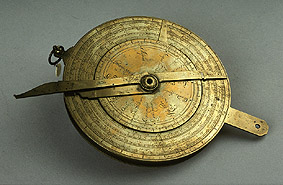
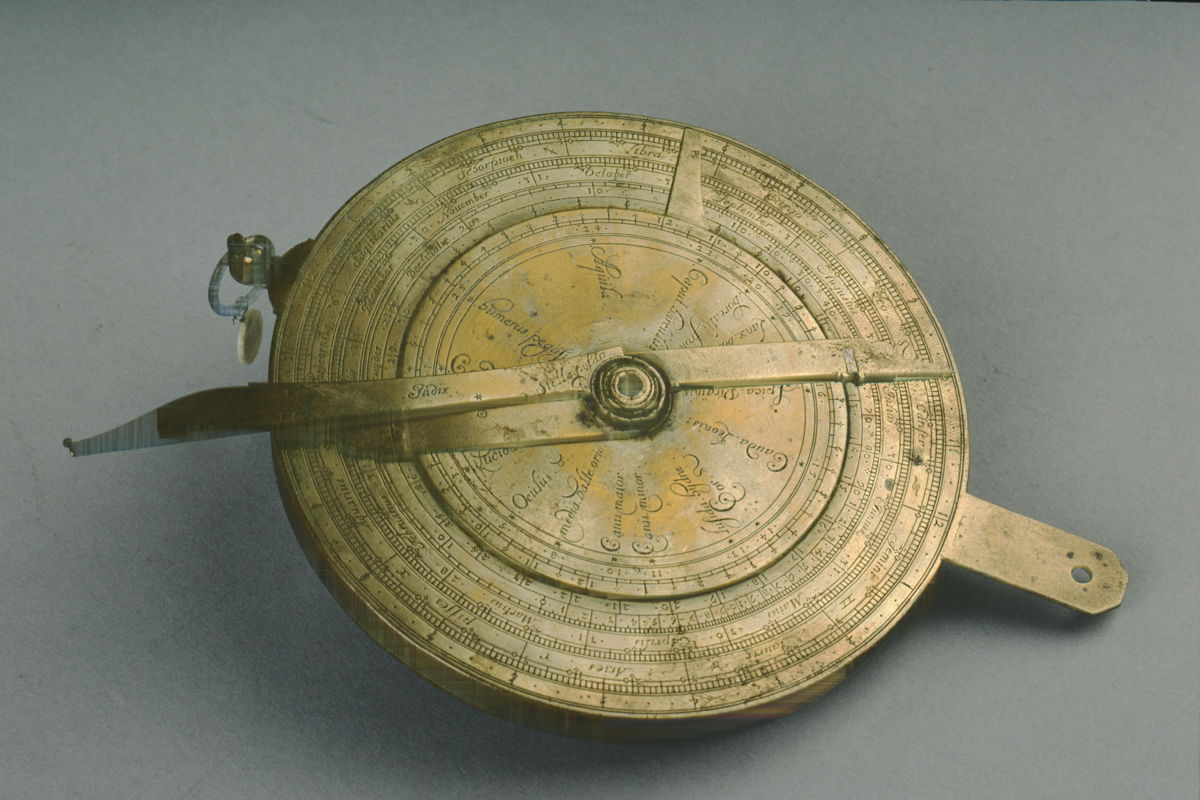
Leaf Ia: nocturnal. Fixed plate has hour scale divided 1 - 12, 1 - 12, numbered by 1, subdivided to 15 minutes. Zodiac scale numbered by 10˚, subdivided to 1˚. Date scale divided to month, numbered by 10 days, subdivided to 1 day. Declination scale marked ‘zuÿder Declinatie’ divided 0 - 23 1/2 - 0, numbered by 10, subdivided to 1. Degree scale divided 0 - 90˚, numbered by 10˚, subdivided to 1˚. Geometric square divided 0 - 10 - 0, numbered by 1, subdivided to 0.2. (Innermost scale divided [0]-30, numbered by 1; 8-2-2000). Volvelle disc with index divided 1 - 12, 1 - 12, numbered by 1, subdivided to 15 minutes; also numbered 1, 2, 3, 5, 8, 10, 11, 13, 14, 15, 16, 17, 19, 20, 22, 24, 25 with the names of the stars (see history file). Pair of radial index arms and indexarm for Ib.
Leaf Ib: calendar and lunar volvelle for 1670, with tables of dominical letters ‘sond.e’, epact numbers ‘epac.1 [8]’, golden number ‘gvlde’ and date of Easter ‘pase’. Hour scale divided 1 - 12, 1 - 12, numbered by 1, subdivided to 15 minutes. Lunar age scale divided 1 - 30, numbered by 1. Volvelle disc with identical hour scale and lunar phase diagram. Along each radial hour line various directional indicators are marked (see history file).
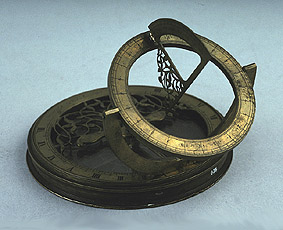
Leaf IIa: horizontal dial, equinoctial dial and compass. Horizontal dial with pierced plate incorporating dolphin motif, set over the compass, with equinoctial dial hinged at the 12 line on the horizontal dial. Horizontal dial divided [III 1/2] IIII - XII, I - VIII [VIII 1/2], numbered by I, subdivided to 7 1/2 minutes. Pierced gnomon. flower and leaf motif. Equinoctial dial on semicircular segment, hour circle divided 0 - 90˚ - 0 - 90˚ - 0, numbered by 10˚, subdivided to 1˚ and I - XII, I - XII, numbered by I, subdivided to 15 minutes, and 1 - 12, 1 - 12, numbered by 1, subdivided to 15 minutes. Pierced latitude arm marked ‘polus’ and divided [6˚] - 90˚, numbered by 10˚, subdivided to 1˚. Pierced gnomon. (Reverse of latitude arc divided 0-[84˚] by 10 to 1˚; 8-2-2000). Compass with degree scale divided 0 - 90˚ - 0 - 90˚ - 0, numbered by 10˚, subdivided to 1˚. 8-point compass rose.
Leaf IIb: quadrant with axis marked ‘Horizont’ and Meridiaen’, the latter divided 36˚ - 62˚, numbered by 1˚, crossed by curved hour lines divided 1 - 6, 6-12, numbered by 1.
Condition: fair; complete.
References
Events
Description
An astronomical compendium is an instrument that carries numerous devices for telling the time and performing astronomical calculations. Many compendia were made in the German lands in the late 16th and early 17th centuries. They are often beautifully engraved in gilt brass. Typically such compendia carry a sundial, various lunar and solar volvelles, a compass, tables of latitude, and a perpetual calendar.
Two characteristics are typical of the construction of these instruments: first, they were often made as lavishly as possible; second, they are ingeniously constructed, with as many instruments as possible filling the available space. Each plate of the compendium is known as a 'leaf', and carries a different device. Most of the instruments on a compendium are used to simplify astronomical calculations. Many compendia have volvelles—rotating discs that show the phases of the Moon, the positions of planets, and other such phenomena.
Almost all compendia have at least one form of sundial. These are often adjustable for use in different places, and are accompanied by lists of the latitudes of major cities around the world. Sometimes these lists are obviously functional, including various towns and major ports, but often they are more fanciful, including places such as Babylon, Alexandria, Moscow, Cuba, Constantinople, and Nineveh (an important ancient city in Assyria). Like the gilt decoration and detailed engraving, these were intended to show the wealth and status of the instrument's owner.
Some compendia also carry stereographic projections. These are multi-purpose maps of the heavens, allowing many astronomical calculations to be simplified. Using these, people could determine the time of sunrise and sunset, and the position of the Sun in its annual (apparent) motion through the sky.
19/12/2013
Created by: [Adapted from Boris Jardine’s 2008 Explore article] on 19/12/2013
FM:43234
Images (Click to view full size):