Accession No
0554
Brief Description
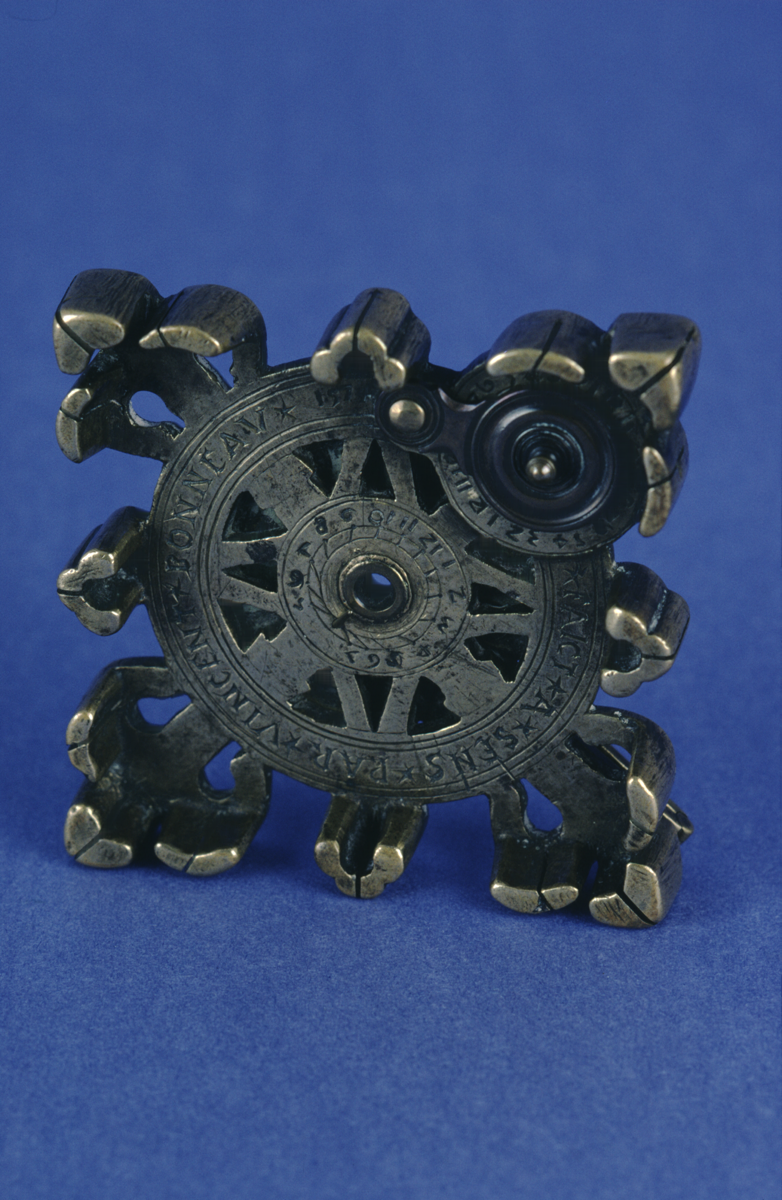
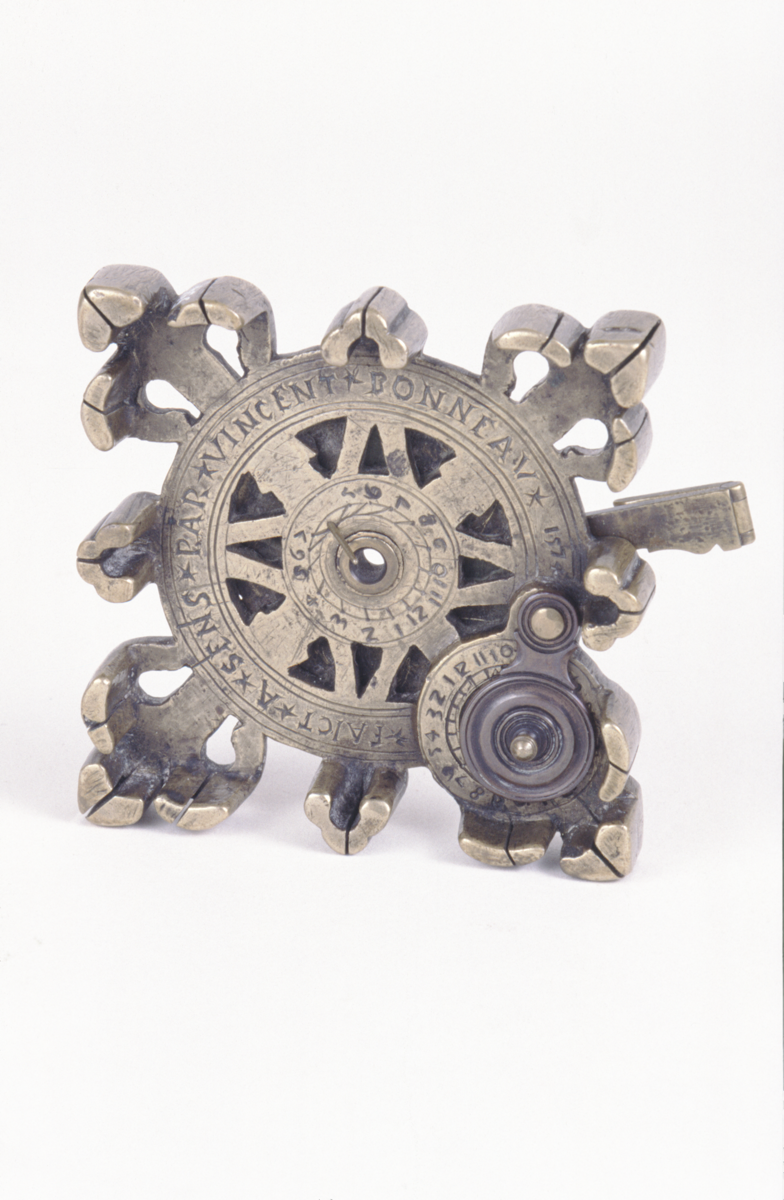
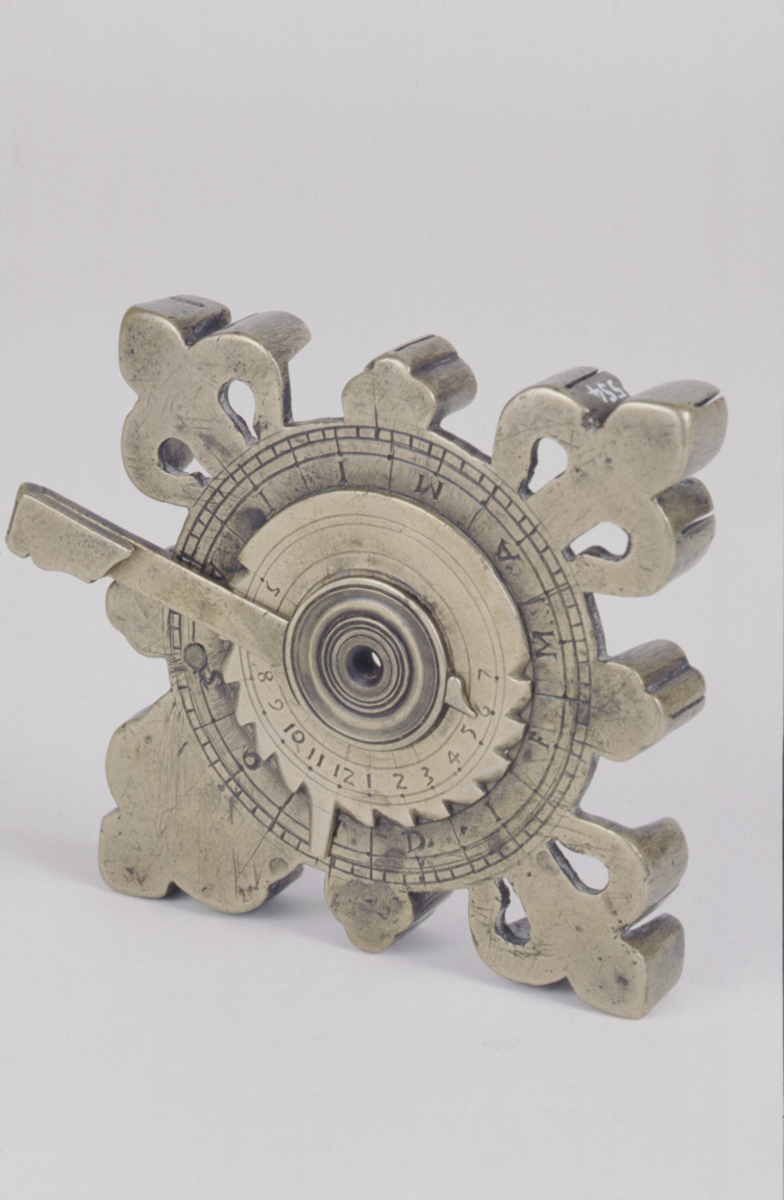
nocturnal and horizontal dial, by Vincent Bonneau, French, 1574
Origin
France
Maker
Bonneau, Vincent
Class
dials
Earliest Date
1574
Latest Date
1574
Inscription Date
1574
Material
metal (brass); glass
Dimensions
length 80mm; breadth 80mm; thickness 20mm
Special Collection
Robert Whipple collection
Provenance
Purchased from 'Mercator', Paris, in 04/1929.
Inscription
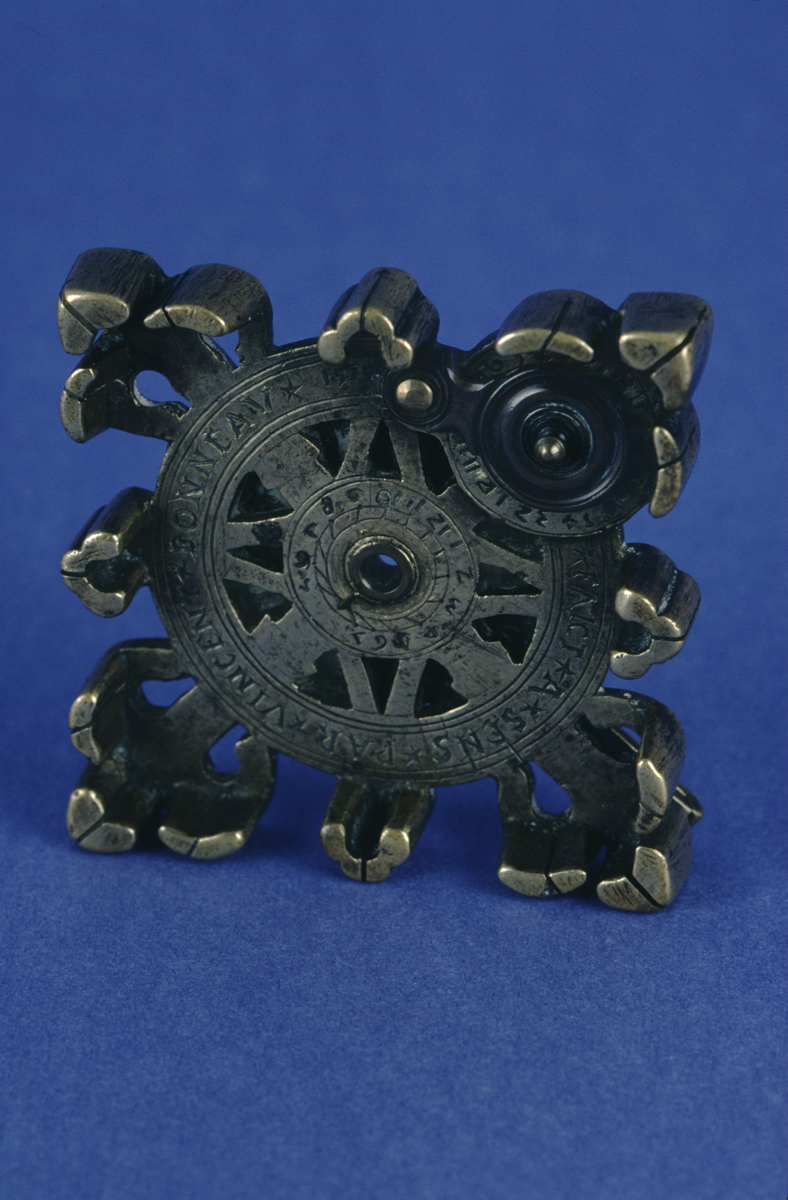
‘*FAICT * A * SENS * PAR * VINCENT * BONNEAU * 1574’
Description Notes
Brass.
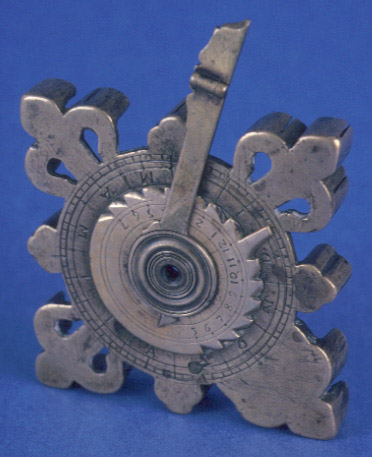
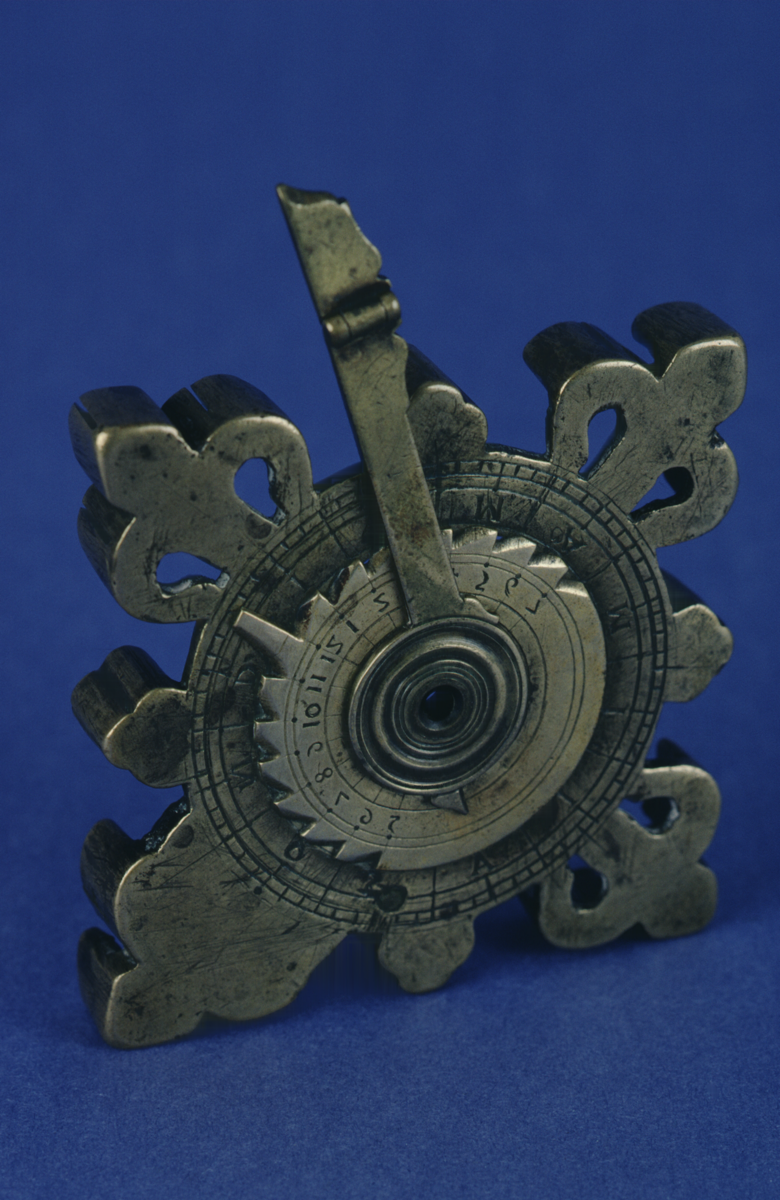
Obverse: nocturnal. Date scale divided to month and subdivided to 5 days. Rotatable disc with teeth for hours, divided 5 - 12, 1 - 7, numbered by 1. Index arm with hinged pointer.
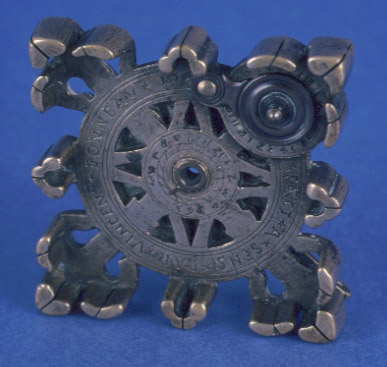
Reverse: central horizontal dial with rod gnomon; hour scale divided 5 - 12, 1 - 7, numbered by 1. In one corner is a compass bowl with hinged cover plate; surrounded by scale divided 1 - 12, 1 - 12, numbered by 1. This face has a raised lobe with slits as if for a crosshead, but there are no calibrations which would allow use for surveying.
Condition: fair.
References
Events
Description
Nocturnal
Nocturnals have been known since at least the 10th Century, and may date from even earlier times. They were generally designed for sailors’ use, to find the time at night by the stars. Most of the ones used on board ship would have been made of wood. However, many metal nocturnals with elaborate decoration also survive.
Various different stars can be used to find the time at night, but the most common ones that nocturnal-makers chose were the Pole Star and the Great Bear. The inner disc of the nocturnal was adjusted so that the short pointer was positioned over the correct date. Then the instrument was lifted up until the user could see the Pole Star through the central hole. With the nocturnal still in this position, the long pointer was turned until it lined up with the two ‘pointer’ stars at the end of the Great Bear. Where the edge of the pointer crossed the inner disc it would show the time.
Many nocturnals had teeth carved into the inner disc to mark the hours so that the time could be read in the dark, by counting round the number of teeth between the big pointer and the small one.
Horizontal Dial
The horizontal dial is the most common form of sundial. The portable version proved very popular with the upper classes during the 19th Century. During this period, it could best be described as the wristwatch of its day.
The hour lines are engraved onto a horizontal surface, with a gnomon (pointer) in the centre. Seasonal variations (caused by the earth’s orbit being elliptical, not circular) have to be compensated for, as they can affect the raw reading by up to 18 minutes.
18/10/2002
Created by: Saffron Clackson and Boris Jardine on 18/10/2002
FM:43249
Images (Click to view full size):