Accession No
0339
Brief Description
diptych dial, universal and with fixed gnomon, Italian, 17th Century
Origin
Italy
Maker
Class
dials
Earliest Date
1600
Latest Date
1700
Inscription Date
Material
wood (boxwood); metal (brass); glass
Dimensions
length 71mm; breadth 66mm; thickness 17mm
Special Collection
Robert Whipple collection
Provenance
Purchased by Robert Stewart Whipple from Antique Art Galleries, London, on 30/11/1928.
Inscription
Description Notes
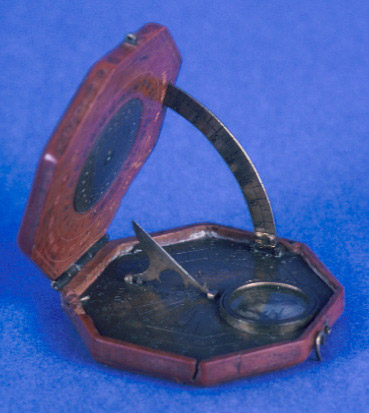
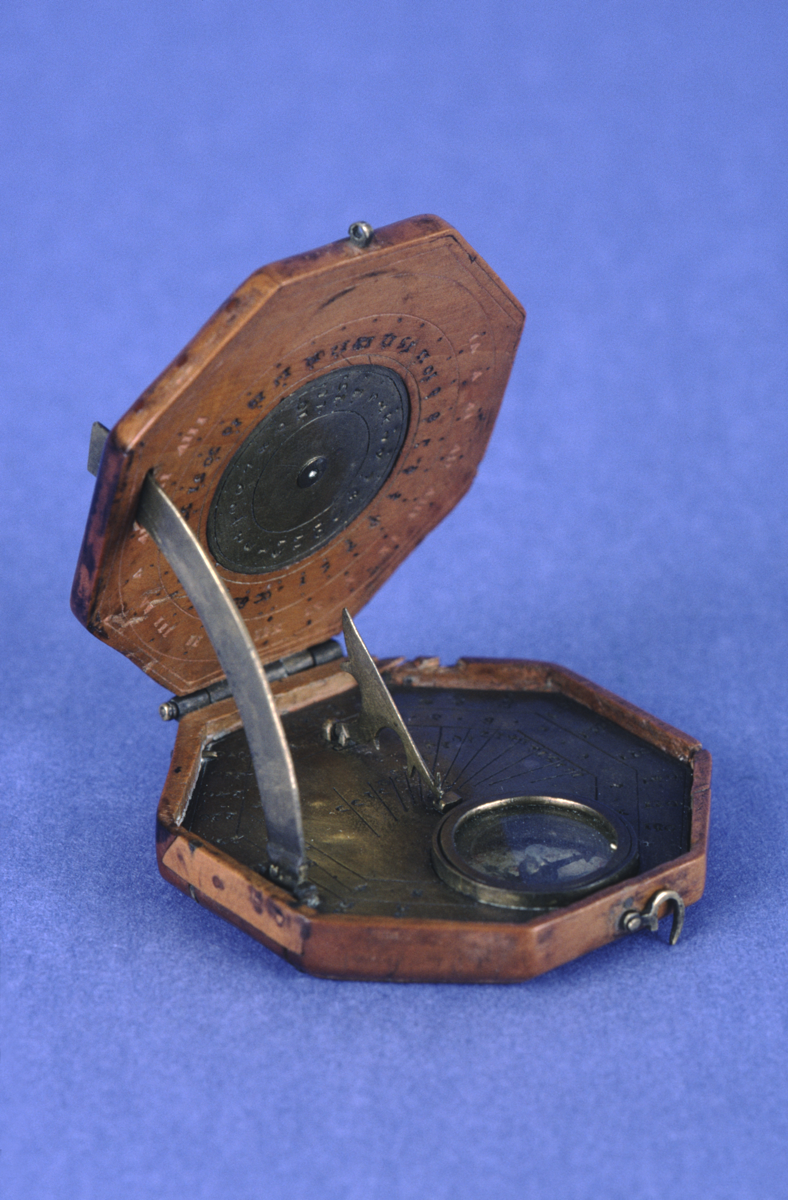
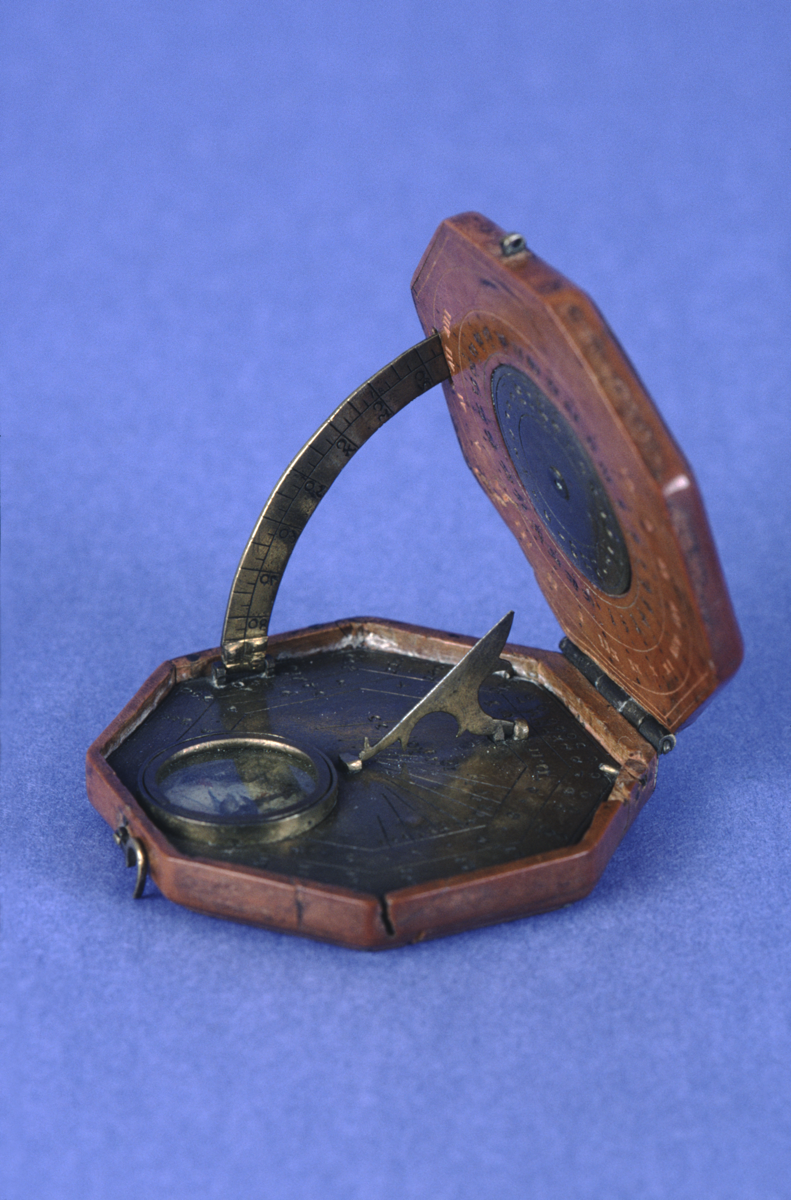
Diptych dial in wood and brass, universal and with fixed gnomon, Italian, 17th century.
Octagonal boxwood case.
Leaf Ia: equinoctial dial and lunar volvelle. Hour scale divided IV - XII, I - VIII, numbered by I. Lunar age scale divided 1 - 29, numbered by 1. Central brass rotatable disc with hours divided 1 - 12, 1 - 12, numbered by 1. Socket for gnomon (missing).
Leaf Ib: as leaf Ia.
Leaf IIa: horizontal dial with degree scale and hour scale. Degree scale divided [0] - 360˚, numbered by 10˚ (but 170-270 missing). Hour scale divided 4 - 12, 1 - 8, numbered by 1, subdivided to 30 minutes. Italian hours dial divided 11 - 22, numbered by 1. Inset compass with coloured card and 8-point rose. Folding fixed gnomon.
Brass latitude arc on right hand side of base divided [85˚] - [0], numbered by 10˚, divided to 2.5˚.
(Leaf IIb: pattern of concentric circles and radii; 1-2-2000).
Condition: fair (wood damaged in places; 1-2-2000); incomplete (gnomon missing).
References
Events
Description
The Diptych dial is a common form of portable multi-function sundial. Diptych dials were made popular by the instrument makers in Nuremberg during the sixteenth and seventeenth centuries. They are usually made of ivory with brass fittings, and are often elaborately decorated. The name of the device derives from the Greek diptychos for a pair of folding writing tablets, which the instrument resembles.
Diptych dials consist of two leaves hinged together, with a string ‘gnomon’ stretched between the inner surfaces of the leaves for casting a shadow. To use the device as a sundial the lower leaf must be placed parallel to the horizon and the upper leaf must be at a right angle vertically to it. The gnomon must then be aligned with the meridian of the place where it is being used by using the inbuilt magnetic compass. Time can then be read from the horizontal or vertical dial by the location of the shadow cast by the string gnomon.
In addition to the horizontal and vertical dials, diptych dials normally carry a number of other features, such as equinoctial dials, windroses, tables of latitude for adjusting the string gnomon for different locations, epact tables, lunar volvelles for telling time at night by the moon, and various pin-gnomon dials for telling the time according to Babylonian or Italian hours, or for calculating the position of the Sun in the zodiac.
27/05/2009
Created by: Joshua Nall on 27/05/2009
FM:43250
Images (Click to view full size):