Accession No
1822
Brief Description
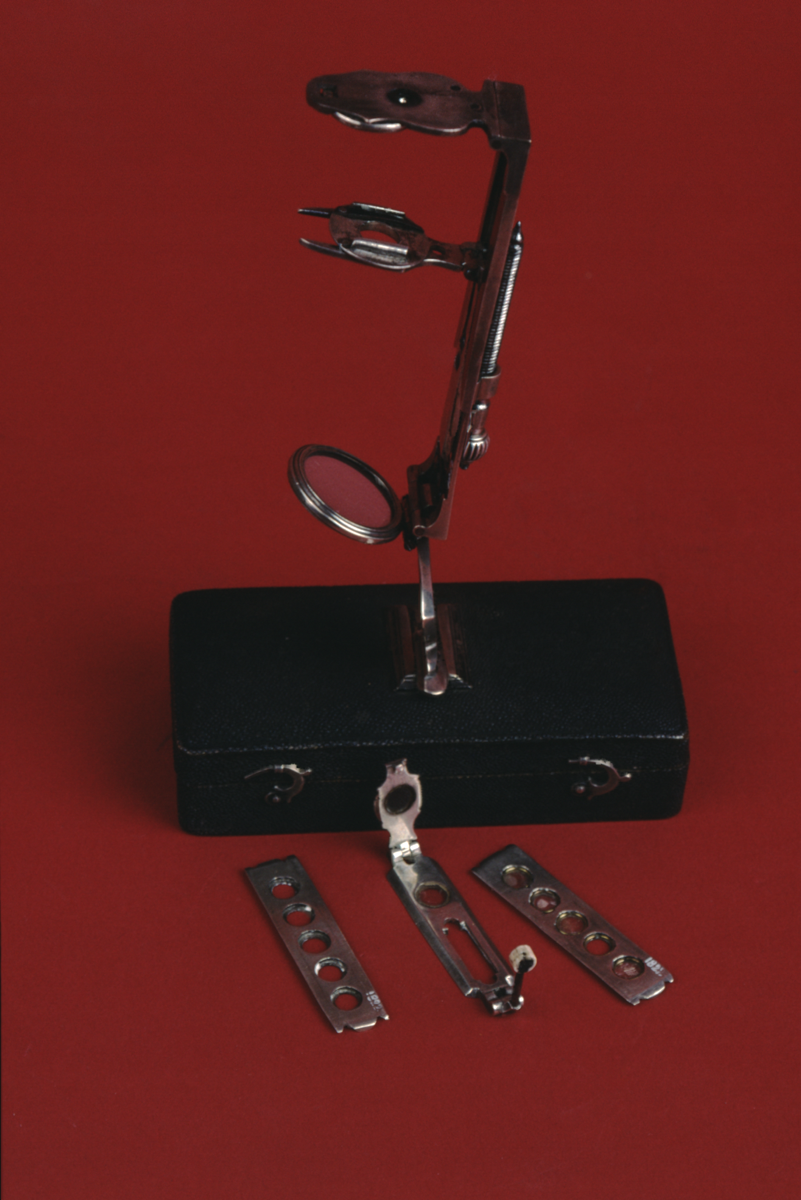
simple microscope, pocket, by John Clark, Scottish, 1754 - 1773
Origin
Scotland; Edinburgh
Maker
Clark, John
Class
microscopes
Earliest Date
1754
Latest Date
1773
Inscription Date
Material
metal (silver); wood; leather (shagreen); cloth (silk); ivory
Dimensions
box length 99mm; breadth 47mm; height 29mm
Special Collection
Heywood collection
Provenance
Purchased from the H.Heywood collection under estate duty exemption benefit with the assistance of a Science Museum grant-in-aid.
Inscription
“J. Clark fecit Edin.r” (on reverse of bed-plate);
“*” (on shoe)
Description Notes
Silver; vertical bed-plate hinged at the bottom with foot fitting onto a slot on the lid of the box; hinged concave mirror; at the top of the bed plate is a hinged wheel of objectives ‘1-5’; the hinged stage slides on the bed plate with a long fine focussing screw; stage plate slots onto the stage and is grooved for taking slides; reverse of the bed plate engraved with a scale of objectives and corresponding magnifications: ‘191.1’; ‘96.2’; ‘48.3’; ‘24.4’ ; ‘12.5’; engraved with foliage decoration.
Fitted wooden box covered with black shagreen and lined with green silk; accessories; 2 silver five-object slides; slide with live box, black and white ground; frog plate; turned ivory talc and ring box.
References
Events
Description
Throughout the 18th century, microscopy remained essentially an amateur activity, the province of educated naturalists and gentlemen with time to explore the mysteries of science.
Instrument makers responded to the nature of the demand for their products with ingenious developments in design. This instrument is an example of a delicately made pocket microscope which could be dismantled and fitted into an attractive miniature case.
George Lindsay in London and John Clark in Edinburgh were mid-18th century instrument makers who made particularly fine examples of pocket microscopes. In 1754, John Clark advertised his silver microscope which was to be sold to subscribers for four guineas - one to be paid on subscription and the remainder on delivery. Fifty subscribers were required, ‘such a Number being absolutely necessary to reduce it to this low price.’ Only seven of these instruments are now known to survive.
For a period of 18 years, from 1755 to 1773 no trace of John Clark working in Edinburgh can be found. However, in 1773 he once again advertised a pocket microscope. The new instrument was manufactured in brass and incorporated improvements over the 1754 design - principally the inclusion of a mirror that fitted above the stage and reflected light onto opaque objects. Again it was for sale for 4 guineas, but not this time on a subscription basis, suggesting that the success of the earlier venture had reduced the need for cash in advance.
30/08/2006
Created by: Corrina Bower; updated by Ruth Horry on 30/08/2006
FM:43264
Images (Click to view full size):