Accession No
2280
Brief Description
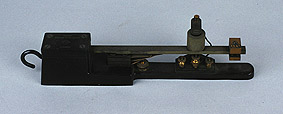
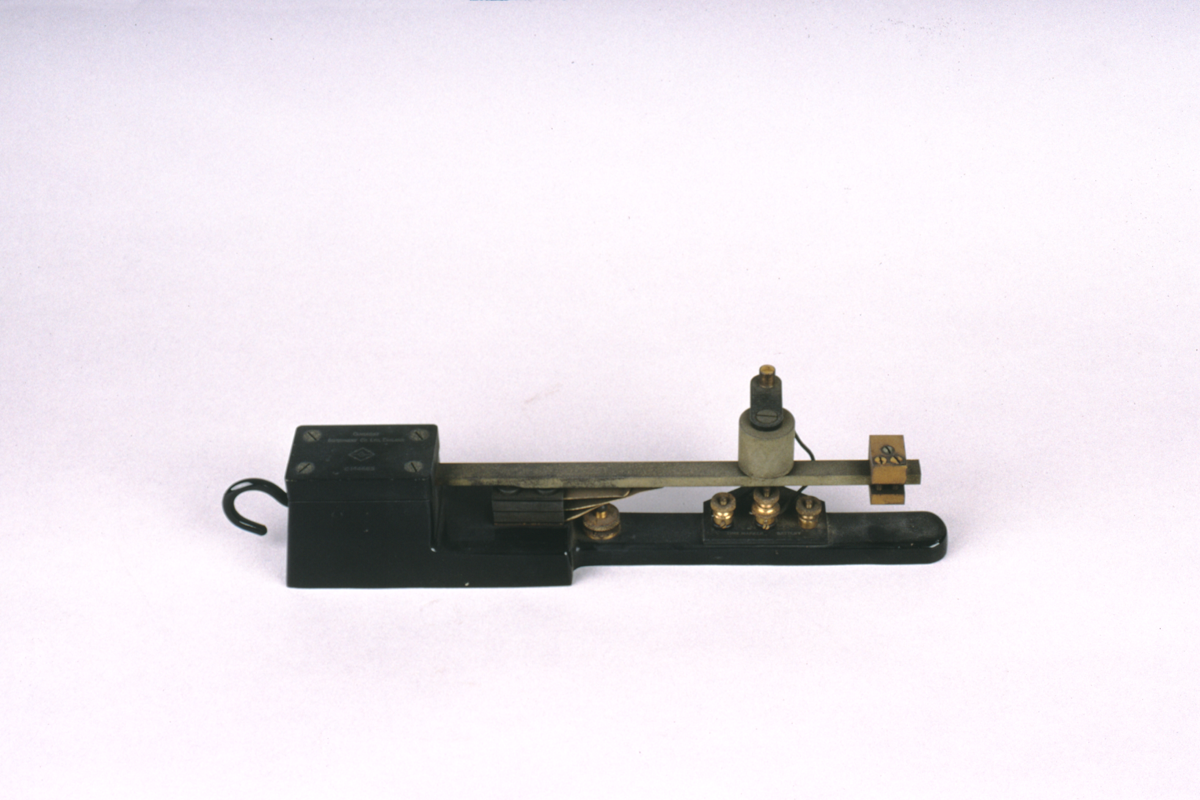
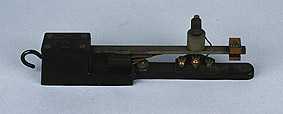
vibrating bar for an electrocardiograph, by Cambridge Instrument Company Ltd., English, 1930
Origin
England; Cambridge
Maker
Cambridge Instrument Company Ltd.
Class
medical; electrical
Earliest Date
1930
Latest Date
1930
Inscription Date
Material
metal
Dimensions
length 362mm; breadth 70mm; height 87mm
Special Collection
Provenance
Transferred from Department of Colloid Science, University of Cambridge, 11/1976.
Inscription
‘CAMBRIDGE
INSTRUMENT Co. LTD ENGLAND
C144665’ (support)
‘TIME MARKER BATTERY’ (by terminals)
Description Notes
Vibrating bar for ECG. The vibrating bar is supported on a rigid black-painted metal support with a hook at one end for suspension. Above the bar at the opposite end is an electromagnet and directly below the bar are 3 terminals. The bar has a weight at one end screwed in position. There is a spring contact with bar attached to the support which can be adjusted by an insulated screw.
References
Events
Description
By the early 1920s, the Cambridge Standard Electrocardiograph had become an established clinicial tool; however, demands on the use of the machine forced designers to modify the instrument. There were three problems in particular: the instrument was sensitive to vibrations (though this was later disproven), considerable skill and training was required for the successful operation of the machine, and lastly, the instrument was extremely heavy. In order create a more mobile apparatus for use in hospital wards, a trolley-mounted version of the Standard was developed. The instrument’s success as a diagnostic tool eventually led to the re-design of electrocardiograph as a portable instrument that could be carried by a medical practitioner. This is a vibrating bar for an electrocardiograph. It was acquired from the Department of Colloid Science at the University of Cambridge.
08/07/2014
Created by: Allison Ksiazkiewicz on 08/07/2014
FM:43347
Images (Click to view full size):