Accession No
0685
Brief Description
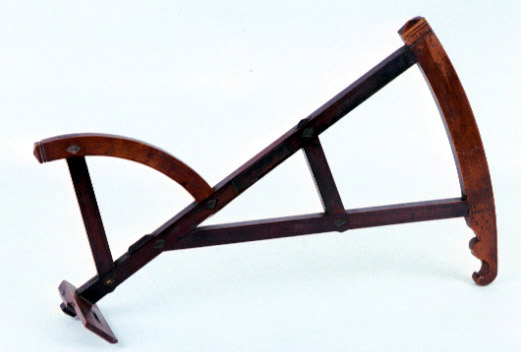
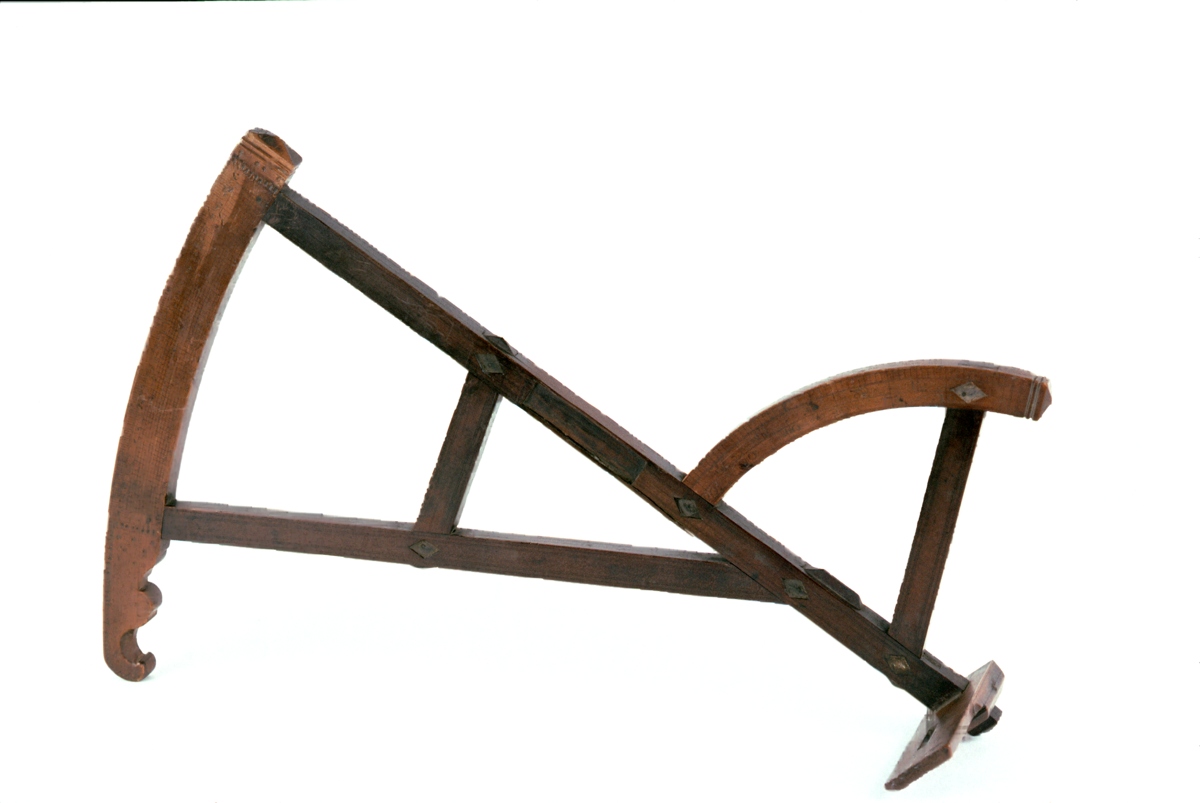
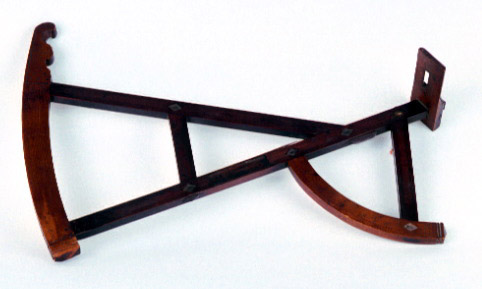
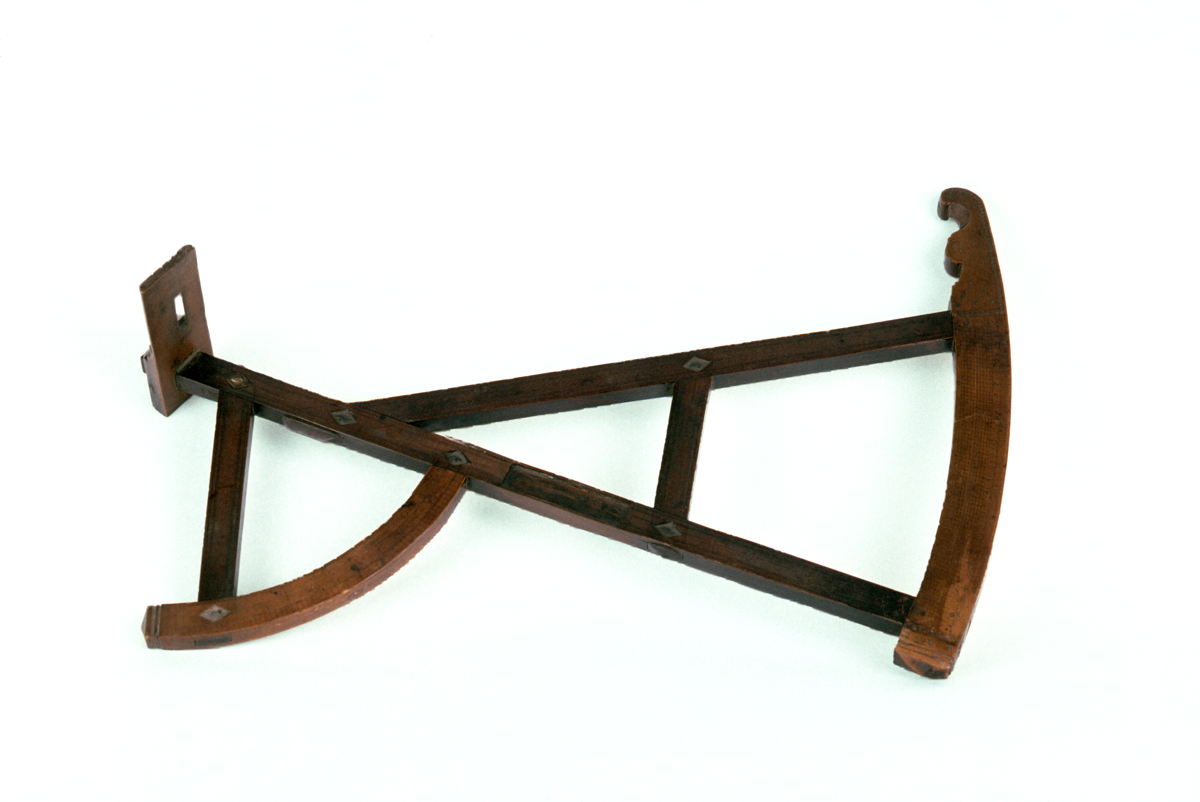
backstaff, c.1750
Origin
Maker
Class
navigation
Earliest Date
1750
Latest Date
Inscription Date
Material
wood (mahogany, boxwood)
Dimensions
backstaff length 495mm; breadth 430mm; height 122mm bag of vanes length 135mm; breadth 115mm; height 50mm
Special Collection
Robert Whipple collection
Provenance
Purchased from Frank Sargent, Durham, England, on 23/11/1932.
Inscription
Description Notes
Backstaff. Mahogany limbs and braces, boxwood arcs. Boxwood horizon vane. Other vanes missing. Inset name plate and decorations missing. 60˚ arc divided 0 - 65˚ by 5˚ and subdivided to 1˚; 62˚ on arc, 3˚ on limb. Lesser arc divided 0 - 25˚ by 1˚, subdivided to 10´, and by transversals to 1´; also numbered 65˚ - 90˚ for zenith distance.
In blue bag: part sight vane (restored), replacement shadow vane (1933), replacement sight vane (1933, broken).
Condition
References
Events
Description
In November 1944, R.S. Whipple’s donation to the University of Cambridge was put on show in the East Rooms of the Old Schools. The University accepted the donation on the condition that they found a new institution within which to house the collection.
Whipple himself wrote a guidebook to this exhibition, describing some of the more important objects and books on show. The front cover includes the following declaration: “The Exhibits are drawn from the Collection which Mr R.S. Whipple is presenting to the University and will form a nucleus for a History of Science Museum and Library in Cambridge.”
Whipple's explanatory text for this backstaff (and for Wh.0698) was:
"Back-staffs. This instrument was invented by John Davis about 1540 for the observation of the sun's altitude at sea without the necessity of looking directly at the sun. Two instruments, c.1700, are shown."
17/10/2025
Created by: Hannah Price on 17/10/2025
Description
The backstaff was devised in 1595 by John Davis, a navigator. By 1604 Davis had modified it to this form, often known as Davis’ staff. It served to measure the sun’s midday altitude, from which the ship’s latitude could be calculated. The Davis staff remained in use for about 150 years.
A sighting vane (missing here) was mounted on the larger arc, which was graduated to 25° or 30°, often with transversals for fine reading. The shadow vane (missing here) was mounted on the smaller arc which is graduated to 60° or 65°. In use the slit horizon vane was placed on the end of the staff, the shadow vane was adjusted to a convenient number of degrees, usually about 10° or 20° less than the estimated altitude, and the sight-vane was slid along the larger arc until, if the sun was being observed, the shadow of the top of the shadow-vane fell on the slit of the horizon-vane at the same time as the horizon was seen through it. The values shown by the vanes on the two arcs were then added together to give either the sun’s altitude (above the horizon) or its zenith distance (measured from a point directly overhead), depending on how the instrument was graduated.
04/08/2008
Created by: Dr Anita McConnell on 04/08/2008
FM:43359
Images (Click to view full size):