Accession No
2356
Brief Description
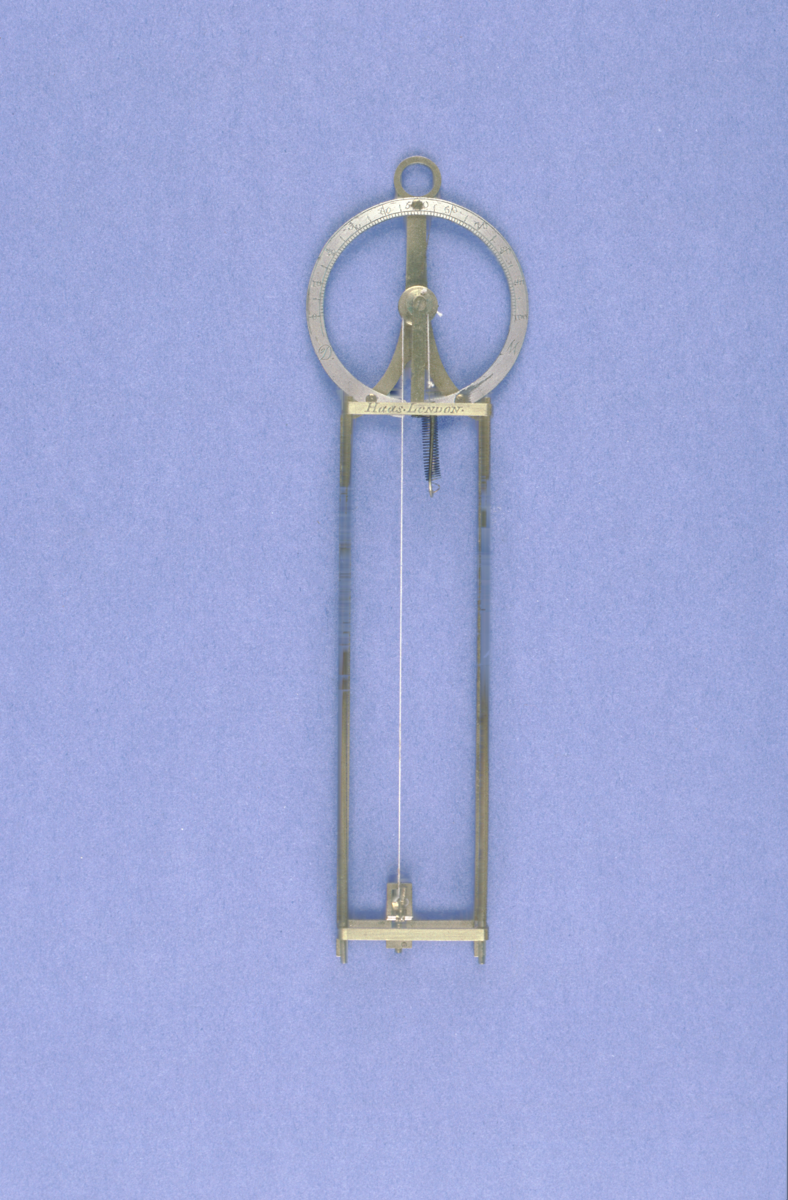
De Luc hygrometer, by J. B. Haas, English, 1790 (c)
Origin
England; London
Maker
Haas, J. B.
Class
meteorology
Earliest Date
1790
Latest Date
1790
Inscription Date
Material
wood; metal (brass, silver); fishskin (shagreen); cloth (velvet, cotton)
Dimensions
length 162mm; breadth 45mm; thickness 12mm; box length 174mm; breadth 57mm; thickness 18mm
Special Collection
Provenance
Bequeathed by R.S. Newall, 17/1/1978. lair element possibly replaced by Negreth & Zambra, 1954 (see file).
Inscription
‘Haas. LONDON’
Description Notes
De Luc whalebone hygrometer, in fitted box.
Skeletal brass box-frame of rods and bars with silvered circular scale at the top and a small brass suspension circle above that. The whalebone hydroscopic element is missing; a cotton line runs direct from the adjustable anchor point for that element to operate the index arm. A similar short line runs from the index pulley to a counter-balancing, helical spring calibrated over some 200o of the circular scale from ‘D’ry 0-100 by 10 to 1 to ‘M’oist. Fitted shagreen-covered wooden box with brass hinges and hook fasteners; lined with green velvet.
Condition of box - fair
References
Events
Description
The hygroscopic element of this instrument is missing here; it would have been a strip of whalebone which changes its length according to the humidity of the atmosphere. The whalebone strip was connected to a thread running over a pulley which drives the pointer. The dial is graduated from 0 to 100.
The whalebone hygrometer was devised by the French meteorologist Jean-André de Luc, who described it in 1786. It was widely made in Britain and Europe. This example was made in London around 1790 by Jacob Bernard Haas.
26/03/2008
Created by: Dr. Anita McConnell on 26/03/2008
FM:43444
Images (Click to view full size):