Accession No
2217
Brief Description
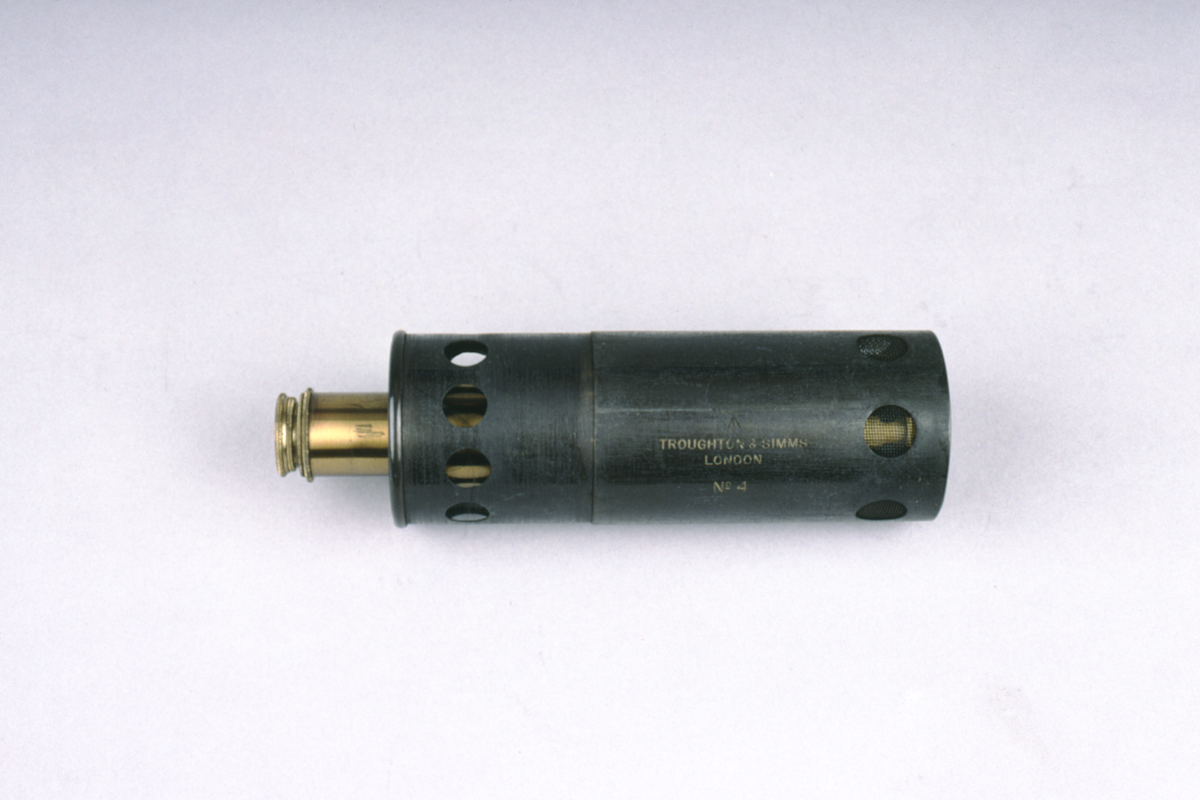
hypsometer, Troughton & Simms
Origin
London; England
Maker
Troughton & Simms
Class
surveying
Earliest Date
Latest Date
Inscription Date
Material
metal (brass, alloy)
Dimensions
height 188mm; diameter 56mm
Special Collection
Provenance
Transferred from Department of Geography, University of Cambridge, Cambridge, England, 05/1969.
Inscription
‘TROUGHTON & SIMMS LONDON No 4’, (Broad arrow)
Description Notes
Brass boiler mounted over brass spirit lamp, with wick. Double wind shield, push fitting. Telescopic thermometer tube; 3 draw tubes; push fitting onto boiler. Metal alloy casing with air vents and viewing apertures.
References
Events
Description
The hypsometer is a device for measuring altitude (which is your height above sea level). It does this by measuring the boiling point of water, which steadily decreases with altitude.
The air around us extends upwards for approximately 30 miles (45 kilometres). Ignoring fluctuations due to the weather, the pressure of the air steadily decreases the higher up you go. At sea-level the average air pressure is about 30 inches (760mm) of mercury. For each 1000 feet upwards that you climb, the pressure drops by about 1 inch, which is why your ears may 'pop' when you go up or down in an aeroplane. So a barometer can be used as an altimeter, that is, an instrument to measure altitude.
The traditional mercury barometer is heavy and awkward to transport. Fortunately, the boiling point of water depends upon the surrounding air pressure, and therefore steadily decreases with increasing height. Thus it is impossible to boil an egg on Mount Everest because the temperature of boiling water - 74° C at the summit - is no longer hot enough to cook the egg. The hypsometer, therefore, is a compact and portable piece of apparatus ( see Fig. 1) with which to measure the boiling point of water. From this measurement the corresponding altitude can be looked up in tables.
The hypsometer was invented in the mid-nineteenth century as an alternative to the cumbersome mercury barometer. It was itself soon replaced by the more compact and robust aneroid barometers.
01/03/2001
Created by: Chris Lewis on 01/03/2001
FM:43464
Images (Click to view full size):