Accession No
0914
Brief Description
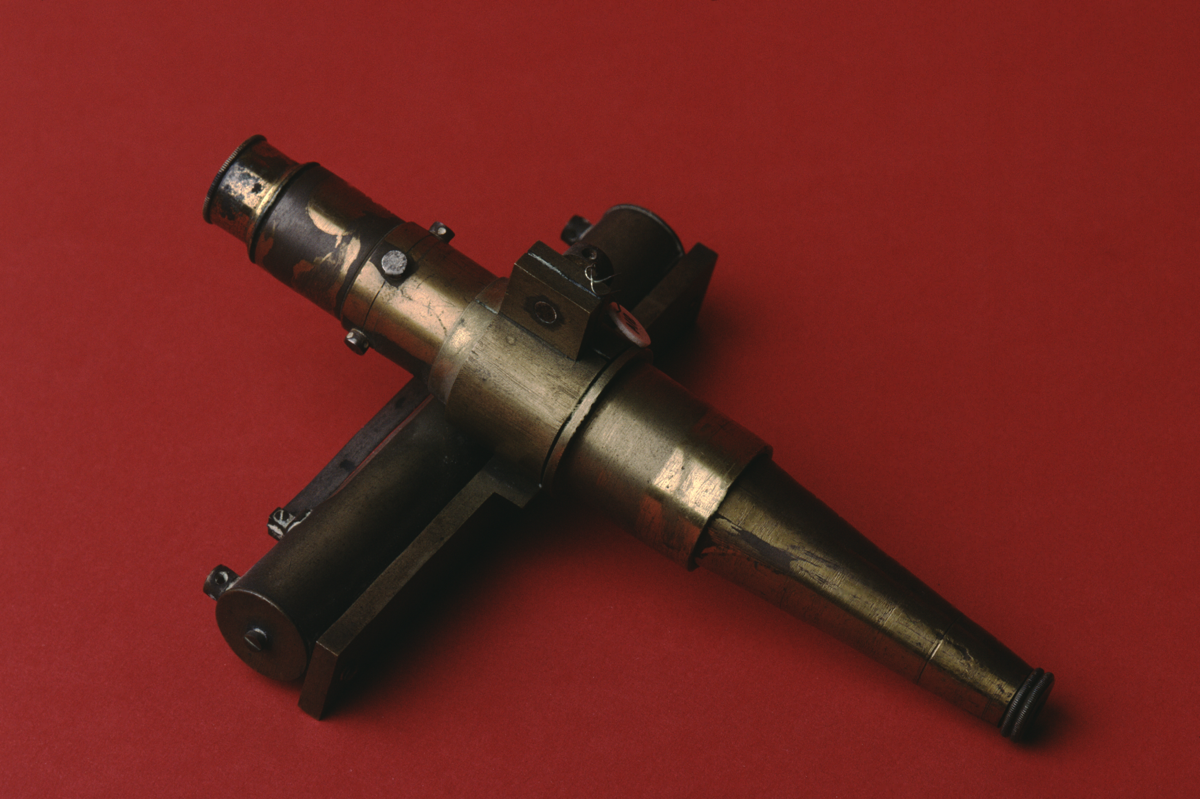
[simple] microscope, reading; 2/2 19th century
Origin
Maker
Class
microscopes
Earliest Date
1850
Latest Date
1900
Inscription Date
Material
metal (brass, steel); glass; liquid
Dimensions
length 166mm; breadth 125mm; thickness 58mm
Special Collection
Robert Whipple collection
Provenance
Inscription
Description Notes
Brass level with blued steel scale divided 40 - 0 and 0 - 40, numbered by 10, subdivided to 1. Band attached to level holds microscope in place in vertical position. Push-fit eye-end with double lens. Tapering body to objective. Cross-hairs.
Condition fair; complete.
References
Events
Description
The simple microscope is essentially one lens, or one thick lens which is composed of two or three pieces of glass. The simple microscope has a short focal length which means that in order to focus clearly the microscope has to be held up to the eye. The magnifying power in this type of microscope ranged from 70 to 250 times.
Antoni van Leeuwenhoek (1632-1723) was a cloth merchant from Delft and made the earliest surviving examples of a simple microscope. Leeuwenhoek crafted the lens from glass beads and mounted the lens in between metal plates. A spike was used to hold the specimen close to the lens and the microscope was then handheld in front of the eye. Leeuwenhoek was the first person to see bacteria. The capillary circulation of the blood, as discovered and demonstrated by Marcello Mapighi could also be observed through a simple microscope. The simple microscope remained in use alongside the compound microscope, as it was a useful alternative if clear images could not be viewed through compound microscopes.
In the early years of the 18th Century, many simple microscopes were of the screw barrel type ,which were produced in ivory or brass. Those particularly interested in the natural world used simple microscopes as they were portable and very useful for work in the field. The botanical microscope as seen in the microscope case (accession number 0587) would open out as the box itself was opened making it immediately ready for use.
FM:43471
Images (Click to view full size):