Accession No
3781
Brief Description
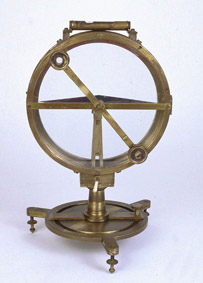
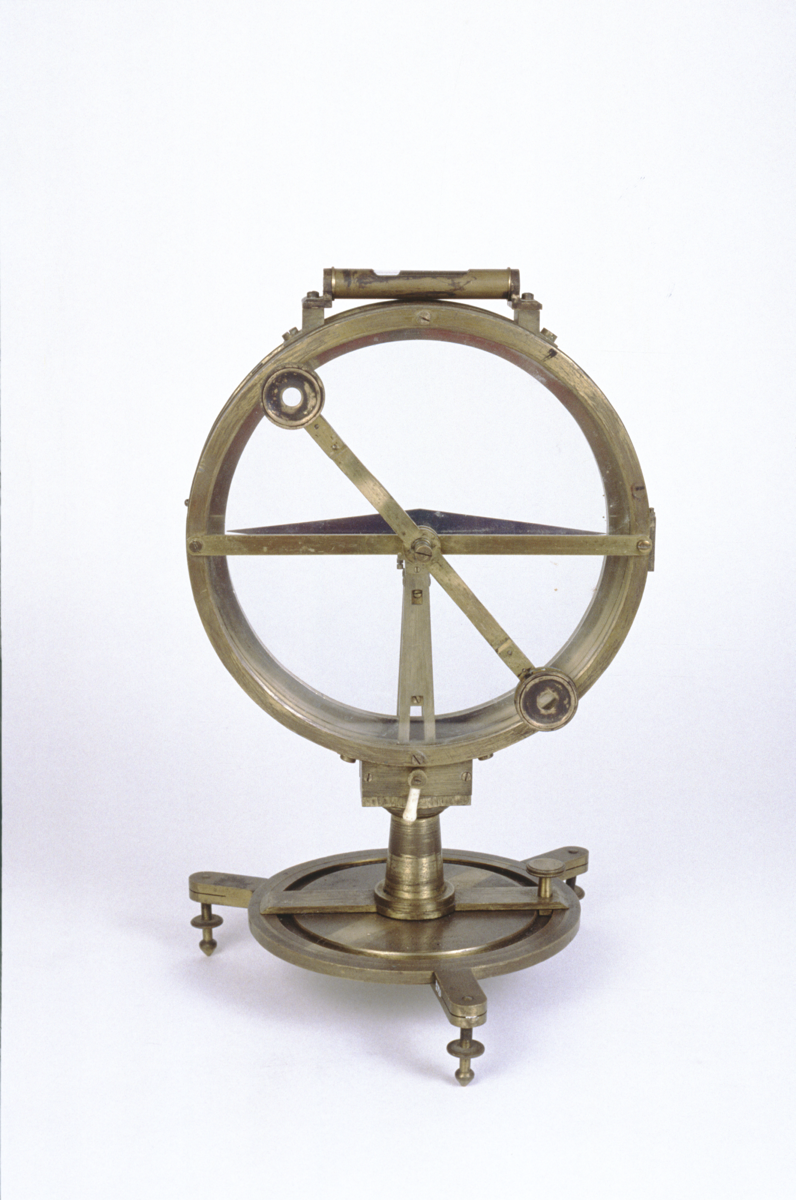
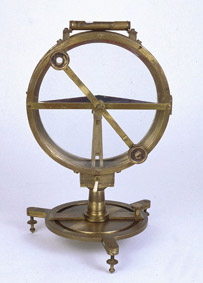
dip circle, by Thomas Charles Robinson, English, 1830 (c)
Origin
38, Devonshire Street; Portland Place; London; England
Maker
Robinson, Thomas Charles
Class
magnetism; earth sciences
Earliest Date
1825
Latest Date
1841
Inscription Date
Material
metal (brass, silver, steel); glass; stone (agate); ivory
Dimensions
height 300mm; breadth 182mm; diameter 180mm
Special Collection
Provenance
Purchased.
Inscription
‘Robinson,
38 Devonshire Street,
Portland Place, London’
Description Notes
Dip circle, by Thomas Charles Robinson, English, c. 1830.
Horizontal, circular brass base with three extensions for levelling screws, circle divided 0-180 twice to 1 degree. Pivoted index arm with clamping screw moving short column, carrying circular housing for horizontally-pivoted blued steel needle, two glazed hinged doors, bubble level above. Needle points extending almost to silver vertical scale, divided (from horizontal) 0-90-0-90-0 to 10’. Double standard support for agate edges, onto which needle axis is lowered in brass Y bearings by moving ivory lever. Pivoted diametric bar carrying two reading glasses for vertical scale. The clamping screw for the through part of the maker’s inscription.
References
Events
Description
A dip circle is used the measure the angle between the horizon and the earth’s magnetic field (the dip angle). They were used in surveying, mining and prospecting as well as for the demonstration and study of magnetism.
Georg Hartmann first discovered dip angle in 1544, when he noticed the needle on a compass dipped towards the north hemisphere. Rather than explore this phenomenon, Hartmann sought ways to eliminate it. However, Robert Norman investigated dip angle further and in 1581 described in print a device to measure this phenomena.
Early dip circles were not accurate and gave poor results. Over the next 300 years many improvements were made, including reducing the friction between the needle and its pivot and encasing the circle in glass. Initially, dip circles could only be used on land, but in the early 1830s Robert Were Fox designed the first that could be used onboard a moving ship. This advance proved to be of major assistance to polar navigation, in particular in the discovery of the exact position of the north magnetic pole by James Clark Ross. Another important improvement to the instrument was developed in the 1830s by the Dublin Physicist Humphrey Lloyd, who devised a way of attaching a magnetic needle at right-angles to the dip needle in order to measure the intensity of force (by seeing the extent to which the right-angle needle deflected the dip-needle).
The design of dip circles approached its peak at the beginning of the Twentieth century and by World War I the most advanced dip circles were being made. However, with the development of electronic systems dip circles became obsolete.
07/02/2008
Created by: Boris Jardine (with amendments by A. McConnell) on 07/02/2008
FM:43488
Images (Click to view full size):