Accession No
1030
Brief Description
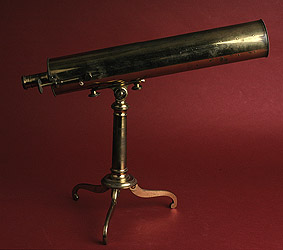
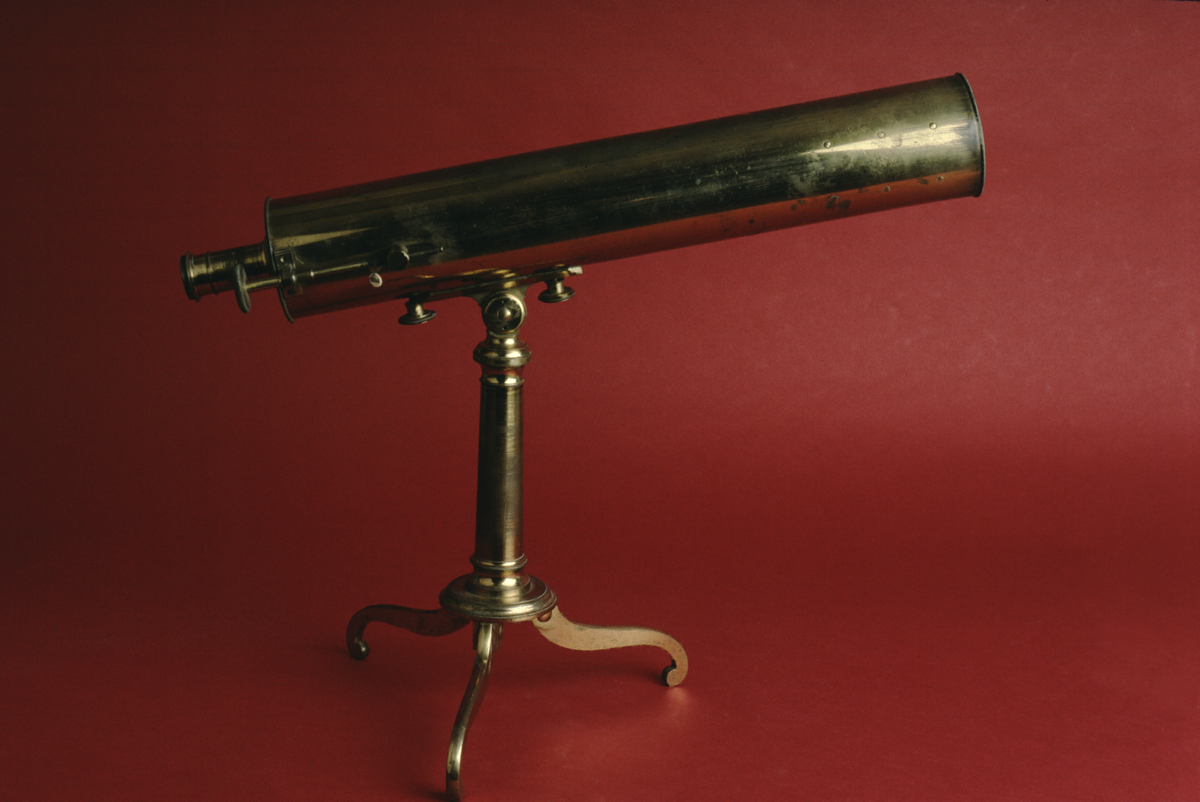
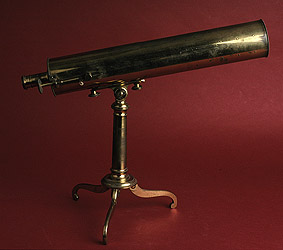
reflecting telescope, Gregorian, which belonged to Dr Whewell and was presented to Trinity College on 3 February 1894, English, 1800 (c)
Origin
England
Maker
Class
astronomy; optical
Earliest Date
1800
Latest Date
1800
Inscription Date
Material
metal (brass, speculum metal); glass; wood (mahogany); cloth (baize)
Dimensions
height 395mm; length 527mm; breadth 260mm box length 520mm; breadth 205mm; height 119mm
Special Collection
Provenance
On loan from Trinity College, University of Cambridge from 1951.
Inscription
‘I W’ (cast on back of primary)
Description Notes
Gregorian reflecting telescope, brass. Barrel with friction-tight cover. Screw-in eyepiece. Speculum metal objective mirror (eye-end not readily removed). Focus by moving secondary mirror, moved from eye-end by screw. Two screws secure barrel to altazimuth mount on pillar and folding tripod stand with scroll feet.
Fitted wooden box with brass hinges and hook fasteners; lined with green baize. Box contains paper reading ‘Gregorian Telescope formerly belonging to Dr Whewell presented to the College by the ? Henry Latham, M.A. Master of Trinity Hall 3 February 1894’. Large crack in lid of box.
References
Events
Description
Isaac Newton built the first reflecting telescope in 1669. Unlike a refracting telescope a reflecting telescope uses concave mirrors to focus light. The great advantage of using mirrors is that all colours of light are reflected equally. This was an improvement on the refracting telescope which used lenses to focus light. Here the light refracted at different angles to create a distorting fringe of colour around the image being observed.
At first high quality reflecting telescopes were difficult to make as the mirrors available to use degraded quickly and were unable to transmit enough light. But by the eighteenth century methods of making mirrors had improved and instrument makers such as James Short had created hundreds of reflecting telescopes for sale.
There are three types of reflecting telescope: the Gregorian, the Cassegrain and the Newtonian. Both the Gregorian and Cassegrain telescopes are pointed directly at the object being viewed. But the Newtonian has a secondary mirror set at 45° to the objective so the observer stands at right angles to the telescope. Today modern telescopes (with apertures greater than one metre) are reflecting telescopes. Various innovations make them more powerful and accurate. Computer controlled deformable mirrors can correct against changes due to atmospheric conditions or faults in the material.
Created by: Jenny Downes
FM:43513
Images (Click to view full size):