Accession No
1314
Brief Description
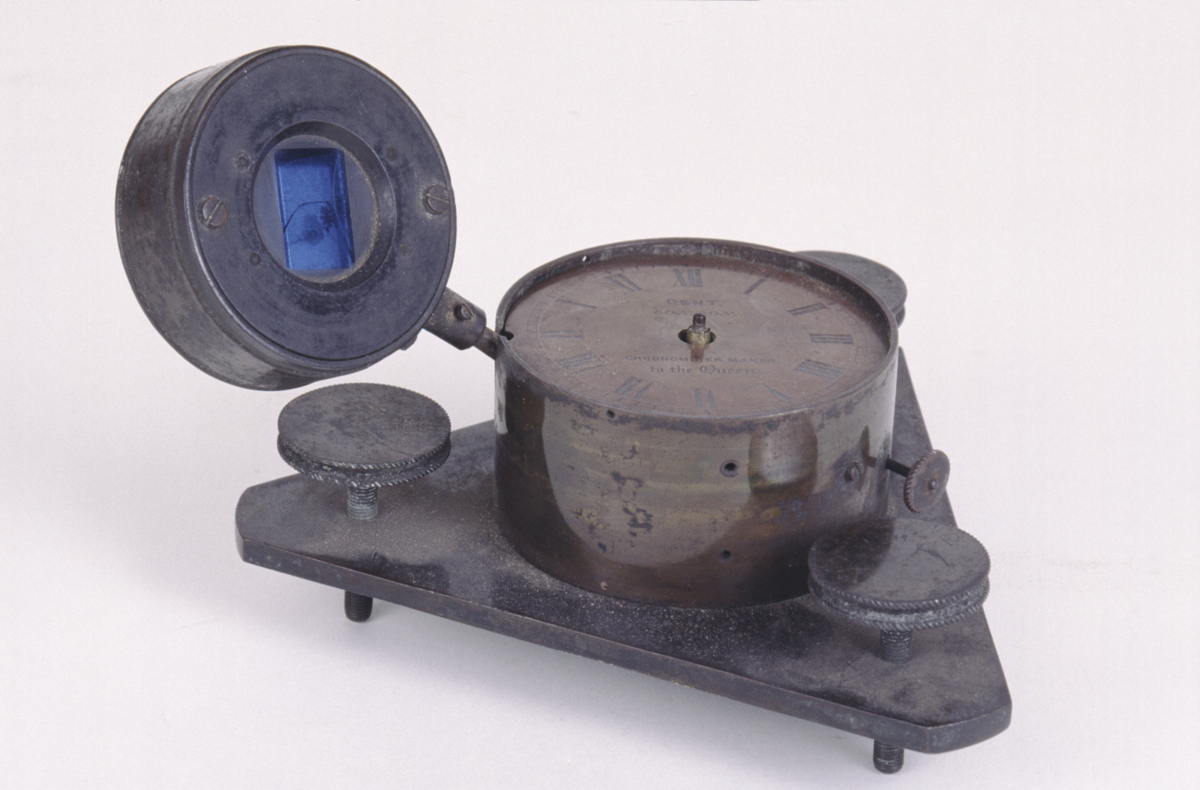
dipleidoscope meridian instrument, by Edward John Dent, English, 1845 (c)
Origin
England; London
Maker
Dent, Edward John
Class
dials
Earliest Date
1843
Latest Date
1853
Inscription Date
Material
metal (oxidised brass); glass
Dimensions
side of base 160mm; height 136mm (height 126mm; 3-2-2000)
Special Collection
Provenance
Inscription
‘DENT.
LONDON.
CHRONOMETER MAKER
to the Queen.’
Description Notes
Dipleidoscope meridian instrument, by E.J. Dent, English, c. 1845.
Oxidised brass triangular base plate set on three levelling screws. Double mirror optical unit with clear aperture set on polar axis. The axis connects with gear work in a cylinder with a clock face divided I - XII, numbered by I, divided to 1 minute, and is turned by a knurled screw, activating the hour and minute hands (missing) of the dial.
Condition: fair (glass cracked); incomplete (clock hands missing).
References
Events
Description
This instrument is used to determine true noon to an accuracy of within 10 seconds. A prism creates a double image of the sun, which merge together as the sun approaches its high point in the sky. When the two images overlap, it is local true noon.
The chronometer and clockmaker Edward John Dent patented his design for the dipleidoscope in 1843, and he exhibited the instrument at the Great Exhibition in London in 1851.
Knowing local noon is useful, for example, for checking and correcting clocks. It is also used in the determination of longitude, which can be calculated by finding the difference in time between local noon and midday at the prime meridian in Greenwich. Whilst the former can be found using a dipleidoscope or sextant, the latter must be read from an accurate chronometer set to Greenwich time.
16/07/2015
Created by: Joshua Nall on 16/07/2015
FM:43543
Images (Click to view full size):