Accession No
1639
Brief Description
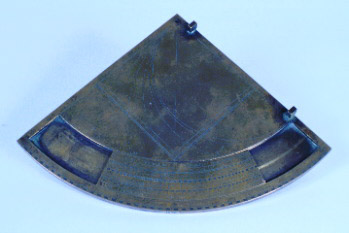
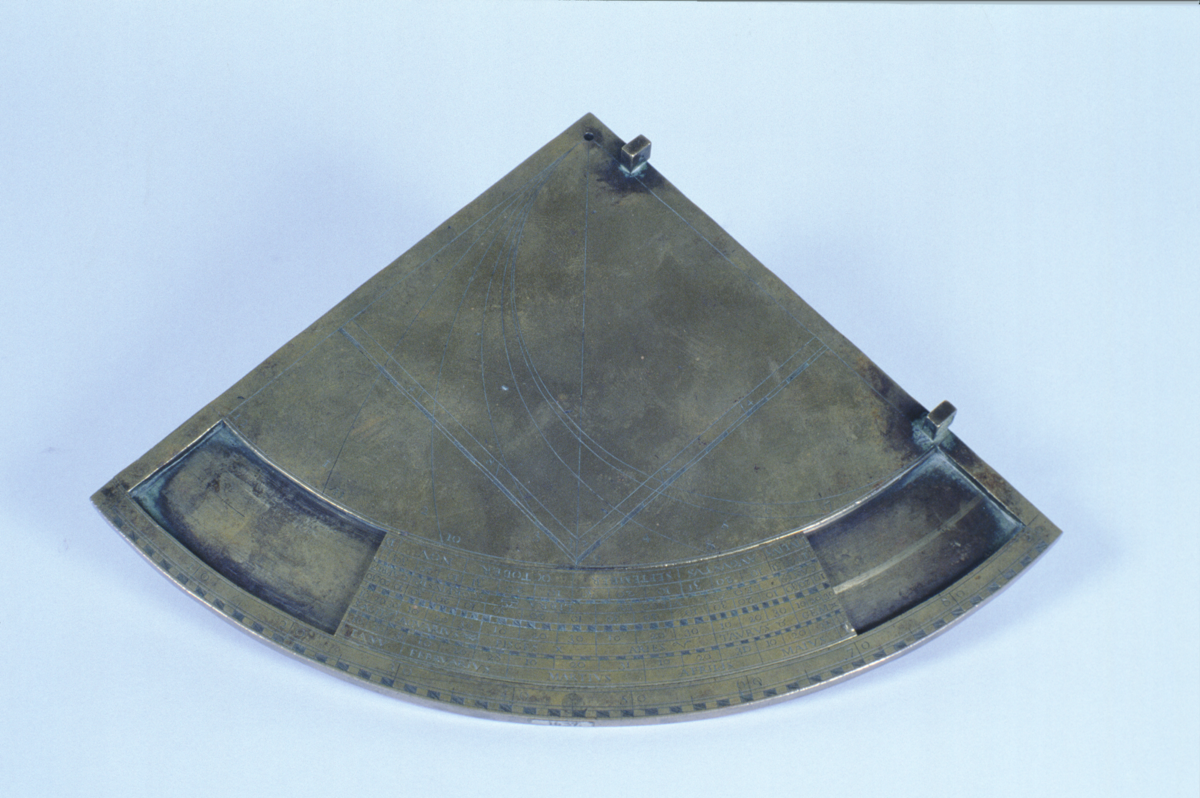
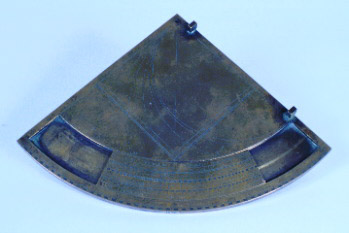
universal horary quadrant, ‘quadrans vetus’, English, fake, forgery by Lloyd Evan Williams, 1971 (c)
Origin
England
Maker
Williams, Lloyd Evan [forger - see notes]
Class
dials
Earliest Date
1970
Latest Date
1972
Inscription Date
Material
metal (brass)
Dimensions
radius 140mm; thickness 11mm
Special Collection
Provenance
Purchased from A. Davidson Ltd., Jermyn Street, London on 23/01/1973. Lot 144 from Sotheby’s sale of Clocks on 22/01/1973.
Inscription
Description Notes
Obverse: horary quadrant with a hole for a plumb line at the apex and pinhole sights on the right hand edge of the face. Circular hour arcs for unequal hours numbered [12], 1/11, 2/10...6. Shadow square divided [0] - 12 - [0], numbered by 4, subdivided to 1. Between the hour arcs and the limb a 24mm wide cursor with date scale, divided to named month, numbered by 10, subdivided to 2 days; zodiac scale also. Degree scale divided [0] - 90˚, numbered by 10˚, subdivided to 2˚ (subdivided to 1˚; 3-2-2000).
Reverse: degree scale divided [0] - 90˚ in both directions, numbered by 10˚, subdivided to 2˚ (subdivided to 1˚; 3-2-2000). Orthographic projection of the celestial sphere with curved meridian lines (Rojas projection); (marked ‘HORE ANTE MERIDIEM’ and ‘HORE POST MERIDIEM’. Edge of circle divided 0-90˚-0-90˚-0 by 10˚ to 2˚; 3-2-2000).
‘The design is that of the medieval quadrans vetus ... but the style is based on later literary sources’ (catalogue)
Condition: fair; complete.
References
Events
Description
Quadrant
A quadrant is a quarter of a circle, and there are different types of instrument that come under that description. The size of quadrants varied hugely from Tycho Brahe’s highly successful huge 2m radius one, to the more portable versions of the 18th century. In all examples it was important to keep movement, wear and flexure to a minimum, especially if results were to form part of an extended research program and to be compared with one another.
The quadrant was the principle measuring instrument of astronomy in the 17th and 18th centuries, being used in all major observatories. Plain sights (where the angle was simply read off by eye) were replaced by telescopic sights in more sophisticated examples.
18/10/2002
Created by: Saffron Clackson on 18/10/2002
FM:43546
Images (Click to view full size):