Accession No
3479
Brief Description
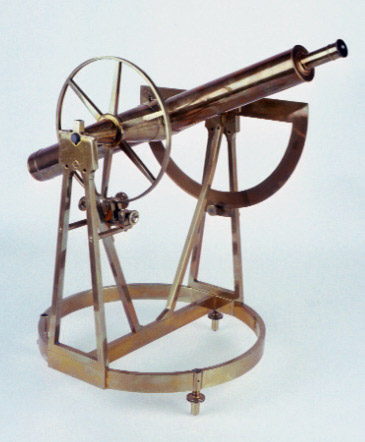
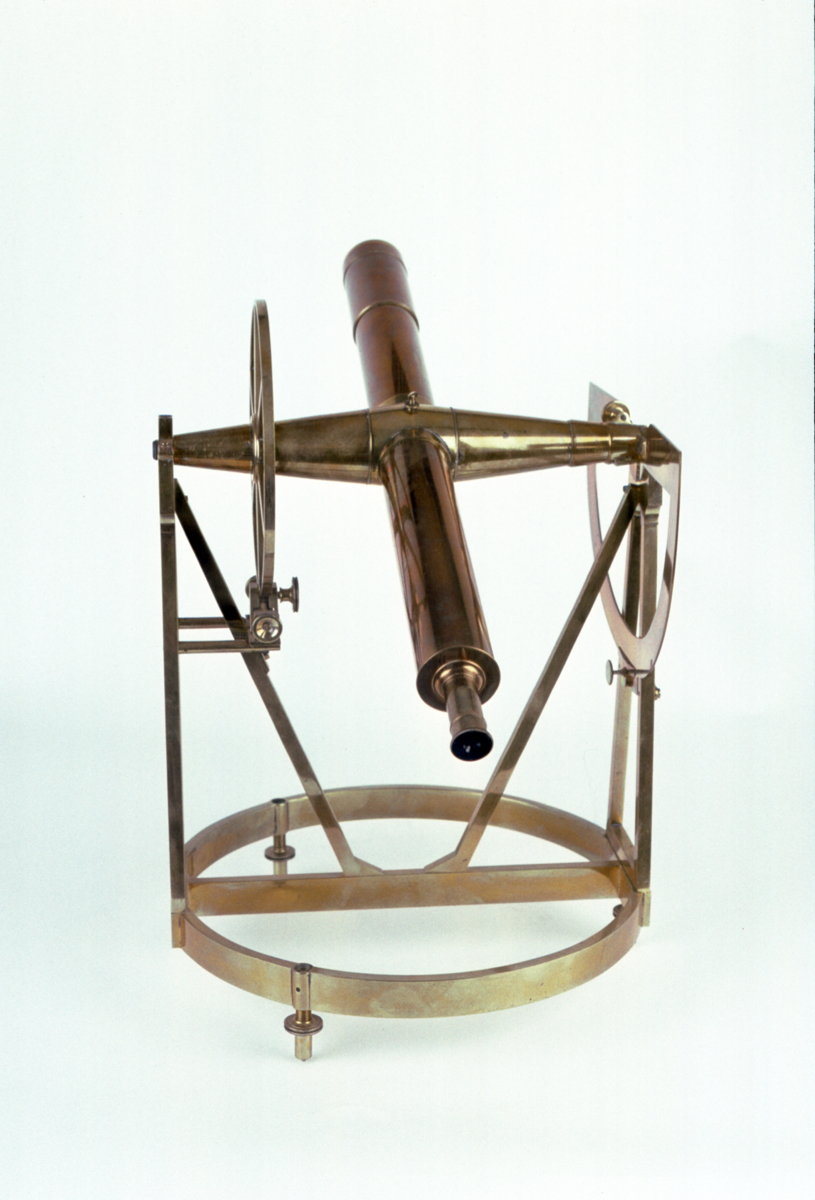
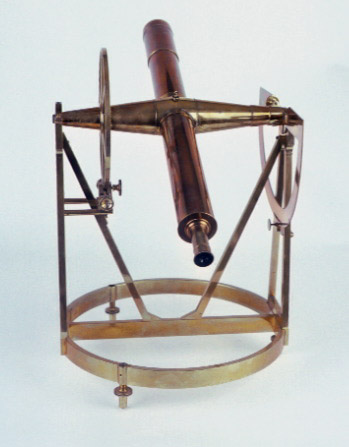
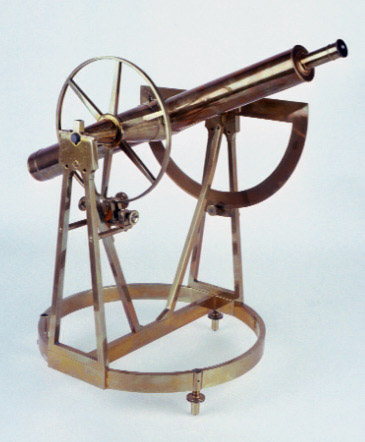
portable transit instrument, by Etienne Lenoir, French, 1800 (c)
Origin
France; Paris
Maker
Lenoir, Etienne
Class
astronomy
Earliest Date
1800
Latest Date
1800
Inscription Date
Material
metal (brass); glass
Dimensions
height 610mm; base diameter 325mm
Special Collection
Provenance
Purchased from Harriet Wynter, London, England, 1987.
Inscription
‘Lenoir’
Description Notes
Portable transit instrument, by Etienne Lenoir, French, c. 1800.
Portable version of the observatory instrument used by astronomers. Used with an accurate clock to measure right ascensions. With stand and double-cone horizontal axis. Spoked wheel for fine adjustment by tangent screw. Broad semicircle for setting altitude, divided 90˚ - 0 - 90˚, subdivided to 30´. Object glass is an achromatic doublet, aperture 37mm. Eyepiece with cross-wires. Small mirror at the centre of the axis that diverts light down the telescope tube. Holes on both sides of the stand to receive a platform for the lamp.
Condition: good; incomplete (lamp missing)
References
Events
Description
Transit instruments were pivoted telescopes that allowed astronomers to time the passage of a star over the meridian (an imaginary line through the poles). As the heavens rotated, an astronomer would look through the transit telescope (aligned in the meridian) and note when a particular star crossed his field of vision.
At the precise moment that the star passed, the astronomer noted the time via the ticking of a nearby astronomical regulator, an accurate clock used specifically for timing these transit observations.
The results were used as an accurate measure of time, in fact, the results show sidereal time (as opposed to solar time, which is what your watch shows and is based on the earth’s orbit of the sun), sidereal time being time measured using the stars.
The transit instrument is also used to determine logitude, which meant that it had applications in surveying.
FM:43555
Images (Click to view full size):