Accession No
2566
Brief Description
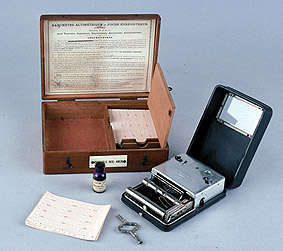
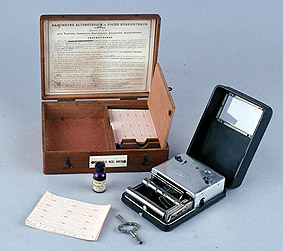
aneroid barograph-altimeter, by Bourgeois, French, 1910 (c)
Origin
France; Paris; 27 Rue des Pyramides
Maker
Bourgeois
Class
meteorology; surveying
Earliest Date
1910
Latest Date
1910
Inscription Date
Material
fishskin; glass; paper; metal (steel); cork; wood; plastic (ivorine)
Dimensions
box length 169mm; breadth 138mm; thickness 50mm
Special Collection
Provenance
Transferred from Institute of Astronomy, University of Cambridge, Cambridge, England, 5/6/1980.
Inscription
‘BOURGEOIS PARIS 27 RUE DES PYRAMIDES
BREVETE
S.G.D.G.’
‘PORTABLE REG: ANER:’ (ivorine plate on box)
Description Notes
Aneroid barograph-altimeter, Bourgeois, 1910 (c).
Portable, self-recording altimetric barometer. Vidie capsule. Clockwork movement and aneroid barometer enclosed in fishskin covered case with glazed aperture. A number of printed charts (24 hours), winding key and two other steel pieces loose. Ink bottle with cork. Printed instructions (in French) in fitted wooden box.
Instrument No. 3225. Stamped trade mark
Pressure measured 76-58mm; altitude 0-2000m
References
Events
Description
A barometer measures the pressure of this air upon us and our surroundings. The precise pressure of the air depends upon the weather, so a barometer is useful for weather forecasting. It can also be used as an altimeter (see "how to use" a hypsometer).
Torricelli, a pupil of Galileo, invented the traditional mercury barometer in 1644. Torricelli took a long glass tube closed at one end and completely filled it with mercury. He chose mercury because of its heaviness. Without letting air into the tube, it was then turned upside down and the open end placed in a bowl of mercury. Suprisingly perhaps, the mercury does not run out of the tube into the bowl (unless the tube is more than 760mm long). In fact, the column of mercury in the tube will always settle at the height of about 760mm above the level of the mercury in the bowl, even if the tube is tilted. This height is where the weight (or pressure) of the column of the mercury is equal to the pressure of air above the bowl, and so the height of the column of mercury measures the pressure of the surrounding air.
It was soon found that the height of the column of mercury was not absolutely fixed, but could rise and fall between 700 and 775 mm, even at sea level. The precise height seemed to depend upon the weather. From the late 17th century, therefore, the barometer rapidly became popular in the home for weather forecasting and later as an aid to the preparation of shipping forecasts. From 1840 onwards other forms of barometer were devised that did not require cumbersome columns of mercury. Best known is the aneroid barometer, which depends upon the expansion and contraction of a partially-evacuated metal chamber to register changes in external air pressure. In the late 19th century small pocket barometers of this type, which could also function as altimeters, were fashionable for mountaineers, balloonists and explorers.
01/03/2001
Created by: Chris Lewis on 01/03/2001
FM:43604
Images (Click to view full size):