Accession No
1111
Brief Description
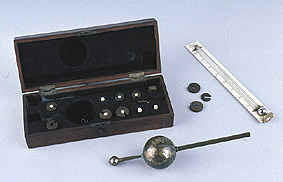
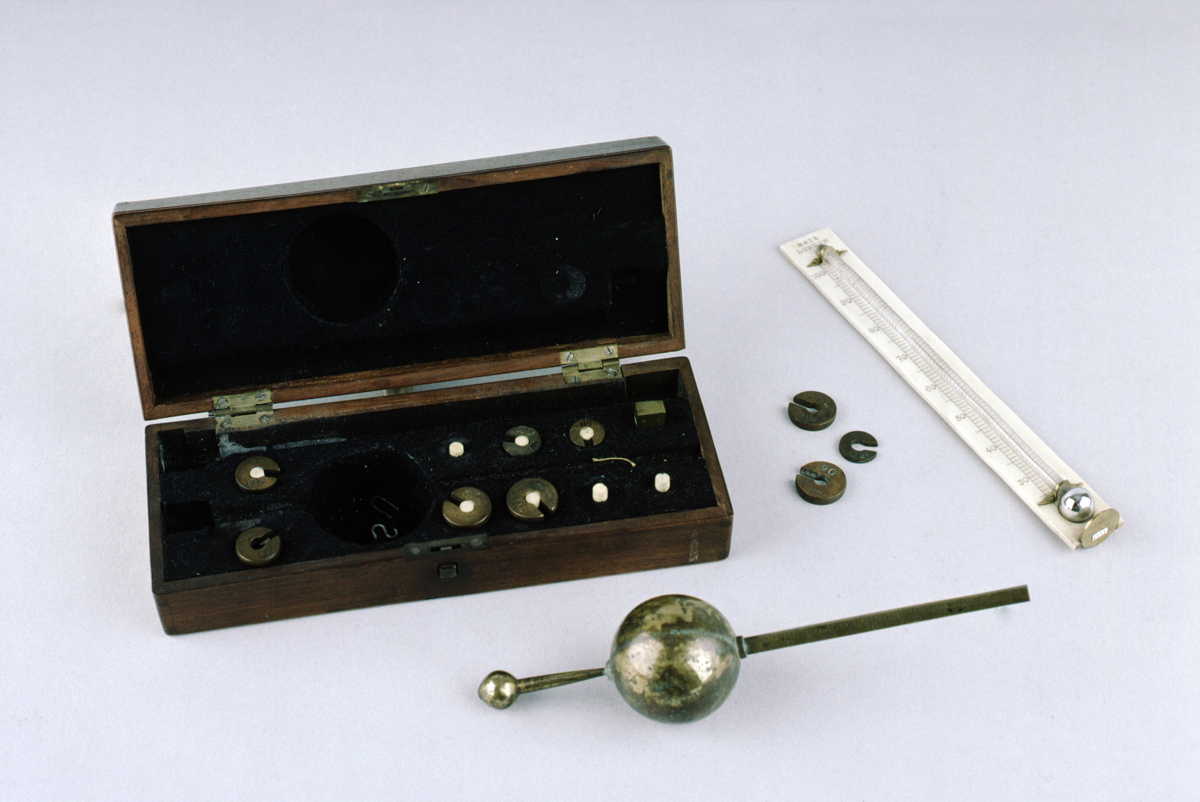
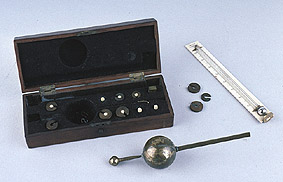
Sikes hydrometer, in fitted case, by Robert Brettell Bate, English, 1/2 19th Century
Origin
England; London; Poultry
Maker
Robert Brettell Bate
Class
physics; metrology
Earliest Date
1803
Latest Date
1847
Inscription Date
Material
metal (brass, mercury, steel); ivory; wood (mahogany); cloth (baize)
Dimensions
hydrometer length 166mm; maximum diameter 39mm thermometer length 176mm; breadth 22mm; thickness 15mm box length 188mm; breadth 74mm; height 49mm
Special Collection
Cavendish collection
Provenance
Transferred from the Cavendish Laboratory, University of Cambridge, from 10/1951.
Inscription
‘3006 SIKES’ (one side of scale)
‘P51˚’ (same side of scale)
‘Bate, London’ (other side of scale)
‘P’ (same side of scale)
‘BATE
LONDON’ (thermometer)
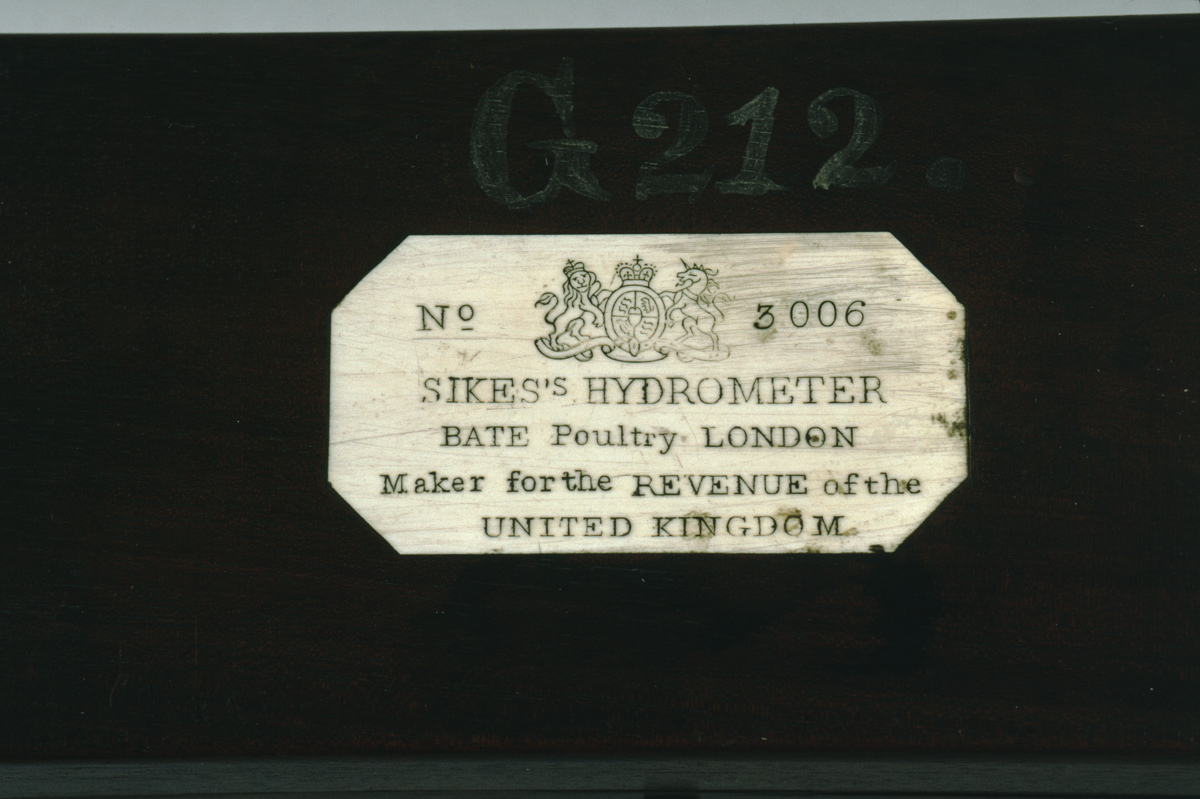
‘NO 3006
SIKES’S HYDROMETER
BATE Poultry LONDON
Maker for the REVENUE of the
UNITED KINGDOM’ (ivory inlay in lid of box)
Description Notes
Sikes hydrometer, in fitted case, by Robert Brettell Bate, English, 1/2 19th C.
Scale divided on both sides 0 - 10, numbered by 1, subdivided to 0.2. Nine disc weights numbered 10, 20, 30, 40, 50, 60, 70, 80 and 90; all marked with serial number and maker’s name. Also a brass block which fits on the top of the hydrometer.
Round-bulb mercury-in-glass thermometer with ivory scale. Scale divided [25] - [102]˚F, numbered by 10˚, subdivided to 1˚.
Fitted mahogany box with brass hinges and pushfit fastener; lined with blue baize; ivory pegs for weights (one broken). Two wire hooks (probably not part of the instrument).
Condition good; complete.
References
Events
Description
This instrument was made by the London scientific instrument maker Robert Brettell Bate (1782–1847). Bate began his working life under his uncle, Robert Brettell, a London haberdasher, probably intending that he should follow his father, Overs Bate, into the mercer’s trade. Bate’s career path changed, however, when he married Anna Maria, the daughter of Bartholomew Sikes, an Excise Official. When Bartholomew died in 1803, he had just secured a contract to supply the Excise Office with his ‘improved’ hydrometer. After strenuous lobbying by Bartholomew’s widow, Bate was allowed to inherit this commission, thus diverting him to a life in the scientific instrument trade.
A hydrometer is used to measure the precise gravity (or density) of liquids. The instrument is lowered into the liquid being tested until it floats freely. The specific gravity is then read off the instrument’s scale at the point at which the surface of the liquid touches the stem. Knowing the specific gravity of a liquid can then allow you to calculate such values as the quantity of alcohol in a drink or the amount of salt in a solution.
For more on Bate’s life and works, see Wh.6262.
10/07/2009
Created by: Anna Judson on 10/07/2009
FM:43628
Images (Click to view full size):