Accession No
2690
Brief Description
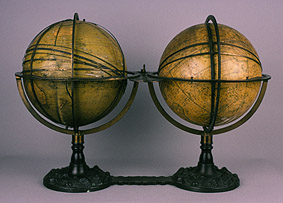
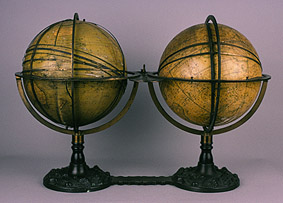
pair of 12-inch globes (celestial and terrestrial) in a wooden chest, by Newton and Son, London, 1848
Origin
England; London; 66 Chancery Lane
Maker
Newton and Son
Class
cartography; astronomy
Earliest Date
1848
Latest Date
1848
Inscription Date
1848
Material
paper; metal (brass, iron)
Dimensions
box length 785mm; breadth 403mm; height 535mm
Special Collection
Provenance
Transferred from Museum of Archaeology & Anthropology, University of Cambridge, Cambridge, England, 10/1980.
Inscription
‘NEWTONS
New and Improved
TERRESTRIAL GLOBE
Embracing every recent
Discovery
to the present time.
Manufactured by NEWTON & SON
66 Chancery Lane
LONDON published Jan 1st 1848’
‘CELESTIAL GLOBE
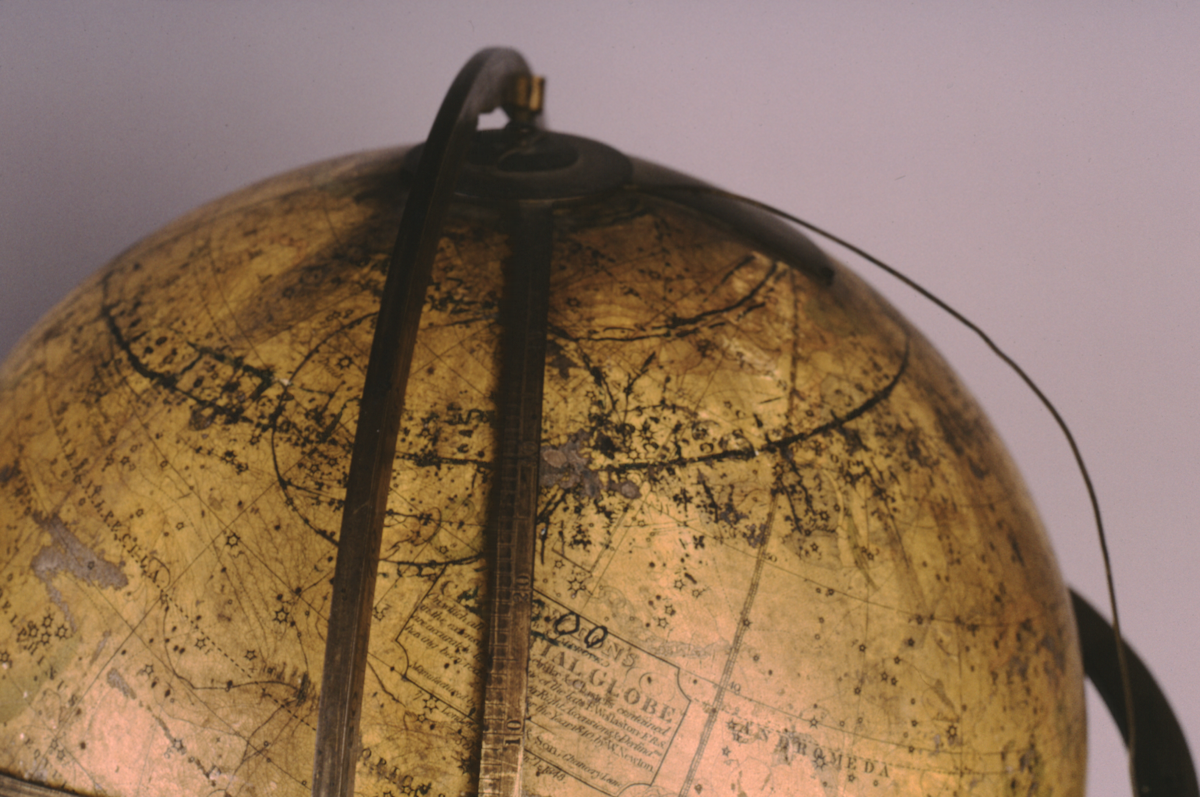
On which all the stars, Nebulae and Clusters contained in the extensive catalogue of the late F Wollaston F R S are accurately laid down, their right Assencions, and declinations having been recalculated for the year 1840 by W Newton.’ (dedication plaque)
‘Haileseam Astronomy
By JOHN DAVEY HAILES Druid Villa Ickleton Cambs
A COPYRIGHT REGISTERED AT THE BRITISH MUSEUM
JULY 20th 18621’
Description Notes
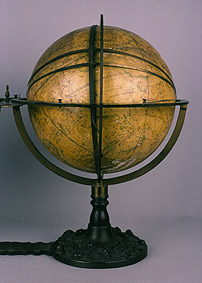
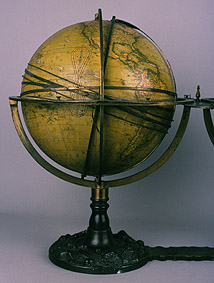
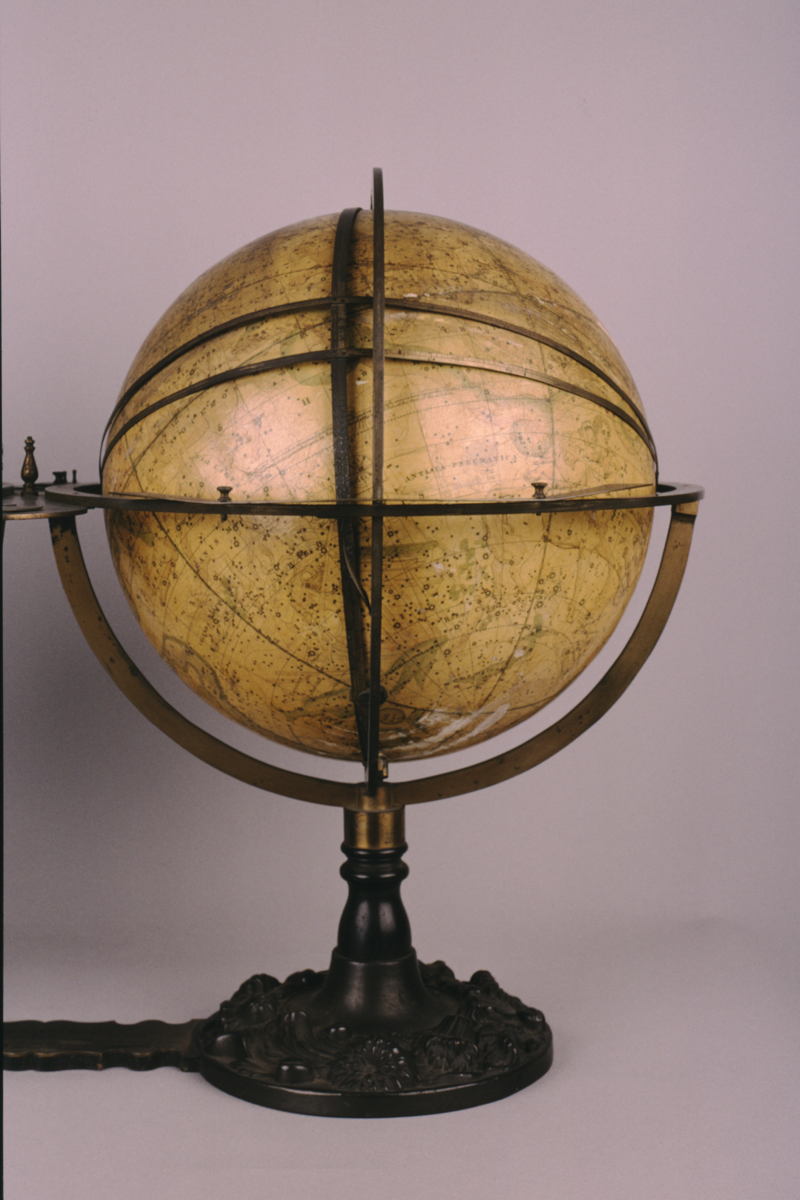
pair of 12-inch globes (celestial and terrestrial) in wooden chest, by Newton & Son, London, 1848. Both have plaster spheres with printed paper gores.
Terrestrial globe: 12 engraved (?) hand-coloured paper gores. Brass meridian circle divided 90˚ - 0 - 90˚ - 0 - 90˚ from poles, numbered by 10˚, subdivided to 1˚. Brass horizon circle divided 0 - 90˚ - 0 - 90˚ - 0, numbered by 10˚, subdivided to 1˚. Second brass meridian circle with dial graduated 1 - 34, and framework of vertical and horizontal brass rods and straps, some graduated, engraved on brass with inked numbers over.
Celestial globe: 12 engraved hand-coloured gores. Brass meridian circle and horizon circle divided as on terrestrial globe. Less complex system of brass rods. ?Hour circle (badly tarnished).
Cast iron base decorated with flowers joined by dedication plaque. Plate between two globes with brass perpetual calendar and second scale (?function).
Condition: poor
References
Events
Description
Celestial globes modelled the heavens and the location of stars in relation to one another. Used to chart the location of the Earth in the universe and for geodesic calculations, these globes were useful in solving navigational and astronomical problems. Terrestrial globes modelled the Earth’s movements in relation to the stars, Sun and Moon, and promoted interest in exploration and charting the surface of the globe. Often celestial and terrestrial globes were sold as a set, as seen in this example. In the nineteenth century, the role of the globe turned from astronomical to geographical study as the importance of the Earth’s surface was increasingly emphasized. During this period, terrestrial globes were used increasingly as teaching aids for geography lessons for example. This set of globes was acquired from the Museum of Archaeology & Anthropology at the University of Cambridge, and may have been part of collections of the Cambridge Society of Antiquaries.
14/01/2014
Created by: Allison Ksiazkiewicz on 14/01/2014
FM:43645
Images (Click to view full size):